Merry Christmas in French: Joyeux Noël + Every Holiday Greeting
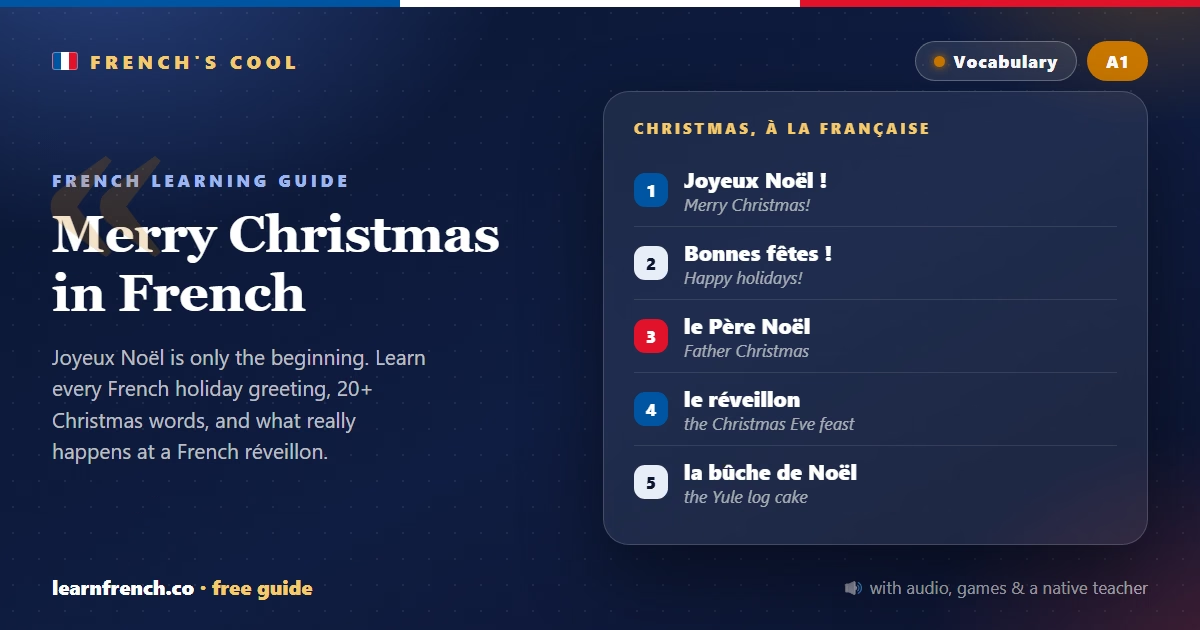
Merry Christmas in French is Joyeux Noël — literally "joyful Christmas" — and it is pronounced zhwah-yeuh noh-EL . That one expression will carry you through most of December. But French has a whole wardrobe of holiday greetings, each with its own occasion, and a Christmas vocabulary that tells you a lot about how France…
What you'll learn
Merry Christmas in French is Joyeux Noël — literally “joyful Christmas” — and it is pronounced zhwah-yeuh noh-EL. That one expression will carry you through most of December. But French has a whole wardrobe of holiday greetings, each with its own occasion, and a Christmas vocabulary that tells you a lot about how France actually celebrates: a midnight feast, a cake shaped like a log, and shoes waiting by the fireplace. This page gives you all of it — the greetings, the pronunciation, 20+ essential words, and the traditions behind them.
How to Say Merry Christmas in French: Joyeux Noël
Joyeux Noël ! is what the French say — to family, to shopkeepers, to strangers in the lift. It works in every situation, formal or informal. Break the pronunciation into three easy pieces:
- Joyeux — zhwah-YEUH. The j is soft, like the “s” in “measure”. The final x is completely silent.
- No — noh, a clean round “o”.
- ël — EL. The two dots on the ë (the tréma) tell you to pronounce this vowel separately: no-EL, never “nol”.
Want to hear it rather than read it? Xavier’s free lessons include video and audio from a native speaker, so you can listen and copy until Joyeux Noël rolls out naturally.
More French Holiday Greetings: Bonnes Fêtes and Friends
Christmas isn’t the only thing worth celebrating in late December, and French has greetings to match. Here are the expressions natives actually use during the holiday season:
- Bonnes fêtes ! — happy holidays! (bun FET — the all-purpose, non-religious choice)
- Joyeuses fêtes ! — joyous holidays! (zhwah-yeuhz FET — the festive twin of the above)
- Bonnes fêtes de fin d’année ! — season’s greetings! (literally “happy end-of-year holidays”)
- Je vous souhaite un joyeux Noël — I wish you a merry Christmas (zhuh voo soo-ET — formal, perfect for cards and colleagues)
- Je te souhaite un joyeux Noël — same wish, informal, for friends and family
- Passe un bon réveillon ! — have a good Christmas Eve feast!
Happy New Year in French: Bonne Année
The moment midnight strikes on December 31st, Joyeux Noël retires and Bonne année ! (bun ah-NAY) takes over. The full traditional version is Bonne année et bonne santé ! — “happy new year and good health!” — because the French consider the second wish at least as important as the first. On written cards you’ll often see Meilleurs vœux (meh-yeur VEUH), “best wishes”. One charming rule: the French wish each other bonne année the first time they see someone in January, even on the 25th of the month.
French Christmas Vocabulary: 20+ Words to Learn
Here is the essential French Christmas vocabulary — the words you’ll meet in songs, cards, and around every table on December 24th.
| French | English | How to say it |
|---|---|---|
| le sapin de Noël | Christmas tree | luh sa-PAN duh noh-EL |
| le Père Noël | Father Christmas (Santa) | luh pair noh-EL |
| le réveillon | Christmas Eve feast | luh ray-vay-YOHN |
| la veille de Noël | Christmas Eve | la vay duh noh-EL |
| un cadeau | a present | uh ka-DOH |
| la bûche de Noël | Yule log cake | la bewsh duh noh-EL |
| une guirlande | a garland, tinsel | ewn geer-LAHND |
| une boule de Noël | a bauble | ewn bool duh noh-EL |
| la crèche | the nativity scene | la KRESH |
| un santon | a Provençal nativity figurine | uh sahn-TOHN |
| la messe de minuit | midnight mass | la mess duh mee-NWEE |
| les souliers | the shoes (left out for gifts) | lay soo-LYAY |
| la dinde aux marrons | turkey with chestnuts | la dand oh ma-ROHN |
| les huîtres | oysters | lay ZWEE-truh |
| le foie gras | foie gras | luh fwah GRAH |
| le gui | mistletoe | luh GHEE |
| le houx | holly | luh OO |
| un ange | an angel | uh NAHNZH |
| une étoile | a star | ewn ay-TWAL |
| la neige | snow | la NEZH |
| un bonhomme de neige | a snowman | uh bun-UM duh nezh |
| le marché de Noël | Christmas market | luh mar-SHAY duh noh-EL |
Want more themed word lists like this? Browse the free French vocabulary lists, or make one word a day stick with the word of the day.
How the French Celebrate Christmas
The heart of a French Christmas is le réveillon, the long, glorious feast on the evening of December 24th. The name comes from réveiller, “to wake up” — because traditionally you stayed awake until (and well past) midnight mass. The typical menu is a national institution: oysters and foie gras to start, turkey with chestnuts as the main event, and for dessert la bûche de Noël, a rolled sponge cake dressed up as a Yule log. Presents are usually opened on Christmas Eve at midnight or on the morning of the 25th, and in the weeks before, Christmas markets fill town squares from Strasbourg — which proudly calls itself the capital of Christmas — to Paris, where the department-store window displays draw crowds of their own.
Here’s how a Christmas exchange sounds between friends:
— Joyeux Noël, Xavier !
— Joyeux Noël ! Tu fais le réveillon en famille ?
— Oui, chez ma grand-mère. Il y aura une bûche au chocolat !
— La chance ! Bonnes fêtes, et à l’année prochaine !
A French Christmas Carol to Know: Petit Papa Noël
If France has one Christmas song, it’s Petit Papa Noël (“Little Father Christmas”), recorded by Tino Rossi in 1946 and still the best-selling single in French history. Every French person can sing it; every December, every French person does. You’ll also hear Vive le vent, which borrows the tune of “Jingle Bells” but sings about winter wind, and Douce nuit, the French “Silent Night”. Singing along is one of the most painless ways to learn — you’ll find more to practise with in our guide to French songs.
FAQ: Merry Christmas in French
Is it joyeux Noël or bon Noël?
Say joyeux Noël. French uses bon for many wishes — bonne année, bon anniversaire — but Christmas takes joyeux. “Bon Noël” will be understood, yet no native says it as a greeting. You will, however, hear Passe un bon Noël ! (“have a good Christmas”), where bon is perfectly natural inside the sentence.
How do you respond to Joyeux Noël?
The easiest reply is Joyeux Noël à toi aussi ! (“Merry Christmas to you too!”) — or à vous aussi in a formal situation. A simple Merci, toi aussi ! works just as well.
Do French children leave out shoes for gifts?
Yes. Instead of stockings, children place their shoes by the fireplace or under the sapin on Christmas Eve, and le Père Noël fills them with presents overnight. It’s one of the most distinctive French Christmas traditions.
How do I wish my boyfriend or girlfriend a Merry Christmas?
Add a term of endearment: Joyeux Noël, mon amour (“Merry Christmas, my love”), or the fuller Je te souhaite un très joyeux Noël, mon cœur. For a card, Passe de merveilleuses fêtes auprès de ceux que tu aimes — “have a wonderful holiday with the people you love” — earns serious romance points.
How do you say Happy Hanukkah or Season’s Greetings in French?
Happy Hanukkah is Joyeux Hanouka. For a neutral “Season’s Greetings”, use Meilleurs vœux or Bonnes fêtes de fin d’année — both are standard on French cards and cover the whole holiday season.
Ready to speak French beyond December? Book a free lesson with Xavier, a native French teacher, and start the new year with a proper Bonne année — or warm up first with our 500 free French games. Joyeux Noël !
🎬 This article in 20 seconds
The quick version — the full detail is below. More shorts → Open this short as a page — transcript included →