French Verb Charts
On this page
Every chart covers the 6 key tenses, with usage notes, key forms, common expressions, audio examples and practice exercises.
📘 How French verbs work
- French verbs fall into 3 groups: regular -er (like parler — 90% of all verbs), regular -ir (like finir), and the irregular third group you learn verb by verb.
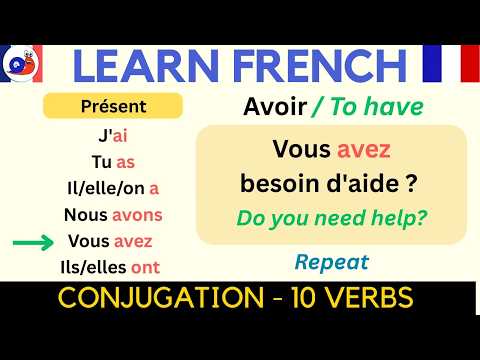
- The past (passé composé) is built with avoir or être + participe passé — master those two auxiliaries first.
- A handful of irregular verbs (être, avoir, aller, faire…) cover a huge share of everyday French — start there.
- Learning order: être & avoir → aller & faire → the modal-like verbs → everyday irregulars → the regular models.
How French verbs work
- Three families
- Regular verbs end in -er, -ir or -re and follow a pattern you learn once.
- Two auxiliaries
- Être and avoir power every compound tense: master them first.
- The 80/20 rule
- About twenty verbs carry most spoken French. They are the top of this page.
Learning order
- 01Présent
- 02Passé composé
- 03Imparfait
- 04Futur proche
- 05Futur simple
- 06Conditionnel
- 07Subjonctif
01 Start here — the big four
4 charts · The auxiliaries and the two verbs French runs on · A102 The modal-like verbs
5 charts · Power, will, duty and knowledge — the sentence starters · A1–A203 The regular models
9 charts · Learn one pattern, conjugate hundreds of verbs like it04 The reflexive life
7 charts · The « se » verbs of routine, memory and feeling05 Everyday irregulars, A to Z
69 charts · The rest of spoken French’s favourite troublemakers- Accueillirto welcome
- Acheterto buy
- Acquérirto acquire
- Aimerto like / to love
- Appelerto call
- Apprendreto learn
- Arriverto arrive / to happen
- Atteindreto reach
- Battreto beat
- Boireto drink
- Chercherto look for
- Commencerto start
- Comprendreto understand
- Conclureto conclude
- Conduireto drive
- Connaîtreto know
- Convaincreto convince
- Courirto run
- Craindreto fear
- Croireto believe
- Cueillirto pick
- Demanderto ask
- Devenirto become
- Direto say / tell
- Donnerto give
- Dormirto sleep
- Écrireto write
- Entrerto enter
- Envoyerto send
- Espérerto hope
- Essayerto try
- Éteindreto switch off
- Fuirto flee
- Haïrto hate
- Laisserto leave / to let
- Lireto read
- Mettreto put
- Montrerto show
- Mourirto die
- Naîtreto be born
- Ouvrirto open
- Partirto leave
- Passerto pass / to spend
- Peindreto paint
- Penserto think
- Plaireto please
- Porterto carry / to wear
- Prendreto take
- Recevoirto receive
- Regarderto watch / to look at
- Rejoindreto join / meet up
- Rendreto give back / to make
- Résoudreto solve
- Resterto stay
- Rireto laugh
- Rompreto break (up)
- Semblerto seem
- Sentirto smell / to feel
- Servirto serve
- Sortirto go out
- Suivreto follow
- Tenirto hold
- Tomberto fall
- Trouverto find
- Vaincreto defeat
- Valoirto be worth
- Venirto come
- Vivreto live
- Voirto see
🇬🇧 How French conjugation actually works (read this once, use every chart better)
Every French verb belongs to one of three groups, and the group decides how much of the conjugation tables you actually need to memorise. The first group — infinitives in -er, model verb parler — covers roughly 90% of all French verbs and is ruthlessly regular: learn one chart, own thousands of regular verbs. The second group (-ir with -issons plurals, model finir) is smaller and just as tidy. Everything else is the third group: the irregular verbs — être, avoir, aller, faire, prendre, the -re and -oir clans — which happen to be the most common verbs in the language. That’s the deal French offers: the verbs you’ll conjugate hourly are irregular, and everything after them is pattern.
Two auxiliary verbs power all compound tenses: avoir for most verbs, être for movement/change verbs and every reflexive — j’ai parlé but je suis allé. Add the past participle and you have the passé composé, the workhorse past tense of spoken French. Beyond tense, French conjugates mood: indicative for facts, subjunctive after doubt and emotion (que je sois), conditionnel for politeness and hypotheticals (je voudrais), imperative for orders. Each verb chart on this page runs the full circuit — present, imparfait, passé composé, futur, conditionnel, subjonctif — with the traps flagged. Suggested route: auxiliaries first, then the modal-like verbs, then everyday irregulars, then let the regular models sweep up the rest of the dictionary.
FAQ
How many verb groups does French have?
Three: -er regulars (≈90% of verbs, model parler), -ir regulars (model finir, -issons plurals), and the third group holding every irregular verb — which includes the most frequent verbs in French.
Which French verbs should I learn to conjugate first?
Être, avoir, aller, faire — the big four appear in almost every sentence and power other tenses (passé composé, futur proche). Then venir, pouvoir, vouloir, devoir, prendre; then the regular models.
What’s the fastest way to learn French conjugation?
Frequency plus pattern: master the ~20 irregular charts here that cover most real speech, learn parler and finir as templates for the rest, and drill aloud — endings you’ve said survive better than endings you’ve read.