I Love You in French: Je t'aime + 12 More Ways to Say It
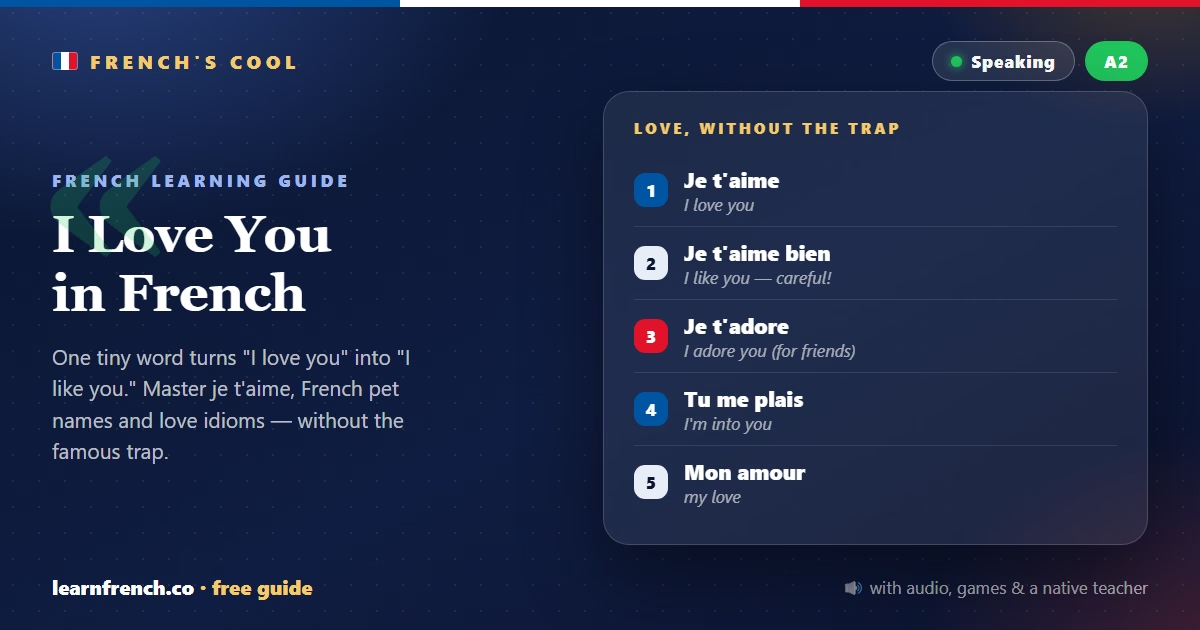
French is called the language of love, so you would expect saying "I love you" in French to be simple. It almost is: je t'aime covers it. But French hides a trap that catches nearly every English speaker — add the innocent little word bien , and you have just demoted the love of your…
What you'll learn
French is called the language of love, so you would expect saying “I love you” in French to be simple. It almost is: je t’aime covers it. But French hides a trap that catches nearly every English speaker — add the innocent little word bien, and you have just demoted the love of your life to a pleasant acquaintance. In this guide you’ll learn the classic declaration and how to pronounce it, all the ways to say you love someone before you’re ready for the big one, the best French terms of endearment, real love idioms, and the culture behind when French people actually say it.
Je t’aime: the classic way to say I love you in French
The essential phrase is je t’aime, pronounced “zhuh TEM”. It comes from the verb aimer, which means both “to love” and “to like” — and that double duty is the source of everything tricky about love in French. The rule to remember: when aimer is used alone with a person, it means love. Full stop, violins, fireworks.
Want to raise the stakes? These variations keep the full romantic charge:
- Je t’aime de tout mon cœur — I love you with all my heart (zhuh tem duh too mohn KUR)
- Je t’aime à la folie — I love you madly (ah lah foh-LEE)
- Je t’aime pour la vie — I love you for life
- Je n’aime que toi — I love only you
You can explore the full conjugation of aimer on our verb charts — you’ll need tu m’aimes (“you love me”) for the reply.
The famous trap: je t’aime bien means LESS, not more
Here is the counter-intuitive part. English speakers assume that adding “well” or “a lot” makes a French word stronger. With aimer, it does the opposite: an adverb pulls the verb away from love and back toward like.
| French | English | How to say it |
|---|---|---|
| Je t’aime | I love you | zhuh TEM |
| Je t’aime beaucoup | I like you a lot (as a person) | zhuh tem boh-KOO |
| Je t’aime bien | I like you (friendly, zero romance) | zhuh tem BYAN |
| Je t’adore | I adore you (warm, usually platonic) | zhuh ta-DOR |
And je t’adore? Despite how it sounds to English speakers, it isn’t a deeper je t’aime. French people say it constantly to friends they find delightful. It expresses enthusiastic affection, not romantic love. If you want the declaration, there is exactly one phrase for it.
— Écoute… je t’aime bien, tu sais. (Listen… I like you, you know.)
— Ah. « Bien » ? (Ah. “Bien”?)
— Non, attends ! Je t’aime. Tout court. (No, wait! I love you. Full stop.)
Not ready yet? Tu me plais and other early-stage phrases
Because je t’aime is a serious declaration, French gives you a whole staircase of phrases to express your feelings before you get there. Climb at your own pace:
- Tu me plais (tü muh PLEH) — literally “you please me”: I’m attracted to you, I fancy you. This is the standard early-dating phrase.
- J’ai le béguin pour toi (zhay luh bay-GAN poor twah) — I have a crush on you.
- Je suis tombé(e) amoureux / amoureuse de toi — I’ve fallen in love with you. Men say amoureux, women say amoureuse.
- Je suis fou / folle de toi (zhuh swee FOO duh twah) — I’m crazy about you.
- Je t’aime — the summit. You’ll know when.
French terms of endearment: mon amour, mon chéri and a small zoo
Once you’ve said it, what do you call each other? Amour is the French word for love — a masculine noun, which explains a quirk below. Here are the terms of endearment you’ll actually hear in France:
| French | English | How to say it |
|---|---|---|
| Mon amour | my love | mo-na-MOOR |
| Mon chéri / Ma chérie | my darling (to a man / to a woman) | mohn shay-REE / mah shay-REE |
| Mon cœur | my heart, sweetheart | mohn KUR |
| Mon trésor | my treasure | mohn tray-ZOR |
| Mon chou | my cream puff (lit. my cabbage) | mohn SHOO |
| Ma puce | sweetie (lit. my flea) | mah PUSS |
| Mon lapin | honey (lit. my rabbit) | mohn la-PAN |
Yes — fleas, cabbages and rabbits. French pet names get stranger as they get more affectionate, and ma puce is among the most tender things you can call someone. One grammar quirk: mon amour stays mon even when speaking to a woman, because the noun amour is masculine — the possessive agrees with the word, not the person. For more everyday words like these, browse our free vocabulary lists.
Romantic French phrases and love idioms worth knowing
These French expressions are how native speakers actually talk about romantic love — and they make wonderful additions to a card or a late-night text:
- Le coup de foudre — love at first sight (literally “the bolt of lightning”). J’ai eu un coup de foudre pour elle.
- Mon cœur bat la chamade — my heart is pounding (for you)
- Avoir un cœur d’artichaut — to fall in love easily (an artichoke heart: a leaf for everyone)
- Être fleur bleue — to be a hopeless romantic
- Vivre d’amour et d’eau fraîche — to live on love alone (literally “on love and cool water”)
- Tu me manques — I miss you (literally “you are missing from me” — arguably more romantic than the English)
French songs are full of these phrases — from Édith Piaf’s La Vie en rose to modern pop. Our French music page turns them into painless listening practice, and it’s the single most enjoyable way of learning French romance vocabulary.
When do French people actually say it? Love and dating in France
Dating in France follows the same logic. There is usually no “define the relationship” talk — kissing someone generally means you’re together — so the first je t’aime carries the weight that “the talk” carries elsewhere. Serge Gainsbourg captured the national ambivalence in his famous duet title Je t’aime… moi non plus (“I love you… me neither”). And la Saint-Valentin? In France it belongs strictly to couples — no cards for classmates. When a French person says je t’aime, believe them: nobody says it by accident. It is a phrase built for life-long love, not small talk.
FAQ: saying I love you in French
How do the French say “I love you”?
Je t’aime (zhuh TEM) — used with anyone you address as tu, which covers virtually every romantic situation. The formal je vous aime exists, but if you’re using vous with someone, a declaration of love is probably premature.
Does “je t’aime” mean “I love you” or “I like you”?
Said to a person with no adverb, it always means “I love you.” The verb aimer only softens to “like” when you add bien or beaucoup (je t’aime bien = I like you) or when the object is a thing (j’aime le café = I like coffee).
How do I reply to “je t’aime”?
If the feeling is mutual: moi aussi, je t’aime (me too, I love you) or simply je t’aime aussi. A playful escalation is et moi encore plus — “and I love you even more.” If you’re not there yet, an honest je tiens beaucoup à toi (“I care about you a lot”) is kind without overpromising.
Why is it “je t’aime” and not “j’aime toi”?
French places object pronouns before the verb: je te aime becomes je t’aime because te drops its vowel before aime. Saying j’aime toi is as odd to native speakers as “I you love” is in English — the object pronoun simply lives on the other side of the verb.
How do you say “to be in love” in French?
Être amoureux de quelqu’un — je suis amoureux de toi (said by a man) or je suis amoureuse de toi (said by a woman). For falling in love, use tomber amoureux: je suis tombé amoureux de Paris works for cities, too.
The best way to make these phrases yours is to say them out loud to a patient native speaker — ideally one who won’t blush. Book a free lesson with Xavier and practise your pronunciation until je t’aime rolls off the tongue, or warm up with our free French lessons. Just remember: no bien.
🎬 This article in 20 seconds
The quick version — the full detail is below. More shorts → Open this short as a page — transcript included →