Dire — to say / tell | French Verb Chart
On this page
🖨️ Print-friendly: use Ctrl+P (⌘P) or your browser menu to print this chart cleanly.
📚 This is the overview. « dire » is taught level by level — pick your CEFR level below for a full lesson (explanation, pronunciation, exercises & games).
Présent (Indicatif)
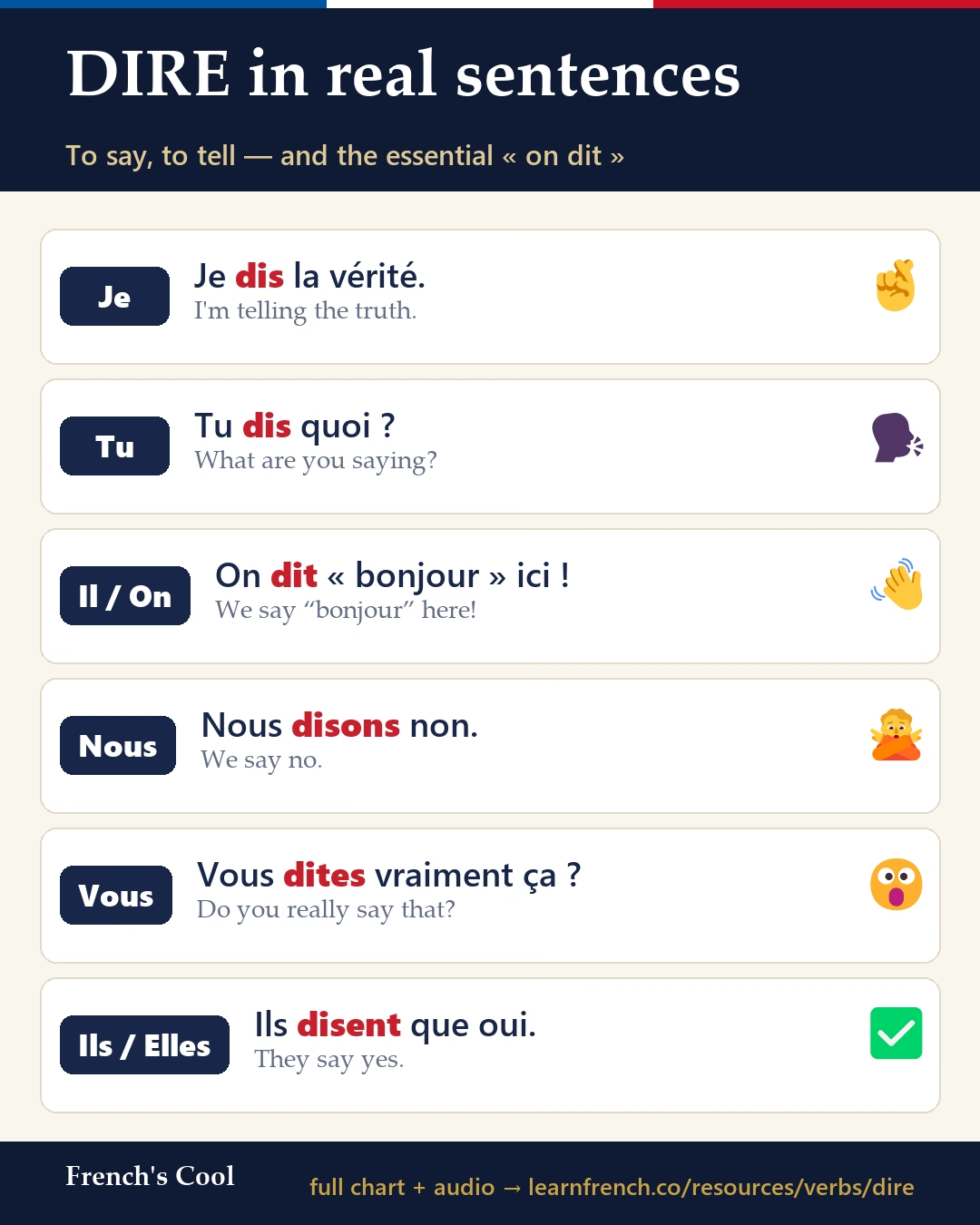
- je disI say
- tu disyou say
- il / elle dithe / she says
- nous disonswe say
- vous ditesyou say
- ils / elles disentthey say
Passé composé (Indicatif)
- j’ai ditI said
- tu as dityou said
- il / elle a dithe / she said
- nous avons ditwe said
- vous avez dityou said
- ils / elles ont ditthey said
Imparfait (Indicatif)
- je disaisI was saying
- tu disaisyou were saying
- il / elle disaithe / she was saying
- nous disionswe were saying
- vous disiezyou were saying
- ils / elles disaientthey were saying
Futur simple (Indicatif)
- je diraiI will say
- tu dirasyou will say
- il / elle dirahe / she will say
- nous dironswe will say
- vous direzyou will say
- ils / elles dirontthey will say
Conditionnel présent
- je diraisI would say
- tu diraisyou would say
- il / elle diraithe / she would say
- nous dirionswe would say
- vous diriezyou would say
- ils / elles diraientthey would say
Subjonctif présent
- que je disethat I say
- que tu disesthat you say
- qu’il / elle disethat he / she say
- que nous disionsthat we say
- que vous disiezthat you say
- qu’ils / elles disentthat they say
Impératif, Participe & Infinitif
- direinfinitive
- disantpresent participle
- en disantgerund (gérondif)
- ditpast participle
- dis · disons · ditesimperative
- avoirauxiliary in compound tenses
📈 « dire » from A1 to native
The same verb grows with your level — from your first words to real native slang.
🎬 The 20-second version
Five phrases with « dire » — guess before the reveal. Practise with the free games → Open this short as a page — transcript included →
📘 How to use Dire
- To say / tell: je dis la vérité, dis-moi tout.
- Dire à quelqu’un de faire = to tell someone to do: il m’a dit de venir.
- Reporting: on dit que… (people say that…).
- Irregular vous dites (not “disez”) — like vous faites.
🔑 Key forms
🔊 Common expressions
🇬🇧 Dire in plain English: the verb conversation is made of
Dire — to say, to tell — powers reported speech, opinions and half the connective tissue of spoken French, and its conjugation carries one celebrity irregularity: vous dites. Not *disez* — dites, one of only three -tes survivors in the language (êtes, faites, dites), and the error every learner makes exactly once in public. The rest of the present behaves: je dis, tu dis, il dit, nous disons, ils disent. Passé composé j’ai dit (participle dit — as in « c’est dit », it’s settled), imparfait je disais, futur je dirai, conditionnel je dirais, subjonctif que je dise — a compact table by irregular-verb standards, which is fortunate given how often French speakers reach for it: dire que (to say that) introduces reported speech, dis-moi (tell me) opens requests, and disons (let’s say) hedges every estimate in the language.
The phrases are where dire earns its keep. C’est-à-dire — “that is to say” — is the great French clarifier, the correct move whenever precision needs a second attempt. On dirait + noun — “it looks like” — turns the conditional into description: on dirait un rêve. Ça te dit ? — literally “does it say to you?” — is the standard casual invitation: ça te dit, un café ? And vouloir dire means to mean: qu’est-ce que ça veut dire ? is THE question of every learner’s day, built from two verbs this site has already taught you. The family: redire (say again) copies dire exactly, vous redites included; interdire (forbid) and prédire copy everything EXCEPT the celebrity form — vous interdisez, regular — a distinction examiners adore. Write the important pair on a card: vous dites, vous interdisez; say them once a day for a week, and the most useful irregular in French conversation is permanently yours — c’est dit.
Dire — FAQ
Is it « vous dites » or « vous disez »?
Vous dites — always. Only être (êtes), faire (faites) and dire (dites) keep the ancient -tes ending. But the derivatives interdire and prédire are regular: vous interdisez.
What does « c’est-à-dire » mean?
“That is to say / i.e.” — the clarification hinge of French, abbreviated c-à-d in notes. Follow it with your second, better attempt at the idea.
What’s the difference between dire and raconter?
Dire delivers words or facts (dire la vérité); raconter narrates (raconter une histoire). You dire a thing; you raconter a story — English’s say/tell split, shifted one notch.
🔊 Example sentences
✍️ Practice
Vous ___ quelque chose ? (dire, present)
Show answer
dites
Hier, il ___ non. (dire, passé composé)
Show answer
a dit
Nous ___ toujours merci. (dire, present)
Show answer
disons
Vous ___ toujours la vérité ? (present — irregular!)
Show answer
dites
Ça te ___ de venir ? (expression: fancy it?)
Show answer
dit

🎮 Practise this with games
🎯 More practice — conjugation drill — all six tenses
je ___ (Dire — present)
Show answer
dis
tu ___ (Dire — passé composé)
Show answer
as dit
il ___ (Dire — imperfect)
Show answer
disait
nous ___ (Dire — future)
Show answer
dirons
vous ___ (Dire — conditional)
Show answer
diriez
Go further: this chart is one small piece — get the full picture in our guide Master the present tense — the full beginner guide.
Dire conjugation FAQ
What is the present tense of dire?
je dis, tu dis, il / elle dit, nous disons, vous dites, ils / elles disent. Full charts for every tense are above, each form with audio.
What is the past participle of dire?
dit — the passé composé is « j’ai dit ». Dire uses avoir as its auxiliary verb.
How do you say dire in the future tense?
« je dirai » — the future stem never changes across persons, only the endings do.
What does dire mean in English?
to say / tell. It is one of the essential French verbs — drill the present first, then the passé composé; those two tenses carry most conversations.
🎮 Practise this lesson
Games built from this exact page — turn what you just read into play:
🧩 Sentence Builder rebuild these sentences
🏁 Conjugation Race type the right form
🎧 Listening Game which sentence do you hear?
🎬 All seven CEFR levels, end to end
« dire » at every CEFR level — the tense, its forms and the mechanic that makes it stick. Practise it with the free games →