The French Present Tense: Your First Real Grammar
A1In this article, you'll learn
If greetings get you into a conversation, the present tense keeps you in it. It’s the workhorse of French — and it covers more ground than its English equivalent, describing what you do, what you’re doing right now, and even what you’re about to do.
🎬 This lesson in one minute
The quick version — the full lesson is below. More shorts →
The three regular groups
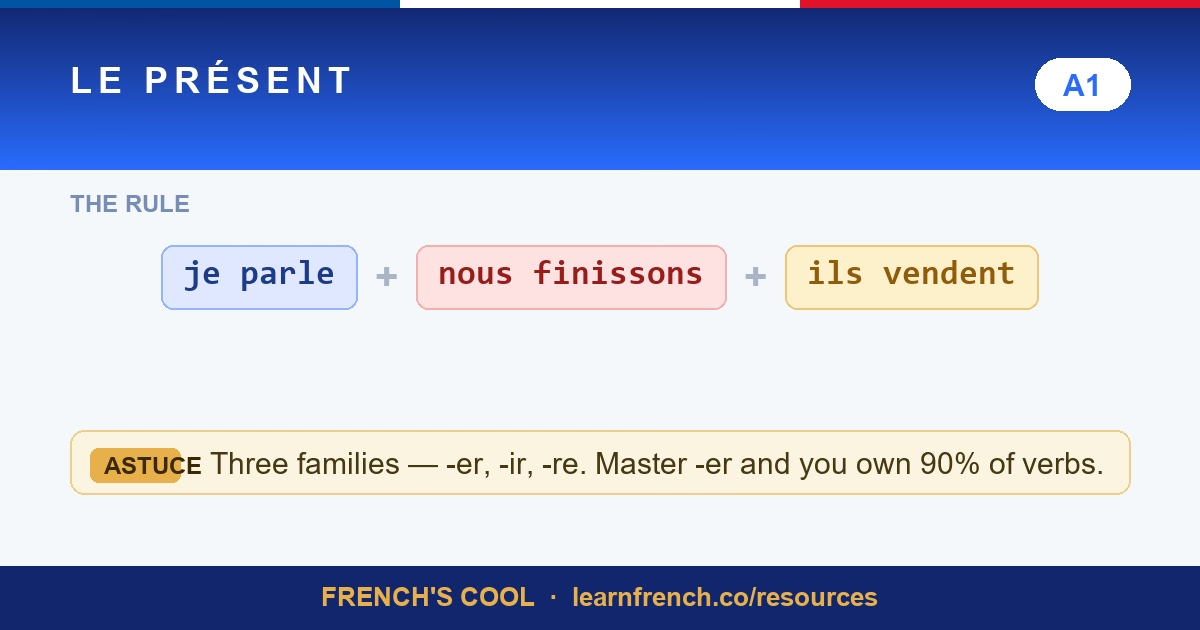
French verbs fall into three families by their ending: -er, -ir, and -re. Learn one pattern from each and you can conjugate hundreds.
-er verbs (the biggest group): parler (to speak)
- je parle, tu parles, il/elle parle
- nous parlons, vous parlez, ils/elles parlent
Around 90% of French verbs are -er verbs, and almost all follow this exact pattern. Master it and you’ve done most of the work.
-ir verbs: finir (to finish)
- je finis, tu finis, il finit
- nous finissons, vous finissez, ils finissent
-re verbs: vendre (to sell)
- je vends, tu vends, il vend
- nous vendons, vous vendez, ils vendent
The four irregulars you can’t avoid
These four are everywhere, so learn them as fixed shapes:
- être (to be): je suis, tu es, il est, nous sommes, vous êtes, ils sont
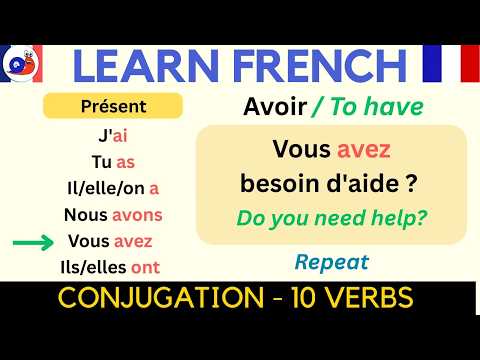
- avoir (to have): j’ai, tu as, il a, nous avons, vous avez, ils ont
- aller (to go): je vais, tu vas, il va, nous allons, vous allez, ils vont
- faire (to do/make): je fais, tu fais, il fait, nous faisons, vous faites, ils font
One tense, three jobs
French present does extra duty. Je mange can mean ‘I eat’, ‘I am eating’, and — with aller — the near future: Je vais manger (I’m going to eat). There’s no separate ‘-ing’ form to worry about, which makes life easier than in English.
How to drill it without boredom
Don’t recite tables — build sentences about your real day: je travaille, je prends un café, je regarde une série. Conjugation sticks when it’s attached to something you actually want to say.
Practise it with a real teacher
Reading about French is one thing — saying it out loud, with someone who corrects you gently and adapts to your level, is what makes it stick. Your first 30-minute lesson with Xavier is free, with no card and no commitment. Book your free lesson and let’s put this into practice.
✍️ Quick quiz — did it stick?
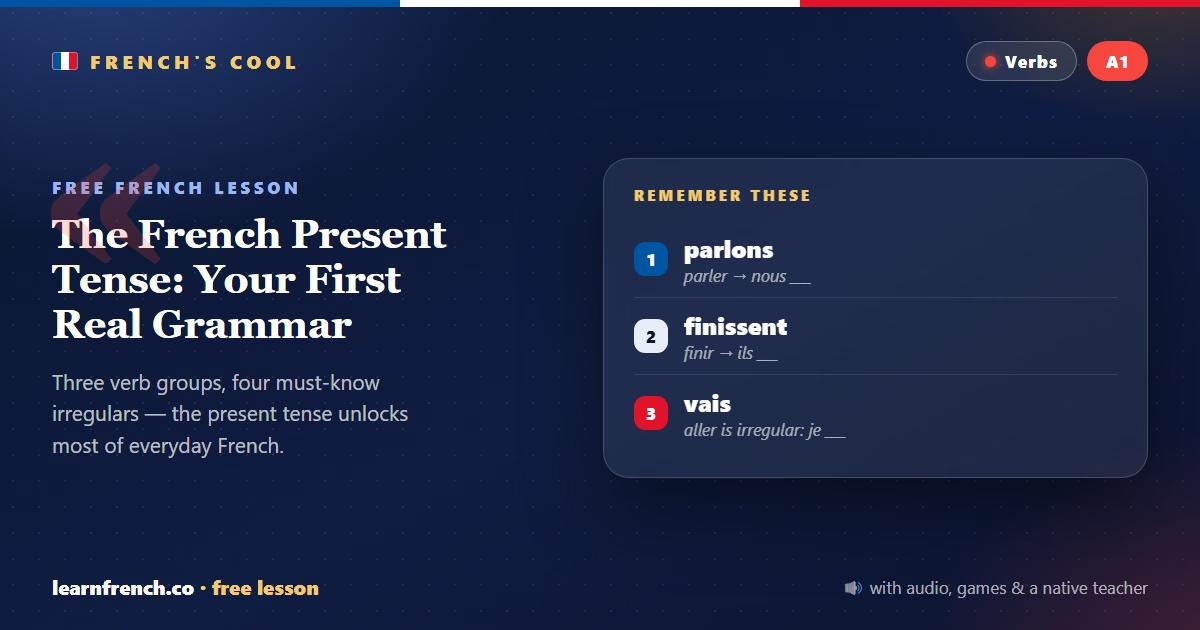
parler → nous ___ (-er endings)
Show answer
parlons
finir → ils ___ (-iss- plural)
Show answer
finissent
aller is irregular: je ___ (memorise it)
Show answer
vais
Play the Quiztap to start · quick practice from this material
Loading the quiz…
The three groups, their endings, and the four-in-one secret
Le présent runs on three conjugation families, and the present tense endings are the most regular grammar French owns. Regular -er verbs (the first group — 90% of all verbs): -e, -es, -e, -ons, -ez, -ent — je parle, nous parlons. Regular -ir verbs of the second group add the -iss- pill in the plural: je finis, nous finissons. Regular -re verbs (third group’s tame wing): -s, -s, —, -ons, -ez, -ent — je vends, il vend with its bare stem and no ending at all, the one exception beginners trip on. Every conjugation pattern above hides a sound rule too: the -e, -es, -ent endings are all SILENT, so je parle, tu parles and ils parlent are pronounced identically — French present tense conjugations are easier said than spelled.
The four-in-one secret is the best news in french grammar for english speakers: French has ONE present form where English juggles four. Je mange = I eat, I am eating, I do eat, and even I have been eating (with depuis: je mange depuis midi). There is no continuous form to build, no do-support to manage — the english simple present and progressive collapse into the same présent de l’indicatif. The price of admission is the handful of important irregular verbs whose present indicative must be memorized — être, avoir, aller, faire first, then venir, prendre, pouvoir, vouloir — each with its own chart on this site. Use the present with confidence for now-statements, habits, universal truths, and (like English) scheduled futures: « le train part à midi ».
FAQ
What are the 4 present tense forms?
That’s an English question with a happy French answer: simple present, present progressive, emphatic present and present perfect progressive ALL translate to the one French présent. Je travaille covers “I work / I’m working / I do work / I’ve been working (+ depuis)”.
What is the hardest tense to learn in French?
Not this one — the present is the friendliest. The genuinely hard choices come later: passé composé vs imparfait for accuracy, the subjunctive for triggers. Master the present’s three ending sets and the rest of conjugation reuses its machinery.
What are 10 examples of present tense?
Je parle, tu manges, il finit, elle choisit, nous vendons, vous attendez, ils habitent, je suis, tu as, on va — three regular families and the irregular core in ten sentences’ worth of forms.
How do you write in the French present tense?
Find the verb group from the infinitive ending (-er, -ir, -re), strip the ending to get the stem, add the group’s endings. Watch the silent forms in writing — ils parlent has four silent letters — and let the tables above be your spell-checker.
The full conjugation, side by side
Here is one regular verb from each group, all six persons. Read each column out loud — the endings are the whole game:
- parler (-er, to speak): je parle, tu parles, il/elle parle, nous parlons, vous parlez, ils/elles parlent
- finir (-ir, to finish): je finis, tu finis, il/elle finit, nous finissons, vous finissez, ils/elles finissent
- vendre (-re, to sell): je vends, tu vends, il/elle vend, nous vendons, vous vendez, ils/elles vendent
The recipe is always: take the infinitive, cut the ending to get the stem (parl-, fin-, vend-), add the ending for your person. Pronunciation win: for -er verbs, je / tu / il / ils forms all sound identical — the silent -ent is the classic trap.
Watch the spelling-change verbs
A few -er verbs tweak their stem to keep the sound right: manger → nous mangeons (keep the soft g), commencer → nous commençons, acheter → j’achète, appeler → j’appelle, préférer → je préfère. They are regular in the endings — only the stem shifts. And the -ir family has a lighter sub-group that drops a letter in the singular: dormir → je dors, sortir → je sors, tenir → je tiens (see the dormir and sortir charts).
Is there a present progressive in French?
English has two present forms (« I eat » / « I am eating ») — French has one: « je mange » covers both. When you really want to stress an action in progress, use « être en train de + infinitive »: « Je suis en train de manger » (I’m in the middle of eating). But in everyday French, the plain present does the job.
French present tense FAQ
How do you write in the French present tense?
Pick the subject, find the verb’s stem, add the matching ending — then keep the sentence order the same as English: Je regarde un film ce soir (I’m watching a film tonight — note the present can even cover the near future).
What is the hardest French tense to learn?
Not this one. Most learners vote for the subjunctive (a mood, technically) or choosing between the two past tenses. The present is where you build the reflexes everything else reuses — the irregular present stems feed the subjunctive and imperative directly.
Which irregular verbs should I learn first?
The big four: être, avoir, aller and faire. They are the most-used verbs in the language and the building blocks of compound tenses.
🧰 Your practice kit
This guide gave you the big picture — now drill the details with these free interactive charts (each with audio examples and exercises):
Prefer a human? Book a free lesson with Xavier →
Keep going: Your nous-forms unlock a whole new structure: the gérondif (en + -ant).
More free French lessons
Désolé pour le retard: announcing a delay without losing the client
How to write the French bad-news email: front-load the context, name the new date, apologise at the right register, and commit again. With a full annotated model.
Learn more →Your N+1, the CSE and fifteen other acronyms
N+1, CDI, CSE, cadre: a working reference to the acronyms and institutions that run a French office, and what each one actually means for you.
Learn more →How to say no in French without ever saying non
A flat Non can cost you more than the favour you refused. Here is the refusal ladder, the constraint move, and how to say no up, sideways and down at work.
Learn more →On se tutoie ? The tu/vous switch at work
How tu and vous actually work in a French workplace: who proposes the switch, the exact phrases, the awkward asymmetric period, and why email stays at vous longest.
Learn more →B1 or B2? Read the marking grids before you book the DELF
B1 means you can cope in French; B2 means you can argue. Four honest self-tests, a paper-by-paper comparison, and how to choose the level you will actually pass.
Learn more →Vrai ou faux, justifiez: the DELF reading question that quietly halves your score
At DELF B2, ticking the right box on a vrai/faux question earns you nothing if the justification is wrong. Here is how the item is actually marked.
Learn more →
Want to learn French with Xavier?
Your first 30-minute lesson is free — no card, no commitment.