The Best Way to Learn French Vocabulary (That Actually Sticks)
Everyone’s tried it: a list of fifty French words, memorised on Monday, gone by Friday. Cramming lists doesn’t work because it fights how memory actually operates. Here are five habits that make French vocabulary stick for good — and where to practise each on this site. 1. Learn chunks, not single words Your brain stores…
What you'll learn
Everyone’s tried it: a list of fifty French words, memorised on Monday, gone by Friday. Cramming lists doesn’t work because it fights how memory actually operates. Here are five habits that make French vocabulary stick for good — and where to practise each on this site.
1. Learn chunks, not single words
Your brain stores phrases more easily than isolated words. Don’t learn « vouloir »; learn:
These ready-made bricks come out of your mouth whole, with the grammar already attached.
2. Space it out (don’t cram)
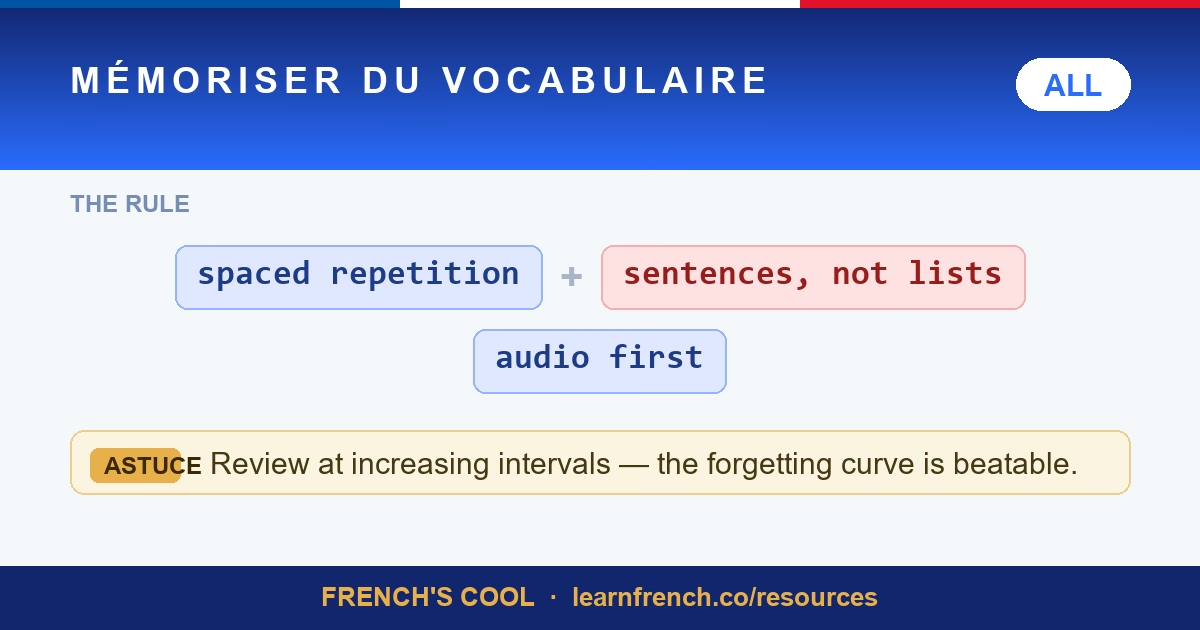
Reviewing a word 5 times over a week beats 20 times in one night. This is spaced repetition: revisit new words after a day, then a few days, then a week. A little every day > a lot once.
3. Hear it and say it
A word you’ve only seen is half-learned. On every resource page, tap the 🔊 button, then say the word OUT LOUD over the audio (« shadowing »). Sound wires memory far better than silent reading.
4. Learn words in context, by topic
Words learned together, in a scene, pull each other out of memory. That’s why our vocab pages are grouped by situation — at the restaurant, transport, family — each with example sentences, not bare lists.
5. Use it or lose it
Recall beats recognition. Force yourself to produce the word: play a game, write a sentence, or say it in a lesson. Every scramble and match is retrieval practice in disguise.
Not sure which words to start with? Work at your level with the by-level directory.
✍️ Method check
Reviewing a word 5 times over a week vs 20 times in one night — which wins? (memory)
Show answer
spaced out over a week
Instead of « vouloir », it’s better to learn… (chunks)
Show answer
a chunk like « je voudrais »
Saying a word out loud over the audio is called… (technique)
Show answer
shadowing
Play the Quiztap to start · quick practice from this material
Loading the quiz…
The retention stack: spacing, association, output
Memory research is unambiguous, so build the stack in this order. Layer one, spaced repetition: review each word at growing intervals — the mechanism behind every serious flash cards app. Anki and Memrise run the algorithm for you; Duolingo gamifies a lighter version; a paper notebook works if you date the pages and revisit on days 1, 3, 7, 21. The tool matters less than the schedule. Layer two, association: a word without a hook slides off — attach each new french word to an image, a rhyme, a story (the sillier the better: un canard wearing a cravate), and always learn the noun WITH its gender — le/la is part of the word, and feminine endings from our gender lesson double as memory hooks. Layer three, output within 24 hours: using new words in a sentence of your own — said aloud or texted to a french friend — moves them from recognition to recall, which is the entire difference between « I’ve seen it » and « I can say it ». Translation drills alone never cross that bridge; a dictionary teaches meaning, only usage teaches memory.
Then aim the stack at the right words: frequency. French runs on a startlingly small core — the top 1,000 words cover ~85% of everyday life, 5,000 french words make you functionally complete — so french vocabulary lists sorted by frequency beat thematic lists for speed. Mine YOUR life for the rest: label objects at home, narrate your hobby in French, and let every exercise on this site’s french vocabulary lessons feed the deck. Expression-level chunks (verb + noun pairs: prendre une décision, poser une question) memorize better than single words — one card, one usable sentence-part, pronoun and all. And forgive the forgetting: needing five meetings with a word before it stays isn’t failure, it’s the algorithm — anyone who started learning french and stuck to a spacing schedule for a season has watched new vocabulary shift from effort to reflex. That shift, multiplied by a thousand words, is what fluency is made of — no matter which YouTube channels, apps or notebooks you enlist along the way; in language learning, the system that survives your bad weeks is the one that works, en français comme en tout.
FAQ
What is the 80/20 rule for studying French?
The top ~1,000 words appear in 80%+ of speech — so frequency-first vocabulary study delivers most of the language for a fifth of the effort. Themes and nuance come after the core.
Can I get B2 French in 1 year?
With ~10–12 focused hours a week and speaking practice — yes, it’s the classic serious-learner timeline. Vocabulary-wise that’s ~20 new words a day through a spaced system, which is entirely doable.
What is A1, A2, B1, B2, C1, C2 for French?
The CEFR ladder: A = beginner (survival), B = independent (conversation to argument), C = proficient (professional to near-native). Our CEFR guide maps each level to real-life ability and hours.
What are the 5 W’s in French?
Qui, quoi, où, quand, pourquoi — and asking them about every new word (who uses it? where? when?) is itself an association trick that deepens memory.
Use spaced repetition (and flashcards)
The single most powerful way to memorize French vocabulary is spaced repetition: reviewing a word just before you’d forget it, at growing intervals. A flashcard app like Anki automates this — it schedules each card so you review hard words often and easy words rarely. Ten minutes a day of spaced review beats an hour of cramming, because it forces active recall (pulling the word from memory) instead of passive re-reading.
- Put French on one side, English + an example sentence on the other. Recall the whole chunk, not the bare word.
- Add audio. Hearing the word locks pronunciation to meaning.
- Keep decks small and topical. 10–15 new cards a day is sustainable; 100 is not.
Exploit cognates — thousands of free words
English and French share huge numbers of cognates — words that look alike and mean the same: nation, table, important, possible, réalité, différence. Learn the patterns (-tion stays -tion, -ty becomes -té) and you unlock thousands of vocabulary items for almost no effort. Just watch the faux amis (false friends) like librairie (bookshop, not library) and actuellement (currently, not actually).
Make words stick with mnemonics and stories
When a word won’t stick, build a mnemonic — a silly mental image that links sound to meaning. Grenouille (frog) → picture a frog throwing a grenade. The weirder the image, the better you’ll memorize it. Tie new words into a little story or a sentence about your own life and they gain a hook your brain can find later.
Review and use it, or lose it
Memory is built by retrieval. Every few days, review old words by using them: write three sentences, describe your room, narrate your morning. Words you actively produce move into long-term memory; words you only recognise fade. Pair this with immersion — French labels around the house, a podcast on your commute, subtitles on films — so the vocabulary keeps coming back in context.
How to memorize French vocabulary FAQ
What is the fastest way to memorize French vocabulary?
Spaced repetition with active recall — ideally an Anki-style flashcard deck — combined with learning words in chunks and context. It’s far faster than re-reading lists because it makes your brain retrieve each word at the perfect moment.
How many French words do I need to know?
Around 800–1,000 words covers most everyday conversation, and the top 2,000 cover the vast majority of daily speech. Focus on high-frequency vocabulary first — you get fluent-feeling results long before you know every word.
Why do I forget French words so quickly?
Because you learned them passively and never used them. Without review and real use, new words fade within days — that’s normal. Spaced repetition and putting words into your own sentences are what turn short-term recognition into lasting memory. Practise with the vocabulary charts.
The complete toolkit: six techniques that actually work
- Spaced repetition, on a real schedule. Review a new word after 1 day → 3 days → 1 week → 2 weeks → 1 month. Five meetings, spaced out, beat fifty crammed. Apps do the timing for you (Anki, Quizlet) — or use our Memory Match as your daily rep.
- Learn in chunks, not words. Not rendez-vous but « prendre un rendez-vous » ; not faim but « j’ai une faim de loup ». Chunks come with their grammar pre-installed.
- Attach a scene. « L’écharpe » alone evaporates; the red scarf your friend forgot at the café stays. One vivid mental image per word — the sillier the better.
- Steal cognate families. English gives you thousands for free: -tion words (nation, information, situation…), -té words (liberté, qualité), -ique words (musique, fantastique). Just watch the false friends.
- Activate immediately. A word is only yours after YOU use it. Write one sentence about your own life with every new word — then say it aloud with the 🔊 audio on our charts.
- Feed on themes. The brain stores meaning in networks: learn la boulangerie with le pain, une baguette, croustillant together — our vocabulary charts are built exactly this way.
Your first 100 words: choose them ruthlessly
The 100 most frequent French words cover roughly half of everyday speech. Frequency beats fancy: chose, truc, faire, aller, temps will serve you daily; époustouflant can wait. Start here: the 100 most common French words (with audio and games), then let the Word of the Day feed you one perfectly-chosen word each morning.
A one-week routine that sticks
- Mon–Fri (10 min): 5 new words from one theme + review of yesterday’s, each in one personal sentence.
- Saturday (15 min): play the games marathon on this week’s words.
- Sunday (10 min): watch one French video (our video lessons) and hunt for this week’s words in the wild.
🧰 Put the method to work
Vocabulary the way memory likes it — in context, with audio, then a game:
Want a plan built around the words YOU need? Book a free lesson with Xavier →
🎬 This article in 20 seconds
The quick version — the full detail is below. More shorts → Open this short as a page — transcript included →