Partir — to leave | French Verb Chart
On this page
🖨️ Print-friendly: use Ctrl+P (⌘P) or your browser menu to print this chart cleanly.
📚 This is the overview. « partir » is taught level by level — pick your CEFR level below for a full lesson (explanation, pronunciation, exercises & games).
Présent (Indicatif)
- je parsI leave
- tu parsyou leave
- il / elle parthe / she leaves
- nous partonswe leave
- vous partezyou leave
- ils / elles partentthey leave
Passé composé (Indicatif)
- je suis parti(e)I left
- tu es parti(e)you left
- il / elle est parti(e)he / she left
- nous sommes parti(e)swe left
- vous êtes parti(e)(s)you left
- ils / elles sont parti(e)sthey left
Imparfait (Indicatif)
- je partaisI was leaving
- tu partaisyou were leaving
- il / elle partaithe / she was leaving
- nous partionswe were leaving
- vous partiezyou were leaving
- ils / elles partaientthey were leaving
Futur simple (Indicatif)
- je partiraiI will leave
- tu partirasyou will leave
- il / elle partirahe / she will leave
- nous partironswe will leave
- vous partirezyou will leave
- ils / elles partirontthey will leave
Conditionnel présent
- je partiraisI would leave
- tu partiraisyou would leave
- il / elle partiraithe / she would leave
- nous partirionswe would leave
- vous partiriezyou would leave
- ils / elles partiraientthey would leave
Subjonctif présent
- que je partethat I leave
- que tu partesthat you leave
- qu’il / elle partethat he / she leave
- que nous partionsthat we leave
- que vous partiezthat you leave
- qu’ils / elles partentthat they leave
Impératif, Participe & Infinitif
- partirinfinitive
- partantpresent participle
- en partantgerund (gérondif)
- partipast participle
- pars · partons · partezimperative
- êtreauxiliary in compound tenses
📈 « partir » from A1 to native
The same verb grows with your level — from your first words to real native slang.
🎬 The 20-second version
Five phrases with « partir » — guess before the reveal. Practise with the free games → Open this short as a page — transcript included →
📘 How to use Partir
- To leave / depart: je pars demain — partir de (from), partir à/pour (to).
- Takes être: elle est partie.
- vs quitter (needs an object: je quitte Paris) and laisser (leave something behind).
- À partir de = from / starting: à partir de demain.
🔑 Key forms
🔊 Common expressions
🇬🇧 Partir in plain English: leaving, properly
Partir — to leave, to depart — conjugates on the sortir pattern: je pars, tu pars, il part, nous partons, vous partez, ils partent, with the passé composé firmly on être: « je suis parti(e) », participle agreeing. Futur je partirai, imparfait je partais, subjonctif que je parte — a tidy table whose real difficulty lives outside it: French has THREE leave verbs and refuses to let them substitute. Partir leaves intransitively (you just go: je pars demain); quitter leaves SOMETHING or someone (j’ai quitté Paris, elle l’a quitté — with avoir); laisser leaves something BEHIND (j’ai laissé mes clés). Pick by what follows the verb: nothing → partir, a place/person → quitter, an object abandoned → laisser.
The bonus structure every timetable reads: à partir de — “from / starting from” — « à partir de lundi » (from Monday), partir conjugating time itself. Travel French leans on the whole family: « le train part à 14h » (schedules use partir, not sortir), « on part en vacances » (leaving on holiday — the happiest sentence in the language), and the farewell « j’y vais, je pars ! » stacking two leaving verbs for emphasis. Drill: announce three departures — one future (je partirai), one habitual past (je partais tous les étés), one accomplished (je suis parti à midi) — and the leaving verb will never leave you.
FAQ
What’s the difference between partir, quitter and laisser?
Partir goes (no object); quitter leaves a place or person (object required); laisser leaves something behind. « Je pars », « je quitte Paris », « je laisse un pourboire ».
Is partir always with être?
In compound tenses, yes: je suis parti, nous sommes partis — with agreement. It has no transitive escape hatch the way sortir does.
What does « à partir de » mean?
“From / as of”: à partir de demain, à partir de 10 euros. The infinitive frozen into the language’s favourite starting-point preposition.
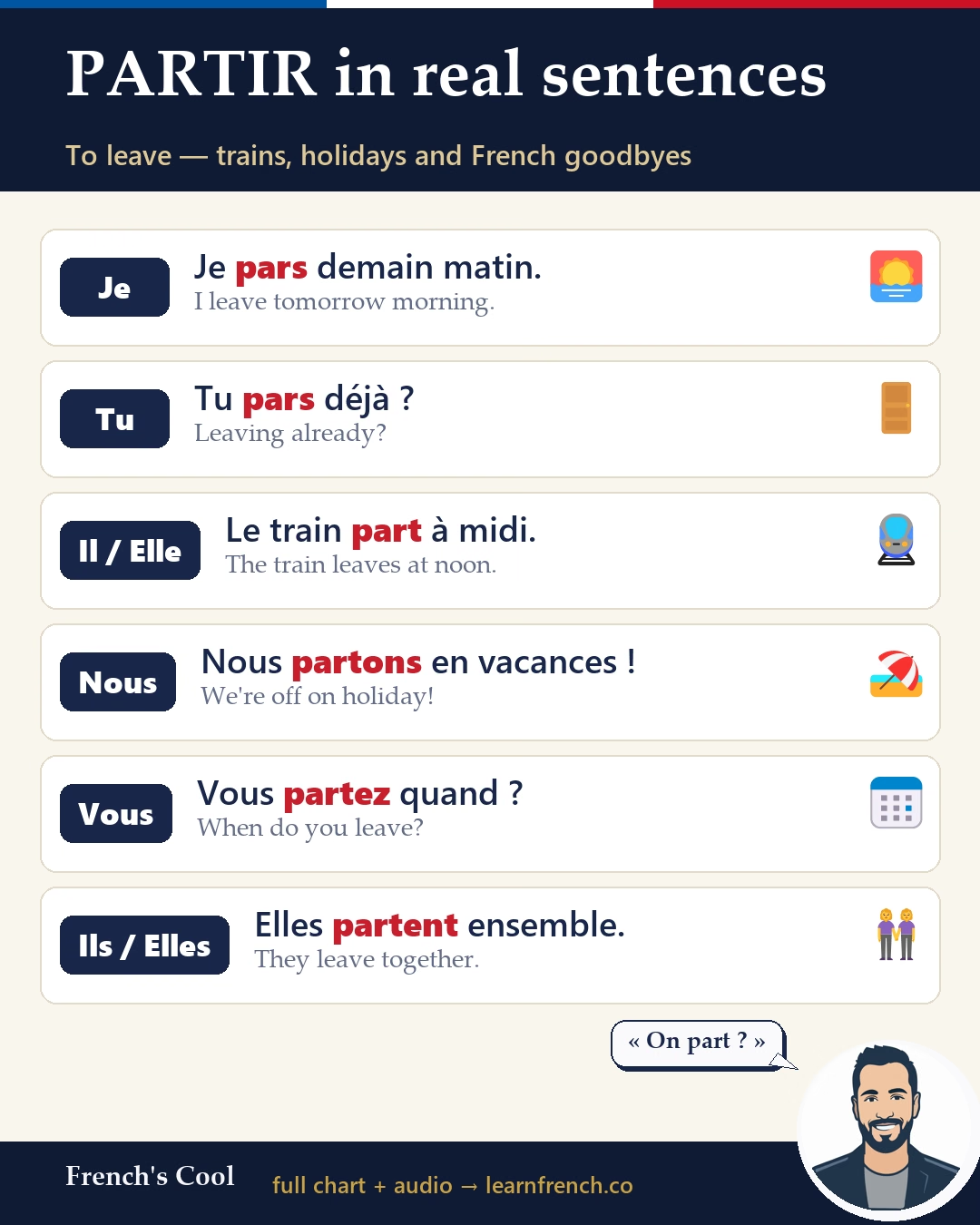
🔊 Example sentences
✍️ Practice
Nous ___ demain matin. (partir, present)
Show answer
partons
Hier, elle ___ très tôt. (partir, passé composé)
Show answer
est partie
Ils ___ bientôt. (partir, future)
Show answer
partiront
« sortir » follows partir : je ___ (present, sortir)
Show answer
sors
Elles sont ___ tôt. (past participle, feminine plural)
Show answer
parties
🎮 Practise this with games
🎯 More practice — conjugation drill — all six tenses
je ___ (Partir — present)
Show answer
pars
tu ___ (Partir — passé composé)
Show answer
es parti(e)
il ___ (Partir — imperfect)
Show answer
partait
nous ___ (Partir — future)
Show answer
partirons
vous ___ (Partir — conditional)
Show answer
partiriez
Go further: this chart is one small piece — get the full picture in our guide Master the present tense — the full beginner guide.
Partir conjugation FAQ
What is the present tense of partir?
je pars, tu pars, il / elle part, nous partons, vous partez, ils / elles partent. Full charts for every tense are above, each form with audio.
What is the past participle of partir?
parti(e) — the passé composé is « je suis parti(e) ». Partir uses être as its auxiliary verb. Because it takes être, the past participle agrees: elle est partie, ils sont parti(e)s.
How do you say partir in the future tense?
« je partirai » — the future stem never changes across persons, only the endings do.
What does partir mean in English?
to leave. It is one of the essential French verbs — drill the present first, then the passé composé; those two tenses carry most conversations.
🎮 Practise this lesson
Games built from this exact page — turn what you just read into play:
🧩 Sentence Builder rebuild these sentences
🏁 Conjugation Race type the right form
🎧 Listening Game which sentence do you hear?
🎬 All seven CEFR levels, end to end
« partir » at every CEFR level — the tense, its forms and the mechanic that makes it stick. Practise it with the free games →