How Long Does It Really Take to Learn French?
It's the question every learner asks, and the honest answer is: it depends on your goal. But the milestones are far more predictable than most people think — and knowing them keeps you motivated when progress feels slow. The official estimate For English speakers, French is one of the easier languages — it shares thousands…
What you'll learn
It’s the question every learner asks, and the honest answer is: it depends on your goal. But the milestones are far more predictable than most people think — and knowing them keeps you motivated when progress feels slow.
The official estimate
For English speakers, French is one of the easier languages — it shares thousands of words with English. Common guidance puts solid conversational ability at around 250–350 hours of study, and strong working proficiency at roughly 600+ hours. At an hour a day, that’s conversational in under a year.
What the levels look like
- A1 (absolute basics): 2–3 months of regular lessons. You can greet, introduce yourself, order, and handle simple exchanges.
- A2 (elementary): ~6 months. You manage everyday situations — shopping, directions, basic past and future.
- B1 (independent): ~9–12 months. You hold a real conversation, handle travel, and express opinions simply.
- B2 (confident / professional): ~18–24 months. You argue a point, follow native speech, and work in French. This is the level employers and universities ask for.
- C1–C2 (mastery): several more years of immersion and practice.
What speeds you up — or slows you down
- Frequency beats intensity: 30 minutes daily beats one long session a week, every time.
- Speaking from day one: output drives progress far faster than passive study.
- A teacher who tailors lessons: targeted correction removes months of plateau.
- Immersion: French media, music and (eventually) time in France compress the timeline dramatically.
- What slows you: perfectionism, app-only learning with no speaking, and long gaps that erase momentum.
How to measure progress
Don’t measure by ‘do I feel fluent’ — you rarely will. Measure by what you can do: Can you order a meal without switching to English? Can you understand the gist of a podcast? Can you describe your weekend in the past tense? Those concrete wins are your real progress.
A realistic first-year plan
- Months 1–3: build the core — greetings, present tense, the 300 most common words. Speak in every lesson.
- Months 4–8: add past and future, expand vocabulary by theme, start listening to slow French daily.
- Months 9–12: push into real conversation and opinions; aim for a comfortable B1.
The honest takeaway
French rewards consistency more than talent. A learner who does a focused half-hour most days, speaks regularly, and gets corrected will pass anyone relying on bursts of cramming. Whatever your timeline, a structured plan makes it shorter.
Practise it with a real teacher
Reading about French is one thing — saying it out loud, with someone who corrects you gently and adapts to your level, is what makes it stick. Your first 20-minute lesson with Xavier is free, with no card and no commitment. Book your free lesson and let’s put this into practice.
✍️ Quick quiz — did it stick?
The CEFR beginner level is called ___ (letter+number)
Show answer
A1
Better for progress: 10 minutes daily or 2 hours once a week? (consistency)
Show answer
10 minutes daily
About ___% of French verbs are regular -er verbs. (big number)
Show answer
90
Play the Quiztap to start · quick practice from this material
Loading the quiz…
The honest math: hours, not months
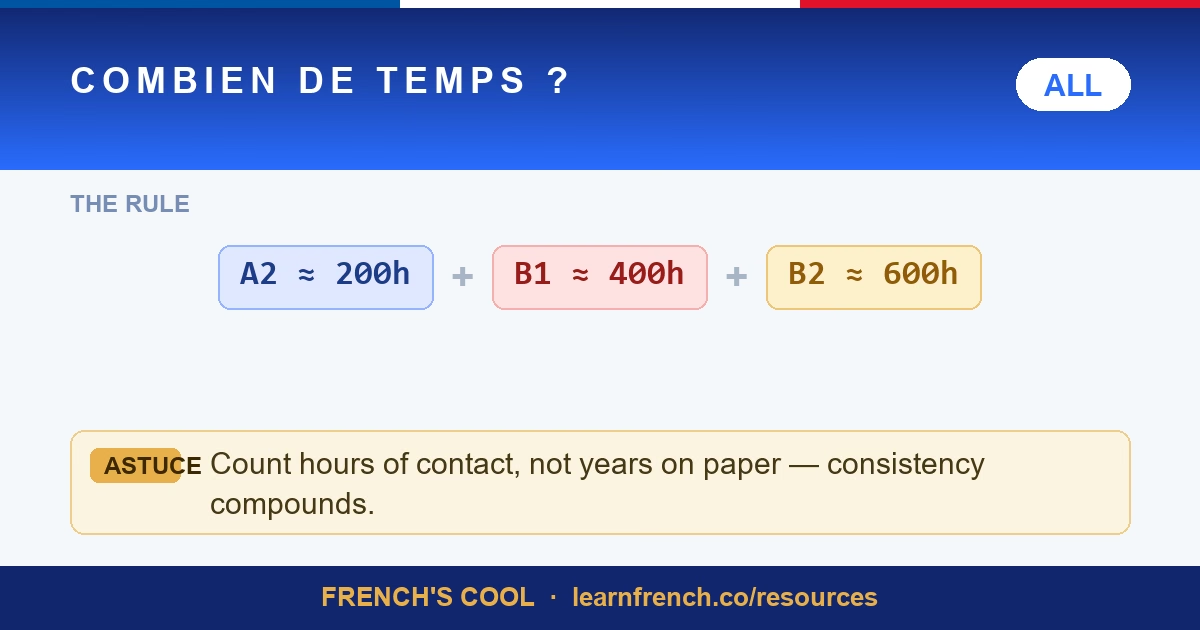
Every serious answer starts from the same benchmark: the US Foreign Service Institute clocks French at roughly 600 hours of guided study for professional working fluency — french is classified in the easiest category for English speakers, alongside languages like Spanish and Italian, because so much vocabulary is shared and the grammatical structures rhyme with English’s. Hours, not months, is the honest unit: 600 hours at five hours a week is around two and a half years; at fifteen intensive hours it’s under a year; living in France with french lessons on top compresses further because the environment bills hours for you. The level-by-level rhythm: A1 level in 60–100 hours (weeks, not months, of steady work), A2 by ~200, B1 by ~400, B2 — the « independent » certificate — around 600–650. Private french lessons or a good french tutor speed the clock less by teaching faster than by making the hours denser: corrected speaking counts double.
What genuinely accelerates the timeline, in order: daily contact (twenty minutes every day beats three hours on Sunday — language acquisition hates gaps), speaking from week one, input you enjoy (watch french films and series with the subtitle ladder — the day you follow a film without subtitles is a level-up you can feel), and already speaking a Romance language (if you already speak Spanish, discount a third). What doesn’t: app streaks without speech, grammar completionism, and waiting to be ready. And define the finish line kindly — most people’s real goal is B1-B2 conversation, not C2 perfection; reach fluency of the practical kind first and let the polish accumulate in use. The realistic timelines: three months of studying french seriously buys survival French and momentum, a year buys conversation, two to three buy independence. Slower than the ads, faster than the fear — and every hour of it compounds, whether you learn french fast or gently: writing in french, speaking, listening all draw from the same account. Start the clock; the french language pays interest from deposit one — that’s how long it takes: exactly as many hours as you give it, on a schedule you control.
FAQ
How fast can you fully learn French?
« Fully » is a moving target — B2 independence in ~600 focused hours is realistic; C-level mastery is a years-long relationship with the language. Fast tracks compress the calendar, never the hours.
Can I learn French in 3 months?
You can reach solid A2 — survival conversation, real exchanges — with daily intensive work. Claims of three-month fluency redefine « fluency »; three-month momentum, however, is the best predictor of eventual success.
What is the 80/20 rule for learning French?
Focus on the 20% that appears in 80% of speech: core verbs, high-frequency vocabulary, the four everyday tenses. It’s how three months of study can sound like a year’s worth.
What is the #1 easiest language to learn?
For English speakers, the FSI ties Spanish, French, Italian, Portuguese and Dutch in its easiest category (~600 hours). French’s shared vocabulary with English — some 10,000 cognates — is the head start most learners underrate.
How many hours does each CEFR level take?
The clearest way to answer « how long » is by CEFR level. These are rough guided-study hours for an English speaker — faster with immersion, slower with only occasional practice:
- A1 (beginner) — ~60–100 hours
- A2 (elementary) — ~160–200 hours total
- B1 (intermediate) — ~350–400 hours total
- B2 (upper-intermediate, conversationally fluent) — ~500–650 hours total
- C1 (advanced) — ~700–850 hours total
- C2 (mastery) — ~1,000+ hours total
See exactly what each stage looks like on the resources by level pages, from A1 to near-native.
Is French one of the easiest languages to learn?
For an English speaker, yes. The US Foreign Service Institute (FSI) rates French as a Category I language — its easiest group — needing roughly 600–750 class hours to reach professional working proficiency. As a Romance language, French shares thousands of cognates with English (nation, important, table), which is why native English speakers usually progress faster in French than in German or Russian.
Can you learn French in 3 months?
You cannot reach full fluency in three months — but you can absolutely reach a confident A1–A2, enough for greetings, shopping, directions and simple conversations, if you study intensively (an hour a day plus regular speaking). « Fluent » is a longer road; « useful » is surprisingly quick.
How long to learn French FAQ
How long does it take to become fluent in French?
Conversational fluency (a solid B2) typically takes 500–650 hours of study — around 1–2 years for most learners practising regularly. True mastery (C1–C2) takes longer and, above all, real immersion and daily use.
How long does A1 take?
Most beginners reach A1 in about 60–100 hours — a few months of steady, little-and-often practice.
How many hours a day should I study French?
Consistency beats intensity: 20–30 focused minutes a day, including speaking out loud, out-performs a rare long session. A weekly lesson with a tutor keeps you accountable and fixes mistakes before they set.
Is French hard to learn for English speakers?
It is one of the easier languages for you, thanks to shared vocabulary and no case system. The trickier parts — pronunciation and noun gender — come with exposure, not memorisation.
The numbers: hours to each level
The most-quoted benchmark (FSI, the US diplomat school) puts French among the easiest languages for English speakers: about 600–750 classroom hours to strong professional fluency. Broken into CEFR levels, typical totals look like this:
- A1 — ~60–100 hours: survival French, introductions, café orders.
- A2 — ~180–200 hours total: daily routines, simple past-tense stories.
- B1 — ~350–400 hours total: hold real conversations, watch series with FR subtitles.
- B2 — ~550–650 hours total: work in French, argue a point, drop the subtitles. (This is DELF B2 — the university-entry level.)
- C1 — ~800–950 hours total: nuance, humour, effortless reading.
What that means per week — do the math once
- 30 min/day (3.5 h/week): A2 in ~1 year, B1 in ~2 years, B2 in ~3–3.5 years.
- 1 h/day (7 h/week): A2 in ~6 months, B1 in ~1 year, B2 in ~18–22 months.
- 2 h/day (intensive): B1 within 6 months, B2 within a year — the immersion-at-home track.
Two multipliers change everything: speaking practice (an hour of conversation is worth several of passive review — that’s what lessons with Xavier are for) and daily contact (the 15-minute streak beats the Sunday marathon; see making vocabulary stick).
Signs you’re on schedule
- After 1 month: you introduce yourself without rehearsing (script here).
- After 6 months (daily practice): you follow the gist of learner-aimed videos without pausing.
- After 1 year: you survive a full evening « en français » — tired, happy, and understood.
🧰 Your practice kit
This guide gave you the big picture — now drill the details with these free interactive charts (each with audio examples and exercises):
Prefer a human? Book a free lesson with Xavier →
🎬 Watch next: Test your level on innerFrench E01 — 28 minutes of clear French about natural learning.
🎬 This article in 20 seconds
The quick version — the full detail is below. More shorts → Open this short as a page — transcript included →