Mettre — to put | French Verb Chart
On this page
🖨️ Print-friendly: use Ctrl+P (⌘P) or your browser menu to print this chart cleanly.
📚 This is the overview. « mettre » is taught level by level — pick your CEFR level below for a full lesson (explanation, pronunciation, exercises & games).
Présent (Indicatif)
- je metsI put
- tu metsyou put
- il / elle methe / she puts
- nous mettonswe put
- vous mettezyou put
- ils / elles mettentthey put
Passé composé (Indicatif)
- j’ai misI put
- tu as misyou put
- il / elle a mishe / she put
- nous avons miswe put
- vous avez misyou put
- ils / elles ont misthey put
Imparfait (Indicatif)
- je mettaisI was putting
- tu mettaisyou were putting
- il / elle mettaithe / she was putting
- nous mettionswe were putting
- vous mettiezyou were putting
- ils / elles mettaientthey were putting
Futur simple (Indicatif)
- je mettraiI will put
- tu mettrasyou will put
- il / elle mettrahe / she will put
- nous mettronswe will put
- vous mettrezyou will put
- ils / elles mettrontthey will put
Conditionnel présent
- je mettraisI would put
- tu mettraisyou would put
- il / elle mettraithe / she would put
- nous mettrionswe would put
- vous mettriezyou would put
- ils / elles mettraientthey would put
Subjonctif présent
- que je mettethat I put
- que tu mettesthat you put
- qu’il / elle mettethat he / she put
- que nous mettionsthat we put
- que vous mettiezthat you put
- qu’ils / elles mettentthat they put
Impératif, Participe & Infinitif
- mettreinfinitive
- mettantpresent participle
- en mettantgerund (gérondif)
- mispast participle
- mets · mettons · mettezimperative
- avoirauxiliary in compound tenses
📈 « mettre » from A1 to native
The same verb grows with your level — from your first words to real native slang.
🎬 The 20-second version
Five phrases with « mettre » — guess before the reveal. Practise with the free games → Open this short as a page — transcript included →
📘 How to use Mettre
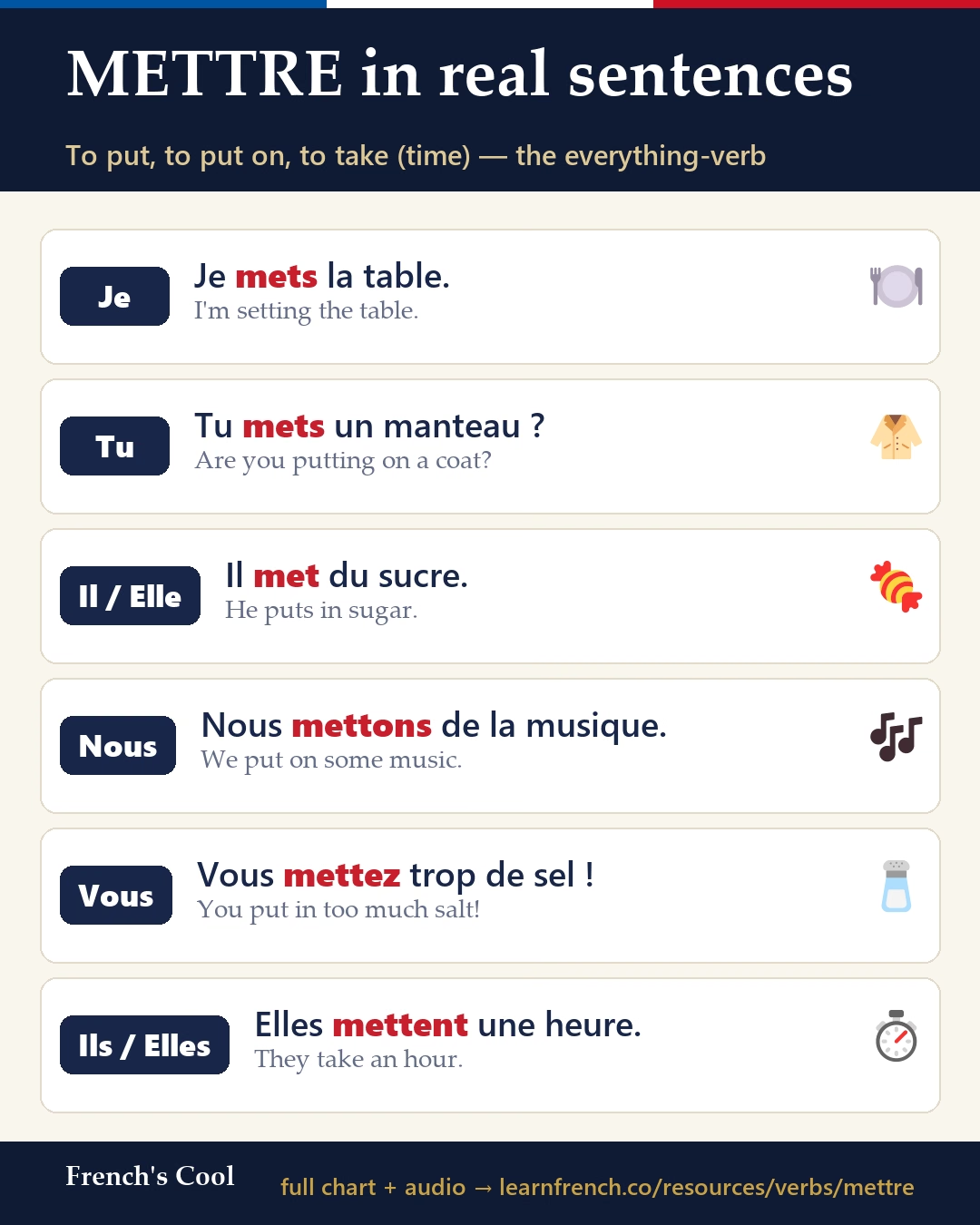
- To put / place: je mets les clés sur la table — and to put on clothes: elle met son manteau.
- Time: mettre du temps à — j’ai mis une heure à venir (it took me an hour).
- Se mettre à = to start doing: il s’est mis à pleuvoir.
- One t in the singular (je mets), two in the plural (nous mettons).
🔑 Key forms
🔊 Common expressions
🇬🇧 Mettre in plain English: the put-everything verb
Mettre — to put, to place, to put on — is an irregular verb with a mercifully small table: je mets, tu mets, il met (one t), then nous mettons, vous mettez, ils mettent (two t’s — the double letter marks the spoken stem, exactly like prendre’s double n). The passé composé is j’ai mis, one of French’s shortest past participles, and the rest of the conjugation behaves: imparfait je mettais, futur je mettrai, conditionnel je mettrais, subjonctif que je mette. To conjugate mettre is mostly to remember which side of the one-t/two-t border each form lives on — say the present aloud down the table and the border installs itself.
The verb earns its chart through family and phrases. The family: promettre (promise), permettre (allow), admettre, soumettre, remettre (put back / hand over / postpone) all conjugate identically — j’ai promis, il permet, nous remettons. The phrases run daily life: mettre la table (set the table), mettre du temps (take time), se mettre à + infinitive (to start doing — « il s’est mis à pleuvoir », it started raining), and the wardrobe sense — « je mets un pull » — which makes mettre the clothing lesson’s favourite verb. In context, one drill covers the lot: narrate getting dressed and setting breakfast in the present, then in the passé composé — mis, promis, permis will follow you politely ever after.
FAQ
What is the past participle of mettre?
« Mis » — j’ai mis. The family copies it: promis, permis, admis, remis, soumis. « Promis ! » alone means “I promise!”.
Which verbs conjugate like mettre?
Everything in -mettre: promettre, permettre, admettre, remettre, soumettre, transmettre, commettre. One table, eight verbs.
What does « se mettre à » mean?
To start doing something: « je me suis mis à apprendre le français ». With weather: « il se met à pleuvoir » — it’s starting to rain.
🔊 Example sentences
✍️ Practice
Elle ___ du sucre dans son café. (mettre, present)
Show answer
met
Hier, j’___ une heure pour venir. (mettre, passé composé)
Show answer
ai mis
___ tes chaussures ! (mettre, imperative (tu))
Show answer
Mets
« promettre » : passé composé → j’ai ___ (past participle)
Show answer
promis
Il se ___ à pleuvoir. (se mettre à, passé composé)
Show answer
est mis

🎮 Practise this with games
🎯 More practice — conjugation drill — all six tenses
je ___ (Mettre — present)
Show answer
mets
tu ___ (Mettre — passé composé)
Show answer
as mis
il ___ (Mettre — imperfect)
Show answer
mettait
nous ___ (Mettre — future)
Show answer
mettrons
vous ___ (Mettre — conditional)
Show answer
mettriez
Go further: this chart is one small piece — get the full picture in our guide Master the present tense — the full beginner guide.
Mettre conjugation FAQ
What is the present tense of mettre?
je mets, tu mets, il / elle met, nous mettons, vous mettez, ils / elles mettent. Full charts for every tense are above, each form with audio.
What is the past participle of mettre?
mis — the passé composé is « j’ai mis ». Mettre uses avoir as its auxiliary verb.
How do you say mettre in the future tense?
« je mettrai » — the future stem never changes across persons, only the endings do.
What does mettre mean in English?
to put. It is one of the essential French verbs — drill the present first, then the passé composé; those two tenses carry most conversations.
🎮 Practise this lesson
Games built from this exact page — turn what you just read into play:
🧩 Sentence Builder rebuild these sentences
🏁 Conjugation Race type the right form
🎧 Listening Game which sentence do you hear?
🎬 All seven CEFR levels, end to end
« mettre » at every CEFR level — the tense, its forms and the mechanic that makes it stick. Practise it with the free games →