DELF B2: A Realistic Study Plan That Actually Works
DELF B2 is the level that opens real doors: many French universities and employers ask for it. It certifies that you can argue a point, follow a debate, and write a structured text. It's demanding but completely achievable with a focused plan. Here's a realistic one. What B2 actually asks of you B2 is the…
What you'll learn
DELF B2 is the level that opens real doors: many French universities and employers ask for it. It certifies that you can argue a point, follow a debate, and write a structured text. It’s demanding but completely achievable with a focused plan. Here’s a realistic one.
What B2 actually asks of you
B2 is the ‘independent user’ level. In practice you need to: defend an opinion clearly, understand the main ideas of complex texts and fast native speech, and write a coherent argued text (around 250 words). The exam has four parts, each scored out of 25 (you need 50/100 overall, with at least 5/25 in each).
- Compréhension de l’oral — listening (recordings, interviews, news)
- Compréhension des écrits — reading (articles, argued texts)
- Production écrite — a formal letter or argued essay
- Production orale — present and defend a viewpoint from a short text
Your 12-week DELF B2 preparation plan
If you’re solidly at B1, twelve focused weeks is a sensible target.
- Weeks 1–3 — diagnose and build: take one full past paper to find your weakest skill. Start a vocabulary log organised by theme (environment, work, society, technology — the exam’s favourite topics).
- Weeks 4–7 — production focus: write one argued text per week and record one spoken presentation. This is where most points are won or lost.
- Weeks 8–10 — exam technique: work to the clock. Learn the structure of the essay (introduction, two or three arguments, conclusion) until it’s automatic.
- Weeks 11–12 — full rehearsals: sit complete timed papers, review every mistake, and rest the day before.
How to prepare each exam skill
- Listening: French news in ‘slow’ format, then real radio (France Inter, RFI). Listen once for gist, once for detail.
- Reading: opinion pieces from Le Monde or Courrier international. Underline connectors (néanmoins, en revanche, par conséquent) — you’ll reuse them.
- Writing: master a bank of linking words and a fixed essay skeleton. Examiners reward clear structure as much as vocabulary.
- Speaking: practise the format — read a short text, summarise it, take a position, defend it against questions. Do it out loud, every week.
The connectors that lift your score
Argued French lives on linking words: tout d’abord (first of all), de plus (moreover), cependant / néanmoins (however), en revanche (on the other hand), par conséquent (consequently), en conclusion (in conclusion). Use them deliberately and your writing instantly reads at B2.
Common pitfalls
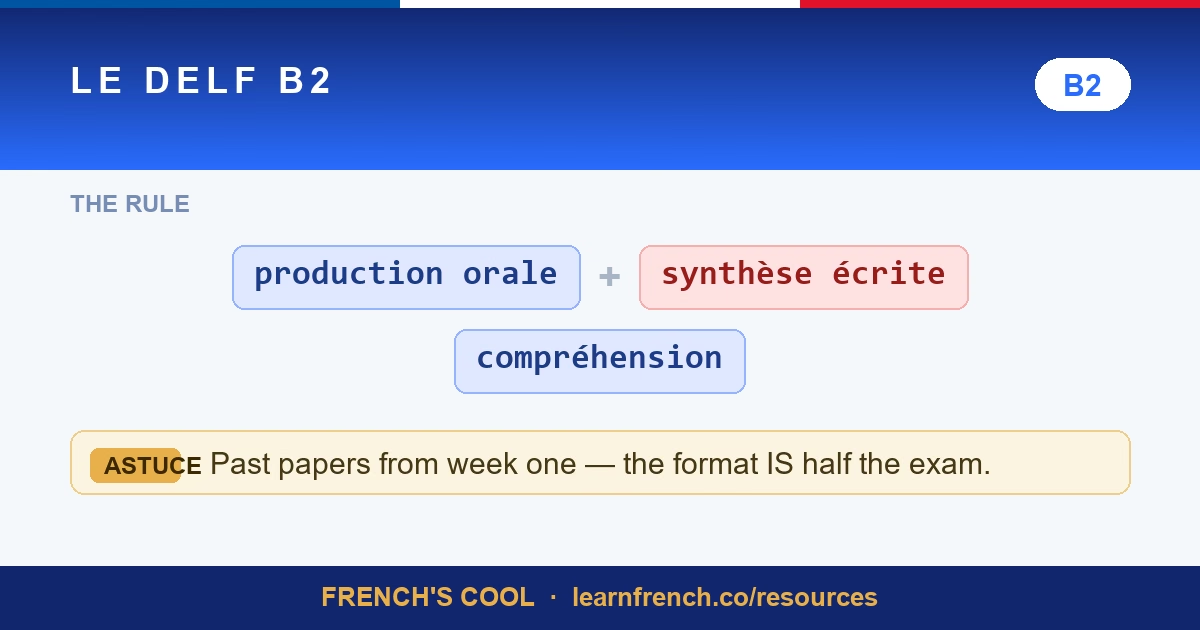
- Skipping the spoken practice — the oral is half the production marks and the easiest to neglect.
- Writing without a plan — spend two minutes outlining; it saves you and earns structure points.
- Ignoring the word count — too short loses marks automatically.
- Cramming vocabulary lists — learn words in example sentences you can actually reuse.
Exam-day checklist
Arrive early, read every instruction twice, watch the clock, and always attempt every section — a partial answer scores more than a blank. And remember: a calm, structured B2 candidate who makes a few grammar slips will pass; a panicked perfectionist often won’t.
Practise it with a real teacher
Reading about French is one thing — saying it out loud, with someone who corrects you gently and adapts to your level, is what makes it stick. Your first 20-minute lesson with Xavier is free, with no card and no commitment. Book your free lesson and let’s put this into practice.
✍️ Quick quiz — did it stick?
Il faut que j’___ (aller) — subjunctive! (irregular)
Show answer
aille
« although » + subjunctive → bien ___ (conjunction)
Show answer
que
The B2 exam tests 4 skills: listening, reading, writing and ___ (speaking)
Show answer
speaking (production orale)
Play the Quiztap to start · quick practice from this material
Loading the quiz…
The exam machine: what DELF B2 actually is and how it’s scored
DELF and DALF are the official diplomas of the French state — DELF (Diplôme d’études en langue française) covers A1 to B2 of the CEFR, DALF takes over for C1–C2 — and unlike course certificates they never expire. B2 level is the CEFR’s “independent level”: you can argue a position, follow abstract discussion, and self-correct — which is why passing the DELF B2 unlocks French universities and fast-tracks residence applications for many francophone destinations. You take the delf at an accredited test center — most exam centres worldwide are run by the Alliance Française de your nearest city — on fixed session dates, so check the calendar early: registration typically closes a month out.
Scoring is friendlier than the exam’s reputation. Four modules — listening, reading, writing, speaking — worth 25 points each; the overall score must reach 50/100, with no module below 5. That grade structure means a strong candidate’s writing can carry a weaker listening day. The correction rubrics are public: examiners award points for structure and task completion more than for elegance, which is exactly what the study plan above exploits. For materials, start with the official DELF sample papers (free PDF downloads on the France Éducation International site), add a drill platform like PrepMyFuture or the RFI/TV5 exercise banks for listening, and make real-world input the daily habit: news articles from the francophone press, one a day, summarised aloud — reading, vocabulary and speaking practice in a single fifteen-minute module of your own. Candidates who have studied french to a solid intermediate level usually need eight to twelve weeks of that rhythm; the complete DELF plan above turns it into a calendar. Work towards the format, not just the language — knowing how to answer the questions is worth a demi-point per question, and demi-points are how the langue française hands out passes.
FAQ
How hard is the DELF B2?
The pass bar is 50/100 with module minimums of 5/25 — designed to certify solid independent French, not perfection. Most failures come from unfamiliarity with the format, not the language: timed practice papers close that gap fast.
How long should I prepare for DELF B2?
From a genuine B1+: 8–12 weeks at an hour a day. From mid-B1: add a semester. The speaking module benefits most from live practice — schedule mock orals in your final month.
Does the DELF B2 expire?
Never — it’s a state diploma, valid for life. That permanence is why B2 is the sweet spot: enough for universities and immigration files, and no renewal treadmill.
The DELF B2 exam format at a glance
Four papers, 25 points each, 50/100 to pass — with a minimum of 5/25 in every paper:
- Compréhension de l’oral (listening, ~30 min) — recordings played twice or once, questions follow.
- Compréhension des écrits (reading, 1 h) — two long texts, argumentative and informative.
- Production écrite (writing, 1 h) — one formal argued text (letter, essay, article) of ~250 words.
- Production orale (speaking, ~20 min + 30 min prep) — defend an opinion from a short prompt, then debate it with the examiner.
The B2 diploma is valid for life, and it’s the level most French universities require of international students.
Registration, cost and past papers
You register through an accredited exam centre — usually your nearest Alliance Française or Institut Français; sessions run several times a year and fill early, so book 2–3 months ahead. Fees vary by country, typically €100–€200. For practice material, use the official France Éducation International sample papers plus a book of past exams (the « ABC DELF B2 » and « Réussir le DELF » series are the classics) — training with real past papers is the single highest-value hour of your preparation week.
DELF B2 FAQ
DELF or DALF — which one am I preparing?
DELF covers A1–B2; DALF is the advanced diploma (C1–C2). If you pass B2 comfortably and want more, DALF C1 is the natural next step — the skills in this plan transfer directly.
How long does DELF B2 preparation take?
From a solid B1: roughly 3–6 months of steady work — the 12-week plan above assumes ~1 hour a day. The exam rewards technique as much as French: knowing the paper formats is worth easy points.
Can I prepare alone?
Reading and listening, yes. Writing and speaking need feedback — an examiner-style eye on your essays and mock oral debates. That is exactly what exam-prep lessons are for: book a free lesson and we will assess where you stand against the B2 grid.
🧰 Your practice kit
This guide gave you the big picture — now drill the details with these free interactive charts (each with audio examples and exercises):
Prefer a human? Book a free lesson with Xavier →
Keep going: Not sure B2 is even the right target? Compare all four exams in the complete French exams guide.
🎬 This article in 20 seconds
The quick version — the full detail is below. More shorts → Open this short as a page — transcript included →