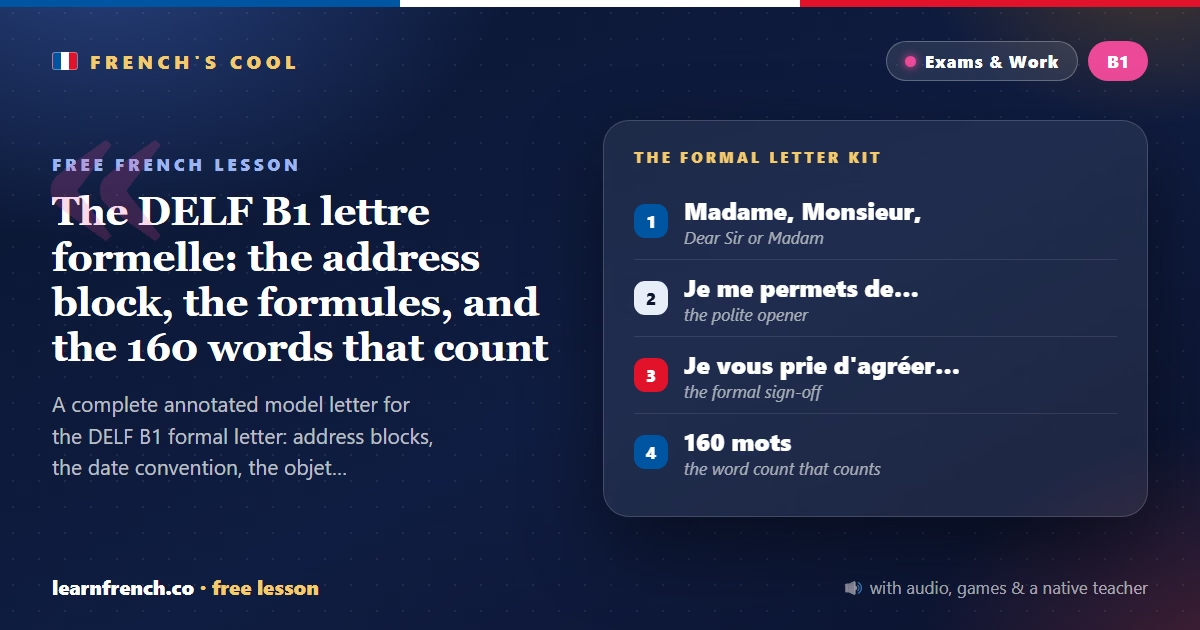
The DELF B1 lettre formelle: the address block, the formules, and the 160 words that count
A complete annotated model letter for the DELF B1 formal letter: address blocks, the date convention, the objet line, three safe formules de politesse, and what 160 words really looks like.
What you'll learn
First, work out what they are actually asking you to write
Most of the marks lost on the DELF B1 written paper are not lost on grammar. They are lost in the first ninety seconds, when a candidate reads “Vous écrivez au directeur de votre école de langues” (“You write to the director of your language school”) and then produces something that opens with Salut ! and ends with À bientôt. The French is fine. The letter is wrong.
🎬 This lesson in one minute
The quick version — the full lesson is below. More shorts →
So before you write a single word, find the recipient in the consigne (the instructions). The recipient decides everything else.
The three signals that say “formal”
- A titled or institutional recipient. le maire (the mayor), le directeur, la responsable du service clientèle (the customer service manager), votre employeur, le journal. Anyone with a function rather than a first name.
- The verb in the instruction. Vous écrivez une lettre pour vous plaindre (to complain), pour demander, pour réclamer, pour proposer. Complaining, requesting and proposing to an institution are formal acts.
- The word lettre or courrier itself, as opposed to message, mail, article or post sur un forum.
The signals that say “informal”
Vous écrivez à votre ami(e) français(e), à votre correspondant (your penfriend), à votre colocataire (your flatmate). Here you use tu, no address block, no objet, and you close with Amicalement or Je t’embrasse.
And a third case that catches people out: the blog post, the forum contribution, the article for the school magazine. That is neither. No address block at all, no Madame, Monsieur. Just a title and paragraphs. If you glue a formal letter layout onto a forum post, you lose points on respect de la consigne, which is the cheapest and most annoying way to lose points.
The layout, block by block
A French formal letter has a fixed geography. It is worth learning once, properly, because it is free marks and it takes you forty seconds in the exam.
- Top left: you. First name, surname, street, then postcode and town. Three or four lines.
- Top right, slightly lower: them. The service or the person, then the organisation, then the address.
- Right, under the recipient’s block: place and date.
- Left, under the date: the objet.
- Then the opening formula, the body, the closing formula, the signature.
The date: get this exactly right
The convention is town, comma, le, number, month, year:
Nantes, le 12 mars 2026
Three things people get wrong. The month is never capitalised in French: mars, not Mars. The le is not optional. And for the first of the month only, you write le 1er mars, never le 1 mars. Every other day is a plain number: le 2 mars, le 21 mars.
The objet: one line, no verb
Objet : réclamation concernant une lampe défectueuse
(“Subject: complaint regarding a faulty lamp”)
Note the space before the colon. French typography puts a space before : ; ? and !. It is a small thing, but a marker writing “native-looking” in the margin is on your side for the rest of the page.
Keep the objet to a noun phrase. Objet : demande d’inscription, Objet : annulation de mon abonnement, Objet : demande d’autorisation. Not a sentence, not a verb, no full stop.
The formules: three you can trust, and the ones that will bite you
Opening: if you do not know the person’s name, write Madame, Monsieur, with both capitals and a comma. That is the whole thing. If the consigne gives you a function, use it: Monsieur le Maire, / Madame la Directrice,.
Never open a formal letter with Bonjour, (that is an email to a colleague) or Cher Monsieur, (that implies you know him).
For the closing, here are three formules de politesse that are correct, current, and impossible to get slightly wrong:
- Je vous prie d’agréer, Madame, Monsieur, mes salutations distinguées.
- Veuillez recevoir, Madame, Monsieur, mes salutations distinguées.
- Dans l’attente de votre réponse, je vous prie d’agréer, Madame, Monsieur, mes salutations distinguées. (Use this one whenever you are asking for something. It does two jobs.)
All three translate loosely as “Yours faithfully”, and all three are appropriate for a shop, a town hall, a school or an employer at B1.
Now the trap. Students find the baroque formulas online, the ones with sentiments and considération and dévoué, and they reproduce them from memory at 11:40 on exam morning. A slightly wrong ornate formula reads much worse than a plain correct one. Real examples I have marked:
- ✗ Je vous prie de croire en mes sentiments distingués. The verb takes à, not en: croire à. And sentiments carries old etiquette baggage you do not need. Use salutations and forget the whole minefield.
- ✗ Je vous prie d’agréer mes salutations distinguées, Madame, Monsieur. The Madame, Monsieur goes inside the sentence, after the verb, not tacked on at the end.
- ✗ Veuillez agréer, Madame, Monsieur, mes salutations les plus distinguées et mes sentiments respectueux. Two formulas welded together. It sounds like a person trying very hard.
- ✗ Cordialement, on a letter to a mairie. Perfectly fine in a work email, too light here.
And the rule that ties it together: the closing must repeat the opening word for word. If you opened with Monsieur le Maire, you close with … je vous prie d’agréer, Monsieur le Maire, mes salutations distinguées. Opening Madame, Monsieur, and closing Monsieur le Directeur is a visible, avoidable error.
The model letter, annotated
Here is a realistic B1 task: Vous avez acheté un appareil qui ne fonctionne pas. Vous écrivez au magasin pour demander un échange ou un remboursement. (160 mots minimum)
| The letter | What this line is doing |
|---|---|
| Léa Fontaine 27, rue des Hauts-Pavés 44000 Nantes |
Sender block, top left. Street number then comma then street name. Postcode before the town, no comma between them. |
| Service clientèle Boutique Maison Lumière 8, avenue de la Gare 44000 Nantes |
Recipient block, top right, a couple of lines lower. Function first, then the organisation. |
| Nantes, le 12 mars 2026 | Right-hand side, under the recipient. Lower-case month. This alone tells the examiner you have written a French letter before. |
| Objet : réclamation concernant une lampe défectueuse | Back to the left margin. Noun phrase, space before the colon, no full stop. |
| Madame, Monsieur, | The safe opening. Remember it, because the closing has to match it. |
| Le 2 mars dernier, j’ai acheté dans votre magasin une lampe de bureau (référence L-450), au prix de 79 euros. Vous trouverez ci-joint une copie du ticket de caisse. Je suis cliente de votre magasin depuis plusieurs années et je n’avais jusqu’ici rencontré aucun problème. | Paragraph 1: the facts. Date, object, price, proof. Vous trouverez ci-joint = “please find enclosed”. The last sentence is strategy: it makes you a good customer rather than a complainer, and it lets you show off a plus-que-parfait. |
| Dès le premier jour, l’appareil s’est révélé défectueux : l’ampoule s’éteint toute seule au bout de quelques minutes et l’interrupteur chauffe. J’ai donc cessé de m’en servir, car je crains un problème électrique. | Paragraph 2: the problem, concretely. Two specific symptoms beat one vague adjective. se révéler défectueux = “to turn out to be faulty”. s’en servir = “to use it”. The examiner is looking for capacité à présenter des faits, and this is what facts look like. |
| Je me suis présentée en magasin le 7 mars, mais votre vendeur m’a répondu que la garantie ne couvrait pas ce type de panne. Cette réponse me surprend, puisque la lampe est neuve et que je l’ai utilisée normalement. J’ai d’ailleurs conservé l’emballage d’origine. | Paragraph 3: what you already tried, and your objection. Two agreements to notice: présentée (Léa is a woman, être verb) and utilisée (the direct object l’ = la lampe comes before the verb). Also couvrait: reported speech pulls the present into the imparfait. Three grammar points, no showing off. |
| Je vous demande donc de bien vouloir échanger cette lampe ou, à défaut, de me la rembourser. Je reste à votre disposition pour tout renseignement complémentaire. | Paragraph 4: the request. Never leave it implied. de bien vouloir is the polite formal request marker; à défaut = “failing that”. Give them two options and you sound reasonable. |
| Dans l’attente de votre réponse, je vous prie d’agréer, Madame, Monsieur, mes salutations distinguées. | Matches the opening exactly. On its own line, with a blank line above it. |
| Léa Fontaine P.J. : copie du ticket de caisse |
Signature bottom right. P.J. = pièce jointe, “enclosure”, optional but a nice touch. In the exam, sign with the name the consigne gives you or an invented French name, never your own: the scripts are marked anonymously. |
What 160 words actually looks like
That letter, counted from Madame, Monsieur to distinguées, is 165 words. Four short paragraphs. In normal handwriting, about twelve lines. That is genuinely all.
The instruction says 160 mots minimum, and correctors work with a tolerance of roughly ten per cent, so a 150-word answer will not be punished. A 100-word answer will: you simply cannot show enough language to score in the upper bands.
The other direction is subtler. Writing 300 words does not earn you more marks, because there are no marks for length. What it does is double your exposure. Every extra sentence is another chance to fumble an agreement, another subjonctif you did not need, another five minutes you do not have for re-reading. The production écrite is marked out of 25 across ten criteria, and several of them are about accuracy: spelling, vocabulary control, verb tenses, sentence structure. Length feeds the wrong side of that ledger.
My advice, and I have watched this work in the room: aim for 170 to 190 words, then spend the last five minutes hunting for agreement errors. Check every past participle, every plural adjective, every vous verb ending.
Six errors that cost real marks
- Tu creeping in. It usually happens in the last paragraph, when you get emotional about the refund. One je te demande and the register collapses. Scan your letter for tu, te, toi, ton, ta, tes before you hand it in. Every single one is wrong here.
- No objet. Two seconds to write, and its absence is the first thing a French reader notices.
- An opening and a closing that do not match. Madame la Directrice, at the top and Madame, Monsieur at the bottom means you were not paying attention.
- Spoken French on the page. j’ai pas reçu instead of je n’ai pas reçu; c’est nul instead of cet article ne correspond pas à la description; je veux instead of je souhaiterais. Write out the ne. Always.
- No actual request. Many candidates describe the problem beautifully and never say what they want. State it plainly in paragraph four.
- The town missing from the date. Le 12 mars 2026 alone is incomplete in a French letter. It is Nantes, le 12 mars 2026.
Learn these four phrases and you can build almost any B1 letter
- Je me permets de vous écrire au sujet de… (“I am writing to you regarding…”)
- Je vous serais reconnaissant(e) de bien vouloir… (“I would be grateful if you would…”) – watch the -e if you are writing as a woman.
- Suite à mon achat du 2 mars… (“Following my purchase of 2 March…”)
- Dans l’attente de votre réponse… (“Looking forward to your reply…”)
Swap the content, keep the frame. The frame is the part you can make perfect before you walk in.
If you want to practise this properly rather than hopefully, I run a 12-lesson DELF preparation course with full mock exams, marked and returned with the same grid the real examiners use. You write the letters, I tell you exactly where the two points went. À très bientôt.