The DELF B2 essai argumenté: the four-paragraph shape examiners are waiting for
A worked DELF B2 essay marked twice: once at 18/25, once at 22/25, with the same vocabulary. The four extra marks come entirely from structure.
What you'll learn
A student of mine in Chonburi sat the B2 last year with French I would happily put in front of any of my colleagues in Nantes. Subjunctive after bien que (although), dont in the right place, not a single anglicism. She came out of the production écrite (written production) confident, and scored 17 out of 25.
🎬 This lesson in one minute
The quick version — the full lesson is below. More shorts →
She sent me her draft. The French was not the problem. The problem was that I had to read to line fourteen before I found out what she actually thought.
That is the whole lesson. At B2, the essai argumenté is not a language test with an opinion attached to it. It is an organisation test that happens to be conducted in French, and the marking grid says so out loud.
What the task actually is
You get sixty minutes and 25 marks. You are given a document déclencheur (trigger document): a short press article, a forum post, a letter, usually 150 to 300 words. Then a consigne (instruction) telling you who you are writing to and in what form – a courrier des lecteurs (letters page), a contribution à un débat (contribution to a debate), a formal letter to a directeur.
Minimum 250 words. That minimum is real: below it, the examiner is instructed to penalise, and in practice a 200-word script bleeds marks across half the grid because there simply is not enough text to demonstrate anything. There is no official maximum, but do not go far past 320. Every extra sentence is another chance to make an agreement error, and nobody has ever gained a mark for stamina.
Here is the part almost nobody is told: 15 of the 25 marks are for pragmatic competence – following the instruction, presenting facts, arguing a position, holding the text together. Only 10 marks are for language. You can have flawless grammar and still be sitting at 17.
The four moves, and the phrases that open them
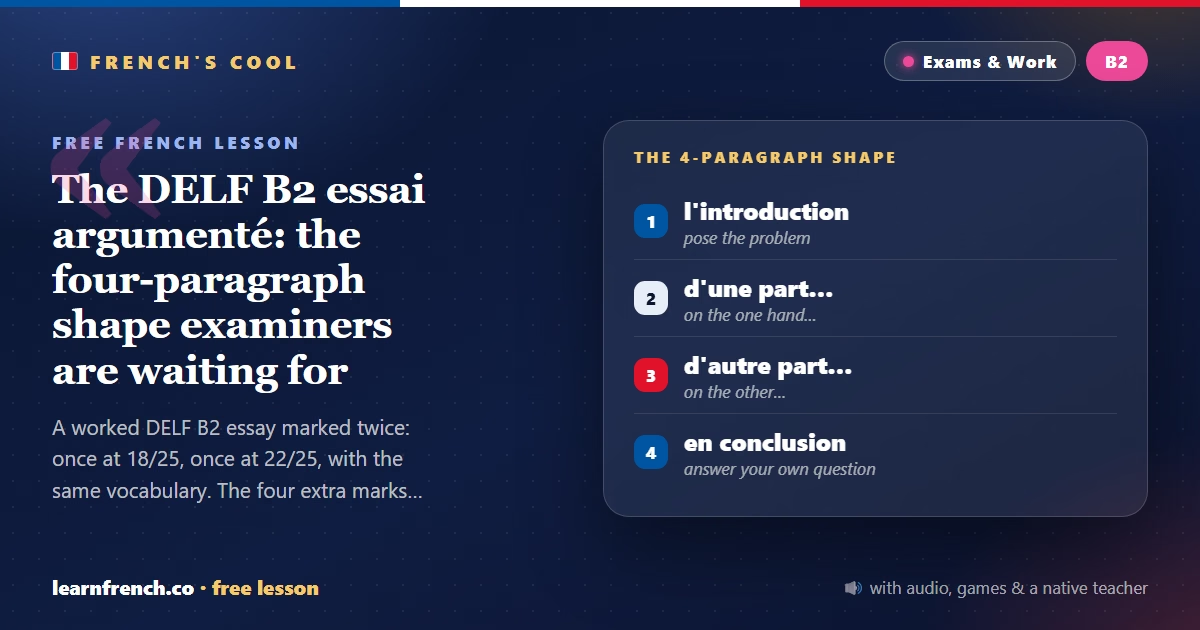
Four paragraphs. Not three, not six. Four. The examiner is reading forty scripts in an afternoon and is looking for a shape she recognises.
1. Introduction: hook, reformulation, position, plan
Four sentences, no more. It does four jobs in order.
- L’accroche (the hook), one sentence that puts the topic in the real world: Depuis quelques années, … (For some years now, …) / En France comme ailleurs, … (In France as elsewhere, …)
- La reformulation – show you understood the document: Votre article s’interroge sur … (Your article asks about …) / Le texte que vous publiez pose une question simple : … (The text you publish asks a simple question: …)
- La prise de position (taking a stance): Cette position me paraît excessive. (This position strikes me as excessive.) / Je partage en partie ce constat. (I partly share this observation.)
- L’annonce du plan (announcing the plan): Je voudrais d’abord rappeler …, avant d’examiner … (I would first like to recall …, before examining …) / Après avoir montré …, je nuancerai … (Having shown …, I will qualify …)
2. First development paragraph
One idea, defended. Open with Il est vrai que … (It is true that …) or On ne peut nier que … (One cannot deny that …). Justify with En effet, … – and note that en effet gives the reason for what you just said, it does not mean “in addition”. Split the idea with D’une part … d’autre part … (On the one hand … on the other …). Land an example with Je pense notamment à … (I am thinking in particular of …).
3. Second development paragraph
The counterweight. Certes, … (Admittedly, …) to concede, then Toutefois, … or Cependant, … (However, …) to turn. This concession-and-turn is the single most B2 thing you can do on the page. A B1 candidate lists; a B2 candidate concedes and then answers.
4. Conclusion
En définitive, … (Ultimately, …) or Il ressort de ce qui précède que … (It emerges from the above that …). Restate your position in different words, then open a door: Reste à savoir si … (It remains to be seen whether …) or a rhetorical question. Never introduce a new argument here.
The worked example
Here is a subject of the type you will meet.
Document déclencheur
« Le télétravail a-t-il tué le collectif ? Trois ans après sa généralisation, le travail à distance séduit toujours autant les salariés. Mais plusieurs dirigeants s’inquiètent : les équipes se parlent moins, les jeunes recrues se forment mal, et le sentiment d’appartenance s’effrite. Certaines entreprises imposent désormais un retour au bureau quatre jours sur cinq. »Consigne : Vous réagissez à cet article dans le courrier des lecteurs du magazine. Vous exposez votre point de vue de façon argumentée et illustrée par des exemples. (250 mots minimum)
Version A: what a real candidate wrote (18/25)
This is the body of the letter, lightly tidied. I have kept the opening formula out of both versions so we compare like with like.
Le télétravail est un sujet très discuté aujourd’hui. Beaucoup de gens aiment travailler chez eux. Il y a moins de trajets, on gagne du temps, et on est plus tranquille pour se concentrer. Mon cousin travaille à distance depuis quatre ans et il est content.
Mais les entreprises disent que les équipes se parlent moins. C’est vrai que les nouveaux employés apprennent difficilement quand personne n’est là pour les aider. Aussi, le sentiment d’appartenance diminue. Le télétravail a des avantages et des inconvénients. Les réunions en ligne sont fatigantes. Je pense qu’il faut trouver un équilibre. Certaines entreprises imposent quatre jours au bureau, je trouve que c’est trop. Deux ou trois jours à la maison, c’est mieux pour tout le monde.
Look honestly at that. The French is fine. There is not one grammatical error I would circle. And it is worth 18.
How the marks fall:
- Respect de la consigne 1.5/2 – it reacts to the article, but never addresses the magazine or its readers. The genre has evaporated.
- Correction sociolinguistique 2/2 – register is consistent, if plain.
- Capacité à présenter des faits 2.5/4 – the cousin is mentioned but does nothing. An example must prove something; this one just exists.
- Capacité à argumenter 2.5/4 – the position appears in the last two lines. Le télétravail a des avantages et des inconvénients is a sentence that costs marks: it says nothing and it tells the examiner you have not decided.
- Cohérence et cohésion 1.5/3 – two paragraphs where there should be four. Aussi used to mean “also” at the head of a sentence is a spoken-register slip. Les réunions en ligne sont fatigantes is an orphan, dropped in after the paragraph had already moved on. And there is a comma splice before je trouve que c’est trop.
- Étendue du vocabulaire 1.5/2 · Maîtrise du vocabulaire 1.5/2 · Orthographe lexicale 1/1 · Choix des formes 2.5/3 · Degré d’élaboration des phrases 1.5/2
Pragmatic column: 10/15. Language column: 8/10. Total 18.
Version B: same words, rebuilt (22/25)
Read this next to Version A and check the vocabulary. There is nothing here she did not already know. Trajets, dirigeants, sentiment d’appartenance, se concentrer – all lifted from her own draft or from the article.
Depuis la pandémie, des millions de salariés travaillent chez eux au moins un jour par semaine. Votre article se demande si le télétravail a tué le collectif, et vous rappelez que certaines entreprises imposent désormais un retour au bureau quatre jours sur cinq. Cette réaction me paraît excessive : le problème n’est pas le télétravail lui-même, mais la façon dont on l’organise. Je voudrais d’abord rappeler ce que les salariés y gagnent, avant d’examiner ce que les entreprises y perdent.
Le télétravail répond en effet à un besoin réel. D’une part, il supprime des trajets longs et coûteux : mon cousin travaille à distance depuis quatre ans et gagne ainsi deux heures par jour, qu’il passe avec ses enfants. D’autre part, il offre le calme qui manque souvent au bureau, et donc la possibilité de se concentrer.
Certes, les critiques des dirigeants ne sont pas sans fondement. Les équipes se parlent moins, les réunions en ligne fatiguent, et les nouvelles recrues se forment mal quand personne n’est là pour les aider ; le sentiment d’appartenance en souffre. Toutefois, ces difficultés viennent d’une mauvaise organisation, non de la distance elle-même.
En définitive, imposer quatre jours au bureau revient à punir tout le monde pour un problème que l’on n’a pas su résoudre. Deux ou trois jours à la maison, accompagnés de véritables journées communes au bureau, constituent une solution plus juste. Reste à savoir si les entreprises accepteront de faire confiance à leurs salariés.
How the marks fall now:
- Respect de la consigne 2/2 – votre article, vous rappelez: the magazine is being addressed.
- Correction sociolinguistique 2/2 – unchanged.
- Capacité à présenter des faits 3.5/4 – the cousin now carries a figure and a consequence.
- Capacité à argumenter 3.5/4 – the thesis is in sentence three, and it is a real one: not “there are pros and cons” but “the fault lies in the organisation, not the distance”.
- Cohérence et cohésion 3/3 – four paragraphs, an announced plan that is then followed, and connectors that do actual work.
- Étendue du vocabulaire 1.5/2 · Maîtrise du vocabulaire 1.5/2 · Orthographe lexicale 1/1 · Choix des formes 2.5/3 · Degré d’élaboration 1.5/2
Pragmatic column: 14/15. Language column: still 8/10. Total 22.
The language score did not move by a tenth of a point. Four marks appeared out of nowhere because the ideas were put in an order and the joints were named.
The grading grid, and what each line is really testing
| Critère | Points | What it is really testing |
|---|---|---|
| Respect de la consigne | 2 | Did you write the right genre, to the right person, at the right length |
| Correction sociolinguistique | 2 | Register held steady: no salut in a formal letter, no on where nous is expected |
| Capacité à présenter des faits | 4 | Do your examples prove something, or are they decoration |
| Capacité à argumenter une prise de position | 4 | Is there a thesis, is it early, is it defended, is it still there at the end |
| Cohérence et cohésion | 3 | Paragraphs, connectors, and a plan the reader can feel |
| Étendue du vocabulaire | 2 | Range: did you say salariés, dirigeants, recrues, or les gens nine times |
| Maîtrise du vocabulaire | 2 | Accuracy: the right word, not the almost-right one |
| Maîtrise de l’orthographe lexicale | 1 | Spelling and accents. One mark, cheap to lose, cheap to keep |
| Choix des formes | 3 | Morphosyntax: agreements, tenses, prepositions, pronouns |
| Degré d’élaboration des phrases | 2 | Subordination. Relative clauses, bien que, alors que, participles |
The three things that most reliably lose marks
1. The catalogue plan
Advantages, then disadvantages, then il faut trouver un équilibre. It feels balanced and mature. It is neither: it is refusal to answer, and Capacité à argumenter is four marks. Decide before you write. Write the thesis sentence first, on your rough paper, in one line. If you cannot, you do not have an essay yet.
2. Connectors used as decoration
En effet introduces a reason. D’ailleurs (besides) adds a supplementary point, not your main one. Aussi at the head of a sentence, in formal writing, means “therefore” and takes inversion – if you mean “also”, write de plus or par ailleurs. And actuellement means “currently”, never “actually”. A connector that names the wrong relationship is worse than no connector: it tells the examiner you learned the word from a list.
3. Ignoring the consigne’s small print
Under 250 words is a penalty. So is forgetting that you were asked for a letter and never writing Madame, Monsieur, or signing off with Je vous prie d’agréer, Madame, Monsieur, l’expression de mes salutations distinguées. Count your words once, roughly, by counting one line and multiplying: ten lines of eleven words is 110, you need twenty-three lines. Do it at the fifty-minute mark, not at fifty-nine.
What to do this week
Take an old essay of your own. Do not improve one word of the French. Cut it into four paragraphs, move your opinion to the third sentence, add an annonce du plan, and put Certes … Toutefois … around your second development. Then read both versions aloud. You will hear the four marks.
Honest caveat: this shape will not carry weak French to a pass. If your choix des formes is at 1.5 out of 3, structure alone will not save the paper. But if your French is already respectable and you keep landing in the high teens, organisation is almost certainly where your missing marks are, and it is the fastest thing on the whole exam to fix.
I run a twelve-lesson DELF preparation course, with full mock exams marked against the real grid, criterion by criterion, so you can see exactly which column is costing you. If you would like your essai read by someone who has sat a lot of students through this paper, come and find me at French’s Cool.
Bon courage,
Xavier