B1 or B2? Read the marking grids before you book the DELF
B1 means you can cope in French; B2 means you can argue. Four honest self-tests, a paper-by-paper comparison, and how to choose the level you will actually pass.
What you'll learn
The registration page is open, your card is on the table, and there are two boxes. B1. B2. Nobody at the centre will advise you, because they cannot: they have never heard you speak. So you sit there doing the only arithmetic available, which is the wrong one. J’apprends depuis trois ans (“I have been learning for three years”), therefore B2. That is not how it works. Hours do not buy levels, and the examiner in the room has a grid in front of her that says nothing at all about how long you have studied.
🎬 This lesson in one minute
The quick version — the full lesson is below. More shorts →
Those grids, the grilles d’évaluation (“assessment grids”), are published. They are on the France Éducation international site and your centre will send them if you ask. Read them before you pay, because they settle the question faster than any online quiz. The B1 speaking grid asks whether you can present an opinion. The B2 grid asks whether you can defend one, and whether you can adjust it when someone pushes back without collapsing into agreement. That gap is the whole decision.
B1 is coping. B2 is arguing.
Here is the plainest version I know, and I have watched enough students through both to trust it.
B1 is the level of the person who can cope. You arrive in Nantes, you rent a flat, the boiler dies, you phone the landlord and explain the problem, you understand that someone will come Thursday morning, you complain politely when nobody comes. At work you follow a meeting on a familiar subject. You can say what you think: À mon avis, ce n’est pas une bonne idée (“In my opinion, that is not a good idea”). Life is livable. It is occasionally exhausting, but it is livable.
B2 is the level of the person who can argue. Someone disagrees with you, out loud, in front of others, and you stay in French. You concede the part of their point that is fair and dismantle the rest. You can say Certes, les coûts sont élevés, mais il faut nuancer (“Admittedly the costs are high, but we need to qualify that”), and then actually qualify it. You handle a document you have never seen, at speed, and tell me not just what it says but what the author is trying to make you believe.
Coping and arguing. That is the difference. Not vocabulary size, not tenses, not years.
What each paper actually demands
| Paper | DELF B1 | DELF B2 |
|---|---|---|
| Compréhension de l’oral (listening) |
About 25 minutes. Short everyday recordings: messages, conversations, a radio item. Most documents are played twice. Questions ask what happened and what was decided. | About 30 minutes. Longer material, real broadcast speed: an interview, a debate, a talk. Expect at least one document you hear only once. Questions ask what the speaker thinks, and how sure they are. |
| Compréhension des écrits (reading) |
Roughly 35 to 45 minutes. Practical texts plus one text carrying an opinion. Mostly locating and matching information. | A full hour. Two long texts, typically one informative and one argumentative. You must separate fact from position, and identify an implied attitude that is nowhere stated directly. |
| Production écrite (writing) |
45 minutes, minimum 160 words. Essay, letter or article giving your view on a familiar topic, usually anchored in your own experience. | 1 hour, minimum 250 words. A reasoned position: formal letter, contribution to a debate, critical article. Register must match the addressee, and the argument must have a shape. |
| Production orale (speaking) |
About 15 minutes, with 10 minutes of preparation for the last part only. Three parts: entretien dirigé (guided interview about you), exercice en interaction (a role play, you negotiate something), expression d’un point de vue (your view on a short trigger text). | About 20 minutes, with 30 minutes of preparation. You get a short article, build a position from it, present it for roughly 10 minutes as a monologue suivi (“sustained monologue”), then defend it in a débat with the examiners. They are instructed to disagree with you. |
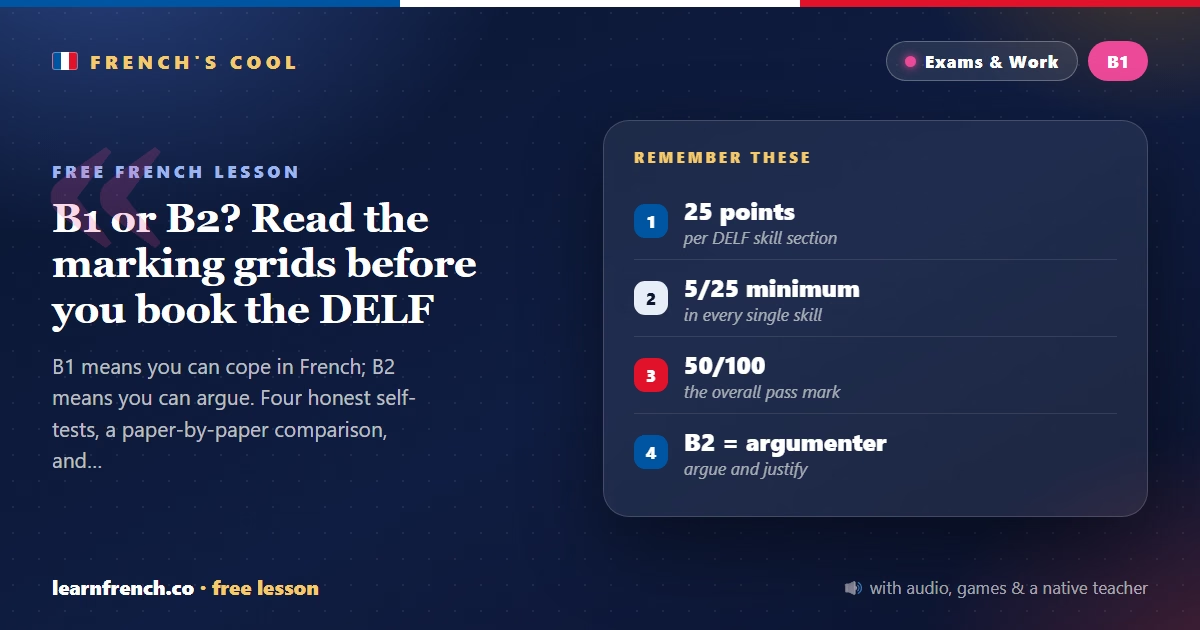
| Pass mark | 50 out of 100 overall, and never below 5 out of 25 on any single paper. That second rule is the note éliminatoire, and it is what kills candidates who decided in advance to sacrifice listening. | |
One caution: the exam formats have been revised in recent years and centres have moved over at different speeds. Download the current sujets de démonstration (“sample papers”) for your level from your own centre before you time yourself against anything. The word minimums and the pass rules above are stable; the exact number of documents and minutes may not be.
Four self-tests. Do them today, not next month.
Listening: one play, one position
Find a real interview on franceinfo or France Inter, made for French adults, not for learners. Play it once. Now, without replaying, tell me the guest’s position and one argument they used. Not the topic. The position and an argument. If you got the subject and a few facts but could not say where the person stood, you are a listener at B1. Understanding the stance on a single pass is B2.
Reading: find the thesis, find the concession
Take an opinion column from Le Monde or Libération. Point at the one sentence that is the author’s actual claim. Then point at the paragraph where the author states the opposing view in order to knock it down. B1 means you understood the sentences. B2 means you saw the architecture.
Writing: 250 words with an objection inside
One hour, no dictionary, no phone. Topic: Faut-il interdire le téléphone portable au collège ? (“Should mobile phones be banned in secondary school?”). Write 250 words. Here is the marker that decides it: does your text contain an objection to your own view, which you then answer? A B1 essay says what you think. A B2 essay says what you think, admits what the other side has right, and explains why it is not enough.
Speaking: the five-second test
This is the clearest of the four, and the one nobody wants to take. Ask a French-speaking friend to disagree with something you have just said. Out of nowhere: Vous ne trouvez pas que c’est un peu exagéré ? (“Don’t you think that is a bit exaggerated?”). You have five seconds. Can you answer, in French, without preparation, without abandoning your position and without your grammar falling apart? Something like Je comprends votre remarque, mais je dirais plutôt que le problème vient d’ailleurs (“I take your point, but I would say instead that the problem comes from somewhere else”).
If you can deliver a prepared opinion beautifully and go silent the moment you are contradicted, you are an excellent B1 candidate. That is not an insult. It is a diagnosis, and it is worth about forty euros of saved fees.
How people choose wrong, in both directions
Over-reaching. This is the common one, and it is rarely vanity. It is a deadline. The university asks for B2. The préfecture asks for B2. So the student enters B2 with a B1 speaking level and hopes the room will be kind. The room is not unkind, it is simply indifferent to your paperwork. A failed B2 costs you the full fee again, plus the wait to the next session, and centres often run only two to four sessions a year with registration closing weeks ahead. You will not have missed one deadline, you will have missed two.
Then there is the part I am obliged to be honest about: the morale. I have seen a failed B2 stop a good learner from speaking French for six months. That is the expensive damage, not the fee. A comfortable B1 at 78/100 is a real diploma, a real morale event, and a precise map of the distance left. You do keep your paper-by-paper scores after a failed B2, so it is not nothing, but you leave with no diploma and a bruise.
Under-reaching. The other error, and I see it in the quiet, hard-working students who read novels in French and argue with strangers online in French and then book B1 because they want a guaranteed win. They pass with 85. Then they discover that the certificate they now hold is not the one the file requires, and they pay again for B2 a year later. If your file genuinely needs B2, a B1 diploma is a very pleasant object that solves nothing.
So the real question, if you need B2 and you are borderline, is not which exam. It is which session. Book B2 for the sitting after next and spend the gap doing timed 250-word essays and unprepared debates. Some centres will let you register for two levels in one session; you pay twice and sit around six hours of exams in a few days, and I have almost never seen it be worth it.
What the DELF is actually used for
- Residence and immigration in France. Language requirements were raised by the 2024 immigration law and phased in from 2026, moving the bar upward for multi-year residence cards, the carte de résident, and naturalisation, with naturalisation now sitting at B2. These rules and their start dates have shifted more than once. Check service-public.fr and your own préfecture, and check which certificates appear on the accepted list, before you book anything.
- University in France. For a licence through the DAP procedure, B2 is the usual requirement, and a DELF B2 normally exempts you from the institution’s own language test. Some Master’s programmes, especially in law, letters and journalism, want C1.
- Quebec and Canadian immigration. Usually assessed by TEF or TCF rather than DELF, on their own scales. Confirm with the programme, never assume.
- Work and CVs. Most employers outside France want evidence that you function, not that you debate. B1 is a perfectly respectable line on a CV.
- Yourself. Entirely legitimate. Some of my best candidates had no external reason at all, and they revised harder than the ones with visas.
One good piece of news: it never expires
The DELF is a diploma, not a score report. It has no expiry date. A DELF B1 obtained in 2019 is still a DELF B1 today and will be in 2050, and this is the real difference between it and the TCF or TEF, which are certificates valid for two years and then gone. You pass once, and it is yours à vie (“for life”).
Two honest caveats. Individual institutions can impose their own freshness rule and ask for a certificate obtained within the last two or three years, even though the diploma itself does not expire, so ask the institution rather than trusting the general principle. And a diploma being permanent does not make your French permanent: the paper from 2019 says what you could do in 2019.
So: go and read the two speaking grids side by side tonight. Then do the five-second test. If you can hold a position under pressure without preparation, book B2 and get to work on the 250-word essay. If you cannot yet, book B1, pass it well, and come back for B2 in twelve months with a diploma already in the drawer and nothing to prove.
If you would rather not guess: I run a 12-lesson DELF preparation course, built around the marking grids and including full mock exams under real timing, with the speaking test done properly, complete with the pushback. By lesson three you will know which box to tick. Bon courage, and choose the exam you can pass, not the one you wish you needed.