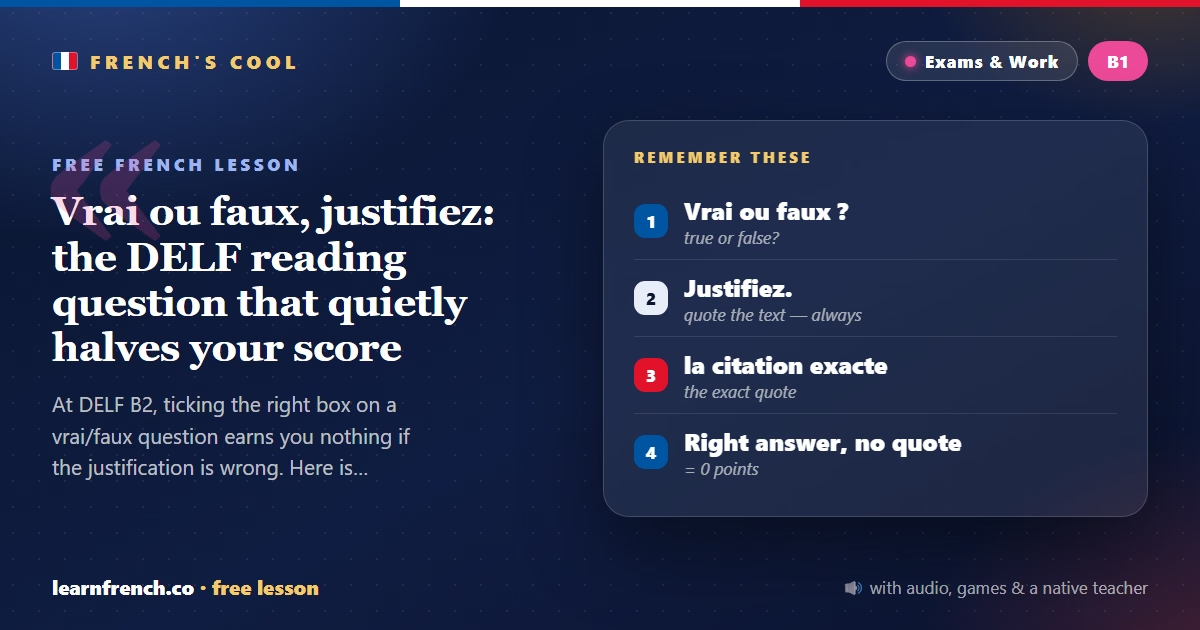
Vrai ou faux, justifiez: the DELF reading question that quietly halves your score
At DELF B2, ticking the right box on a vrai/faux question earns you nothing if the justification is wrong. Here is how the item is actually marked.
What you'll learn
“Halves” is the optimistic version. In most DELF B2 papers, a correct vrai (true) or faux (false) with a bad justification is worth zero. Not half. Zero.
🎬 This lesson in one minute
The quick version — the full lesson is below. More shorts →
I watch this happen every June. A student comes out of the compréhension des écrits (the reading paper) pleased with herself, because she understood the texts and got the true/false items right. Six weeks later the result arrives and the reading score is eleven out of twenty-five. She did understand. She just did not prove it in the way the barème (marking scheme) requires.
What the barème actually says
The instruction on the paper is some version of this:
Dites si les affirmations suivantes sont vraies ou fausses et justifiez votre réponse en citant un passage du texte.
(Say whether the following statements are true or false and justify your answer by quoting a passage from the text.)
And in the corrigé (the marker’s answer key), next to each item, there is a line that most candidates never see. It reads along these lines: 1 point (la réponse seule ne rapporte aucun point ; la justification doit être correcte) – one point, the answer alone earns nothing, the justification must be correct.
Sessions vary a little. Some papers split the point 0,5 for the box and 0,5 for the quote. But the strict version is standard at B2, and since you cannot see which barème you have been given, you must assume the strict one. That single assumption changes how you spend your hour.
| What you wrote | What you score (strict barème) |
|---|---|
| Correct V/F, correct quote | 1 |
| Correct V/F, no justification | 0 |
| Correct V/F, paraphrase instead of quote | 0 |
| Correct V/F, quote from the wrong part of the text | 0 |
| Wrong V/F, correct quote | 0 |
Look at the last row for a second. The quote alone does not save you either. Both halves have to land.
What counts as a justification
A justification is a stretch of the text, copied. Nothing else qualifies.
Not a paraphrase
If the text says beaucoup ont déjà réduit la surface de leurs bureaux and you write “the companies have made their offices smaller”, you have shown comprehension and earned nothing. The examiner is not testing whether you understood; the tick box did that. The justification tests whether you can locate the evidence. Rewriting it in your own words proves you cannot point at it.
Not your own reasoning
This one hurts, because the reasoning is often excellent. “The report wants to regulate remote work, not ban it, so the statement is false” is a perfect analysis. It is also zero marks. Your logic is not in the text, and the text is the only source the marker accepts.
Not a line number on its own
Ligne 7 is not a citation. Some markers are generous, most are not, and you will never know which one you got. Copy the words. If you want to add the line reference as well, fine, but the words must be there.
Put it in quotation marks
Use guillemets (« ») or ordinary inverted commas. This is not decoration. It tells the marker where your copying stops and your own writing starts, and it stops you drifting mid-sentence into paraphrase, which is the commonest way people lose the mark without noticing.
How much to quote
The rule: the shortest stretch that, read completely on its own, settles the statement.
Test it by covering the rest of the text with your hand. Does your quote still decide the question? Then stop. Usually that is one clause. Occasionally half a sentence.
Two adjustments:
- Pronouns. If your quote begins ils y voient un avantage, the marker cannot tell who ils is or what y refers to. Extend backwards until the referent is inside the quote.
- Negation and qualifiers. Never cut off ne… pas, plutôt que, sauf, seulement. Those little words are frequently the entire answer.
Copying the whole paragraph is rarely penalised outright, but it is a bad habit for two reasons: it eats minutes you do not have, and if the block happens to contain a sentence pointing the other way, a strict marker may decide you have not identified anything. Aim for the clause.
A worked example
Here is a B2-level extract. Read it once, properly.
Depuis la pandémie, le télétravail s’est installé durablement dans les entreprises françaises. Selon une étude publiée en mars, 38 % des salariés du secteur tertiaire travaillent à distance au moins un jour par semaine. Les directions y voient une économie de mètres carrés, et beaucoup ont déjà réduit la surface de leurs bureaux. Les salariés, eux, apprécient surtout le temps de trajet gagné. Mais les responsables des ressources humaines s’inquiètent : les jeunes recrues, privées des échanges informels du bureau, mettent nettement plus de temps à devenir autonomes. Un rapport parlementaire recommande donc d’encadrer la pratique plutôt que de l’encourager sans limite.
(Since the pandemic, remote working has settled permanently into French companies. According to a study published in March, 38% of employees in the service sector work remotely at least one day a week. Management sees it as a saving in square metres, and many have already cut their office space. Employees, for their part, mainly appreciate the commuting time saved. But HR managers are worried: young recruits, deprived of the informal exchanges of the office, take considerably longer to become independent. A parliamentary report therefore recommends regulating the practice rather than encouraging it without limits.)
1. Certaines entreprises ont déjà diminué l’espace occupé par leurs bureaux.
The plausible wrong answer: Vrai. Les entreprises réduisent la taille de leurs bureaux pour faire des économies.
The box is right. The candidate has understood perfectly. And the mark is gone, because that sentence appears nowhere in the text. It is a summary. A marker scanning for a copied string finds none, and moves on.
The correct answer: Vrai. « beaucoup ont déjà réduit la surface de leurs bureaux »
Note what is not in the quote: Les directions y voient une économie de mètres carrés. That clause is about the motive, not the action. It is a tempting quote, it sits right next to the good one, and on a strict barème it does not prove the statement.
2. Les salariés apprécient le télétravail parce qu’il leur fait gagner du temps de trajet et parce qu’il les rend plus autonomes.
This is the partially true statement, and it is where the item is designed to catch you.
The plausible wrong answer: Faux. « Les salariés, eux, apprécient surtout le temps de trajet gagné. »
Right box, wrong evidence. The candidate has quoted the half of the statement that is true. Read the answer as the marker does: a claim marked false, supported by a quote confirming it. That reads as a contradiction, and it scores nothing.
The correct answer: Faux. « les jeunes recrues, privées des échanges informels du bureau, mettent nettement plus de temps à devenir autonomes »
When you answer faux, your quote must attack the part of the statement that is false. That is the whole discipline. Everything else is scenery.
3. Le rapport parlementaire demande l’interdiction du télétravail.
The plausible wrong answer: Faux. Le rapport veut seulement contrôler le télétravail, il ne veut pas le supprimer.
Correct, well expressed, zero. It is reasoning, not citation. If you find yourself writing le texte dit que (“the text says that”), stop. You are about to paraphrase.
The correct answer: Faux. « recommande donc d’encadrer la pratique plutôt que de l’encourager sans limite »
And notice that if you had trimmed the quote to « recommande donc d’encadrer la pratique », you would arguably still be fine, but plutôt que de l’encourager sans limite is what makes the contrast explicit. When a qualifier does real work, keep it.
The partially true statement, on its own
Statement 2 is the item type that separates B2 candidates from B1 candidates, so it is worth naming the mechanism. The examiner takes a true fact from the text and welds a false clause onto it, joined by et, parce que, ce qui or donc.
Your eye recognises the true half, feels the click of recognition, and your hand ticks vrai. Or you sense something is off, tick faux correctly, then justify with the half you recognised.
Defence, and it costs you eight seconds: break the statement into its clauses and check each one separately. Draw a slash on the exam paper between them if it helps. If any clause is false, the whole statement is faux, and the quote must target that clause.
Also treat these words as alarms wherever they appear in a statement: tous, toujours, seulement, la plupart, aucun. A text that says 38 % does not support a statement that says tous les salariés.
Timing on the compréhension des écrits
One hour, twenty-five points, two documents. That is roughly two and a half minutes per point, and justification items are the ones that swallow time, because writing a quote by hand is slow.
A budget that works:
- Text 1, 4 minutes reading. One pass, pen in hand, number the paragraphs 1, 2, 3 in the margin. Do not read it three times before you look at the questions. You cannot know what matters yet.
- Text 1, 20 minutes on the questions. Go in order. The questions almost always follow the order of the text, which means if you cannot find question 6, it lives between wherever 5 and 7 came from. Reread that stretch only.
- Text 2, same again: 4 and 20.
- 10 minutes at the end. Not spare time. Checking time.
Spend those last ten minutes on one job: go down the paper and confirm that every single vrai/faux item has words in quotation marks next to it. A blank justification is a guaranteed zero, and there is no partial credit waiting for you. If you have run out of time and are not certain, copy the sentence that seems closest anyway. A wrong quote costs exactly the same as an empty line, which is to say the mark you had already lost.
Two more habits. Never answer a justification from memory once you have read the text; go back and find the words, because your memory reconstructs them into a paraphrase without telling you. And write your V or F clearly, on the line provided. A hedged mark that could be either is read as neither.
The one-line version
Tick the box, then find the clause that makes the box correct, then copy it inside quotation marks, then check that the clause you copied is the one that decides the statement rather than the one next to it. Four moves, maybe forty seconds an item, and it is the cheapest four or five points on the whole paper.
If you want to practise this under real conditions, I run a twelve-lesson DELF preparation course with full mock exams, marked to the actual barème, so you find out now which of your justifications a French examiner would strike through. Rather sooner than in June.