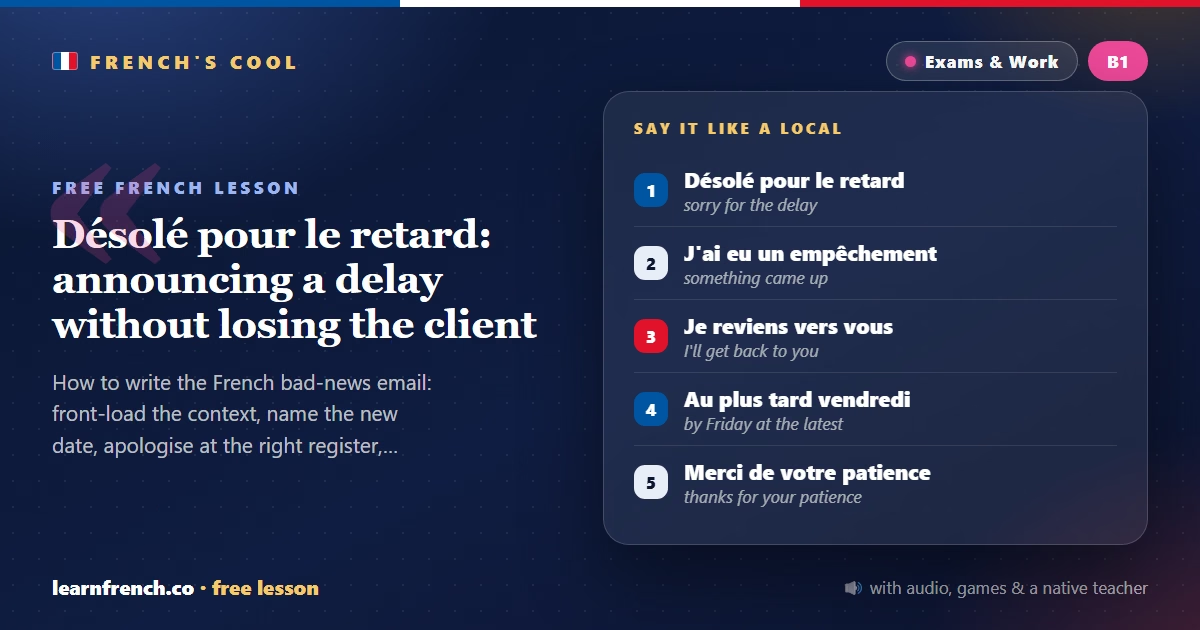
Désolé pour le retard: announcing a delay without losing the client
How to write the French bad-news email: front-load the context, name the new date, apologise at the right register, and commit again. With a full annotated model.
What you'll learn
Half past four on a Thursday, in an office above a warehouse outside Nantes. The supplier has just phoned: the parts are not coming this week. Twelve of us know already. The one person who does not know is the client, and she is expecting a lorry on Tuesday morning.
🎬 This lesson in one minute
The quick version — the full lesson is below. More shorts →
Somebody has to write that email. In my old job that somebody was often me, and I can tell you that the difference between a client who sighs and a client who starts phoning your competitor is about six sentences of French.
Most business-French lessons teach you how to request, confirm and thank. They skip this one, because it is uncomfortable. So let us do it properly.
First, the phrase in the title is not the email
Désolé pour le retard (sorry I’m late) is spoken French. It is what you say walking into a meeting room at 9.05, coat still on. It is warm, it is human, and it is completely wrong as the opening line of a written message to a client. Written French does not open with the apology. It opens with the file.
1. The shape of the French bad-news email
An English delay email often leads with the headline: “Unfortunately your order will be three days late.” Then context, then apology. French inverts the first two moves. You re-establish the shared file, then you deliver the news.
- Le rappel du contexte (the reminder of the context). One sentence. Which order, which date was agreed.
- L’annonce (the announcement). The bad news, with a number in it.
- La cause. One sentence, factual, no self-defence.
- L’excuse, at the right register. See section 3.
- La solution et le nouvel engagement: what you are doing, and a firm new date.
- L’ouverture: you are available.
- La formule de politesse, matched to how you opened.
Here is the trap, and I have watched intermediate learners fall into it every time. Given permission to front-load context, they write three paragraphs of context and the reader reaches the bottom without ever finding out what is actually happening. Context is one sentence. The news comes in the very next one. French politeness is about the order of information, not about hiding it.
2. Announcing the delay
Two workhorse constructions. Learn them as blocks.
Je me permets de vous informer d’un retard sur votre commande.
I’m writing to inform you of a delay on your order.
Je me permets de + infinitive, literally “I allow myself to”, is the standard French marker for taking an initiative towards someone: you are stepping into their inbox and you acknowledge it. You will reuse it constantly: je me permets de vous relancer, je me permets d’insister. Note the grammar: informer quelqu’un de quelque chose.
La livraison sera décalée de trois jours.
The delivery will be pushed back by three days.
Décaler is to shift something along a timeline. The preposition carries the meaning:
- décalée de trois jours – by three days (the size of the shift)
- décalée au vendredi 21 mars – to Friday the 21st (the new point)
Near neighbours: reporter and repousser, both “to postpone”, used with à: le rendez-vous est reporté à mardi.
And now the false friend that costs people money. Un délai is not a delay. It is a lead time or a deadline. Le délai de livraison est de cinq jours means the delivery takes five days, which is normal and fine. A delay is un retard. If you write il y a un délai hoping to confess, your client will read “there is a lead time” and understand nothing is wrong.
3. Owning it without grovelling
French apology has a register ladder, and the rungs are further apart than in English. Pick the wrong one and you sound either cold or oddly intimate.
| French | Register | Use it with |
|---|---|---|
| Désolé pour le retard. | Spoken, casual | A colleague, face to face or in a chat message |
| Je suis vraiment désolé pour ce retard. | Personal, warm, singular | A client you know and speak to by phone; a small business; a long relationship |
| Je vous prie de m’excuser pour ce retard. | Formal, still personal | A client, when you personally are the one responsible |
| Nous vous prions de nous excuser pour ce contretemps. | Formal, institutional | A client, when the company is responsible. The default for most professional situations |
| Veuillez nous excuser pour la gêne occasionnée. | Very formal, impersonal | Notices, mass emails. Correct but cold: it apologises to nobody in particular |
The move from je to nous is doing real work. Je suis vraiment désolé says a person let you down. Nous vous prions de nous excuser says an organisation acknowledges a fault and has the means to fix it. In a client email the second is usually stronger, because it implies a company behind you. Save the je version for someone who would notice its absence.
One thing to avoid outright: Je m’excuse. You hear it everywhere in speech, and every careful French reader winces, because grammatically you are excusing yourself rather than asking to be excused. Never in writing. Je vous prie de m’excuser or veuillez m’excuser.
And do not stack apologies. One apology, once. Saying sorry three times in eight lines reads as panic, and panic makes clients nervous about the new date too.
4. A cause, not an excuse
Give one. A delay with no stated cause sounds like incompetence being hidden. But give it in a single flat sentence and then move on.
- un imprévu – something unforeseen. Nous avons eu un imprévu sur la chaîne de production.
- un contretemps – a hitch, a setback. Slightly elegant, mild. It usually lives inside the apology rather than the explanation.
- une rupture de stock – out of stock. Nous sommes en rupture de stock sur cette référence. (une référence = a product line or item code.)
- un retard de livraison – a delivery delay, typically your own supplier’s. un retard de livraison de notre fournisseur.
- un problème d’approvisionnement – a supply problem.
- un aléa – a contingency, a hazard of the job. Common in project and site French: les aléas de chantier.
Two register notes. Prefer en raison de (owing to) over à cause de: the second leans towards blame. And à la suite de is safer than the very common suite à, which purists still mark as sloppy in written correspondence.
What never goes in: ce n’est pas de notre faute. Even when it is true. Especially when it is true.
5. The recovery move
This is the part learners skip, and it is the part that keeps the client. An apology without a repair is just noise. You need two things: an action already taken, and a new commitment with a date on it.
- Nous avons relancé notre fournisseur ce matin. – We chased our supplier this morning.
- J’ai fait passer votre commande en priorité. – I’ve had your order moved to priority.
- Je vous confirme une nouvelle date de livraison : le vendredi 21 mars.
- Vous recevrez le numéro de suivi dès l’expédition. – You’ll get the tracking number as soon as it ships.
- Je vous tiens informée d’ici jeudi. – I’ll keep you posted by Thursday.
Small but visible detail in that last one: the participle agrees with the person you are writing to. Je vous tiens informé to a man, informée to a woman. Getting this right is one of those things that quietly tells a French reader you are not machine-translating.
Resist the hedge. Sauf nouvel imprévu, la livraison devrait arriver vers la fin de la semaine protects you and destroys the client’s confidence at the same time. Give one date, and make it a date you will actually hit.
6. The complete model
Objet : Commande n° 2214 – nouvelle date de livraison
Madame,
Je fais suite à votre commande du 3 mars, dont la livraison était prévue le mardi 18 mars.
Je me permets de vous informer d’un retard. Notre fournisseur nous a signalé une rupture de stock sur les modules de commande. La livraison sera décalée de trois jours.
Nous vous prions de nous excuser pour ce contretemps.
Nous avons relancé le fournisseur ce matin et votre commande est passée en priorité au conditionnement. Je vous confirme donc une nouvelle date de livraison : le vendredi 21 mars, avant 12 h. Vous recevrez le numéro de suivi dès l’expédition, jeudi.
Je reste à votre disposition si vous souhaitez en discuter par téléphone.
Je vous prie d’agréer, Madame, l’expression de mes salutations distinguées.
Xavier Leroy
Responsable logistique
| Line | What it is doing |
|---|---|
| Objet : Commande n° 2214 – nouvelle date de livraison | The subject line says there is a new date. Never write a vague objet to soften bad news: the client finds out anyway, and now they know you tried to bury it. |
| Madame, | The appel. Madame, on its own, with no surname, is the standard in formal correspondence. The surname belongs after Bonjour in a less formal email, not in front of a Je vous prie d’agréer. |
| Je fais suite à votre commande du 3 mars, dont la livraison était prévue… | The whole context, in one sentence. Je fais suite à = further to, referring back. Note était prévue, imperfect: it was the plan, and the plan has changed. |
| Je me permets de vous informer d’un retard. | The news, second paragraph, first sentence. No cushion, no malheureusement pile-up. |
| Notre fournisseur nous a signalé une rupture de stock. | One sentence of cause. Factual. It names the supplier without blaming them at length. |
| La livraison sera décalée de trois jours. | The number. This is what the client actually needs. |
| Nous vous prions de nous excuser pour ce contretemps. | Its own paragraph, so it is not lost. Institutional register. Said once. |
| Nous avons relancé… votre commande est passée en priorité… | Action already taken, in the past. Not nous allons voir ce que nous pouvons faire. |
| Je vous confirme donc une nouvelle date : le vendredi 21 mars, avant 12 h. | The new commitment. Day, date, time. Je vous confirme is stronger than je pense que. |
| Je reste à votre disposition… | Standard, and here it means something: you are offering to be shouted at by phone. |
| Je vous prie d’agréer, Madame, l’expression de mes salutations distinguées. | The closing repeats the appel, Madame, and never the surname. If you had opened with Bonjour Madame Rousseau, you would close with Bien cordialement instead. Match the two ends. |
7. And when they are late to you
The same speech act, reversed. The verb is relancer, to chase, and the noun is une relance, the chasing email itself. Two lines will do:
Je me permets de revenir vers vous au sujet de la commande n° 2214, dont la livraison était prévue le 18 mars.
Pourriez-vous me confirmer une nouvelle date d’ici vendredi ?
Notice you are not asking for an apology. You are asking for a date, which is the only thing that helps you. And if you need to point out the silence, the neutral form is sauf erreur de ma part, je n’ai pas eu de retour de votre part (unless I’m mistaken, I haven’t had a reply), where un retour means a response. It leaves the other person a door.
Once you can write both directions, you own most of what a French supplier relationship consists of.
Ready to write these for real?
Delay emails are lesson-shaped: small, high stakes, endlessly reusable. I run a 12-lesson Professional French Foundations course at B1, one to one, built for working adults who have to send this kind of message with their own name at the bottom. We work on your actual files, not invented ones. Bring the email you have been putting off since Tuesday.