How to say no in French without ever saying non
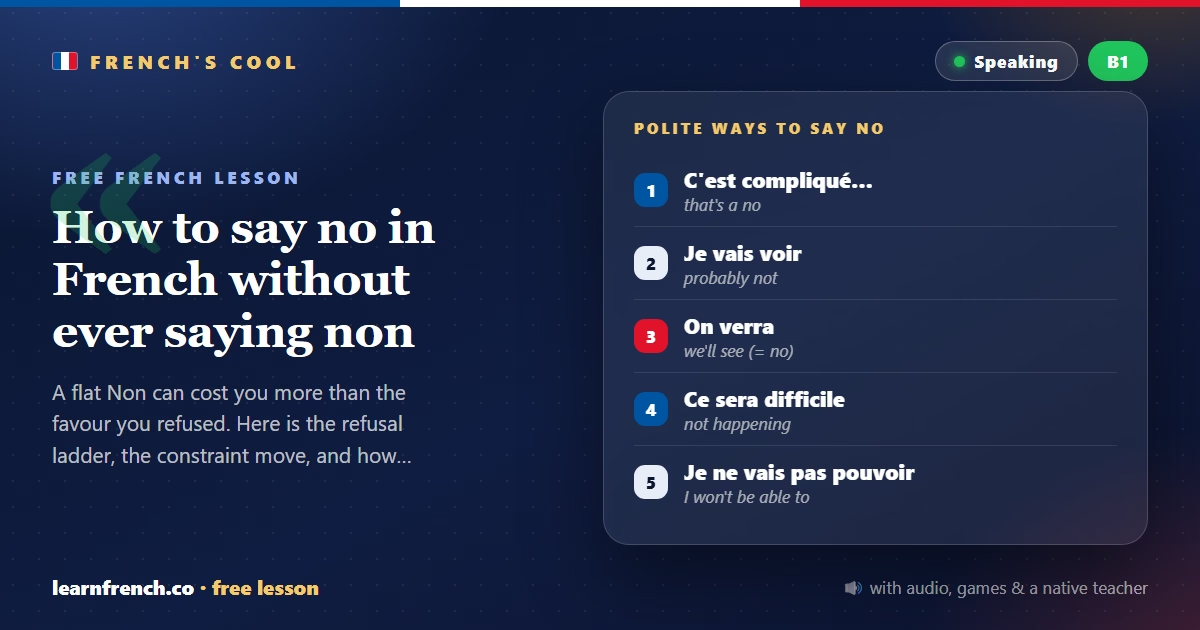
A flat Non can cost you more than the favour you refused. Here is the refusal ladder, the constraint move, and how to say no up, sideways and down at work.
What you'll learn
A learner of mine, a British operations manager in a company just outside Nantes, told me about a Tuesday morning meeting that went sideways. His French colleague asked him to take on an extra site visit. He answered, in perfectly correct French: “Non, ce n’est pas possible.” (“No, that’s not possible.”) Grammatically, nothing to fix. But the room went slightly cool, and for the next fortnight the colleague routed everything through someone else.
🎬 This lesson in one minute
The quick version — the full lesson is below. More shorts →
He had not been rude. He had simply used a shape of refusal that does not exist in French professional speech. And the correction most learners then make, piling on apologies and conditionals until the sentence collapses, is just as costly in the other direction. Too blunt and you look aggressive. Too soft and you look like you cannot be trusted with a decision. This is a register problem, not a vocabulary problem, and it is where most B2 speakers are still losing ground at work.
Why a bare non lands harder than “no”
Here is the trap. You hear non constantly in France. “Ah non !”, “Non mais attends”, “C’est pas mal, non ?” It is everywhere, so it feels neutral. It is not neutral in the slot where you need it.
English softens refusals with grammar and set phrases. “I’m afraid not.” “I don’t think we can.” “That might be tricky.” Those words carry almost no meaning; they are packaging. You can refuse in English and give no reason at all, because the packaging has already done the polite work.
French softens refusals with argument. The expected shape is not refusal + cushion but refusal + reason. A refusal that arrives with no justification is read as a decision rather than an answer, and decisions belong to whoever has the authority to make them. So a bare non does something you did not intend: it quietly claims rank. That is what your colleague heard. Not “I can’t”, but “I have decided, and I do not owe you an explanation.”
There is a second mechanic worth knowing. French refusals often move the obstacle off the person and onto the situation. Compare “Je ne peux pas” (“I can’t”) with “Ce n’est pas possible” (“it isn’t possible”). The second one is not about you. Nobody is refusing anybody; the world is simply arranged badly this week. Most of the ladder below runs on that trick.
The refusal ladder
Four rungs, softest to firmest. They are not four ways to say the same thing. Each one signals something different about how much room is left.
1. Je crains que ce ne soit pas possible
“I’m afraid that won’t be possible.” The most cushioned rung. Craindre que takes the subjunctive, so être becomes soit; that little formality is part of the effect.
Signals: the door is closed, and I am handling you carefully. This is client language, hierarchy language, written language. Use it in an email to an external partner or to someone well above you. Say it to the colleague at the next desk and you sound like a bank letter: correct, cold, and slightly odd.
2. Ce sera difficile / Ça va être compliqué
“That’ll be difficult” / “that’s going to be tricky.” Compliqué is the spoken version and you will hear it ten times a day.
Signals: negotiable, in theory. In practice, when a French colleague says ça va être compliqué, you have been refused. The crack in the door is a courtesy, not an invitation. English natives routinely hear this as “maybe” and come back two days later, which is how people end up annoyed with each other. Two rules follow. When you hear it, treat it as no unless the other person reopens it. When you say it, understand you have not fully closed the matter, so do not use it if you mean a hard no.
3. Je ne vais pas pouvoir
“I’m not going to be able to.” The workhorse, and the one I would put in your mouth first. The near future does the softening: je ne peux pas is a fact about you, je ne vais pas pouvoir is a fact about the coming week.
Signals: settled, personal, no drama, no offence. It expects a reason immediately after it, and it works up, down and sideways. If you learn one rung, learn this one.
4. Ce n’est pas envisageable
“That’s out of the question.” Formal, flat, final. It is the register of a decision being announced.
Signals: stop asking. Perfectly normal from a manager, from a legal or compliance position, or about something genuinely non-negotiable. Aimed upwards at your N+1 (your line manager, real French office vocabulary) it reads as insubordinate. Handle it the way you would handle a fire extinguisher: useful, rarely.
Give the constraint, not the refusal
Now the move that does most of the work, and the one almost nobody teaches. Very often the French speaker never produces a refusal at all. They produce the constraint and let you do the arithmetic.
“J’ai déjà trois dossiers cette semaine.” (“I’ve already got three files on this week.”)
No non. No je ne peux pas. Just a fact, laid on the table, from which the answer follows. This is not evasion; it is the standard form. It keeps the refusal impersonal, it gives the other person something concrete to argue with if they want to, and it leaves both of you free to renegotiate without anyone having to climb down.
Other everyday versions: “Je suis déjà pris jusqu’à jeudi” (“I’m booked until Thursday”, prise if you are a woman), “J’ai le budget à boucler pour vendredi” (“I’ve got the budget to close by Friday”), “Sur ce délai, je ne peux pas garantir la qualité” (“at that deadline I can’t guarantee the quality”). Note tenir un délai, to meet a deadline, and sortir un dossier, to get a file out of the door. Both are ordinary office French and both make you sound like you have worked in an office in France.
When I worked in logistics, I heard perhaps three explicit refusals a year. What I heard constantly was “Le camion part à seize heures”. The lorry leaves at four. Nobody said no. Everybody understood.
Refusing up, sideways and down
These are three different speech acts. Using the wrong one is the most common register injury I repair.
Upwards
French workplaces are, on the whole, more vertical than British or American ones. You rarely refuse your N+1 the task. You refuse the conditions, and you hand the decision back:
“Pour vendredi, je ne vais pas pouvoir faire les deux. Si je prends celui-ci, il faut décaler le dossier Legrand. Je vous laisse arbitrer.” (“For Friday I won’t be able to do both. If I take this one, the Legrand file has to move. I’ll let you decide.”)
Arbitrer, to arbitrate between competing priorities, is genuine corporate French and it is exactly the right verb. You have not refused anything. You have made the trade-off visible and returned it to the person whose job it is to choose. That reads as competent, not obstructive.
Sideways
Between peers, usually tu, the currency is reciprocity. A sideways refusal is banked and remembered, so you soften it with a return date rather than with politeness:
“Là, je ne peux pas, j’ai trois dossiers à sortir avant vendredi. Lundi, sans problème.” (“Not right now, I’ve got three files to get out before Friday. Monday, no problem.”)
Short, concrete, and it closes with what you can do. That last part is not optional.
Downwards
Here, and only here, a plain non is normal, and the reason can be one clause: “Non, on reste sur la version actuelle : le budget est bouclé.” (“No, we’re staying with the current version, the budget is closed.”)
The failure downwards is the opposite one. A manager who hedges, who says “Ce serait peut-être bien si on pouvait éventuellement…”, is not being kind. In French they are read as someone who has not decided, and teams find that far more unsettling than a clear no.
The counter-offer is the professional norm
Refuse the what, offer an alternative. In French professional speech a refusal with nothing after it feels unfinished, the way a letter feels unfinished without a closing formula.
- “En revanche, je peux vous envoyer la première partie mardi.” (“On the other hand, I can send you the first part on Tuesday.”)
- “Ce que je peux faire, c’est vous préparer une note d’ici jeudi.” (“What I can do is prepare you a note by Thursday.”)
- “Je vous propose plutôt qu’on en reparle après la réunion de service.” (“I’d suggest instead that we come back to it after the team meeting.”)
A note on en revanche. In speech, par contre is far more common and nobody will blink. In writing, and with people who care about such things, en revanche is the safer choice. Keep both, deploy accordingly.
The other failure: too much cushion
Learners who have been burned once by bluntness tend to overcorrect, and the result is worse than the original problem:
“Je suis vraiment désolé, j’aurais tellement aimé pouvoir vous aider, mais je crains qu’il ne me soit malheureusement pas vraiment possible de m’en occuper cette semaine, si cela ne vous dérange pas trop.”
Every word is correct. The effect is dreadful. It reads as either weak or shifty, as though the real reason is being kept back. Three specific things go wrong.
Apology inflation. English “sorry” is lubricant, used dozens of times a day. French désolé is closer to an admission of fault. Say it three times in one refusal and you have confessed to something. Once, or not at all.
Stacked conditionals. One conditional distances you politely. J’aurais aimé, ce serait, il faudrait in the same breath and you sound as if you are refusing to sign your own sentence.
Hedge pile-up. Peut-être, un peu, si possible, je ne sais pas si, all at once. Each one alone is fine. Together they read as someone circling the point because the real answer is embarrassing.
The instinct to fix: the politeness should sit in the reason and the counter-offer, not in the padding.
Before and after
| Too blunt (English shape) | What a French colleague says | What changes |
|---|---|---|
| Non, je n’ai pas le temps. | Cette semaine, j’ai trois dossiers à sortir. Je peux m’en occuper lundi, si ça vous va. | Constraint replaces refusal; a date replaces a wall. |
| Non, c’est impossible. | Sur ce délai, ce ne sera pas possible. En revanche, je peux vous livrer la moitié pour vendredi. | The obstacle is the deadline, not you. Counter-offer attached. |
| Non, votre idée ne marche pas. (to your N+1) | Je vois la logique. Ce qui me gêne, c’est le calendrier. | You object to one component, not to the person. |
| Non, je ne peux pas faire ça pour demain. (to your N+1) | Pour demain, je ne peux pas garantir la qualité. Si c’est vraiment demain, je vous propose une version courte. Je vous laisse arbitrer. | Refuse the conditions, hand back the decision. |
| The over-soft version: Je suis vraiment désolé, je ne sais pas si ce serait possible… | Je ne vais pas pouvoir, j’ai déjà deux réunions ce jour-là. Désolé. | One apology, at the end, after the facts. |
Notice what survives every rewrite: a reason, and something you can do. Get those two into the sentence and you can be as firm as you like. The firmness was never the problem.
If this is the layer of French you keep hitting at work, refusing, pushing back, negotiating a deadline without damaging a relationship, that is precisely what my Professional French Foundations course is built around: twelve one-to-one lessons at B1, working on the French you actually need on a Tuesday morning. Get in touch and tell me what your last difficult conversation was. We will start there.