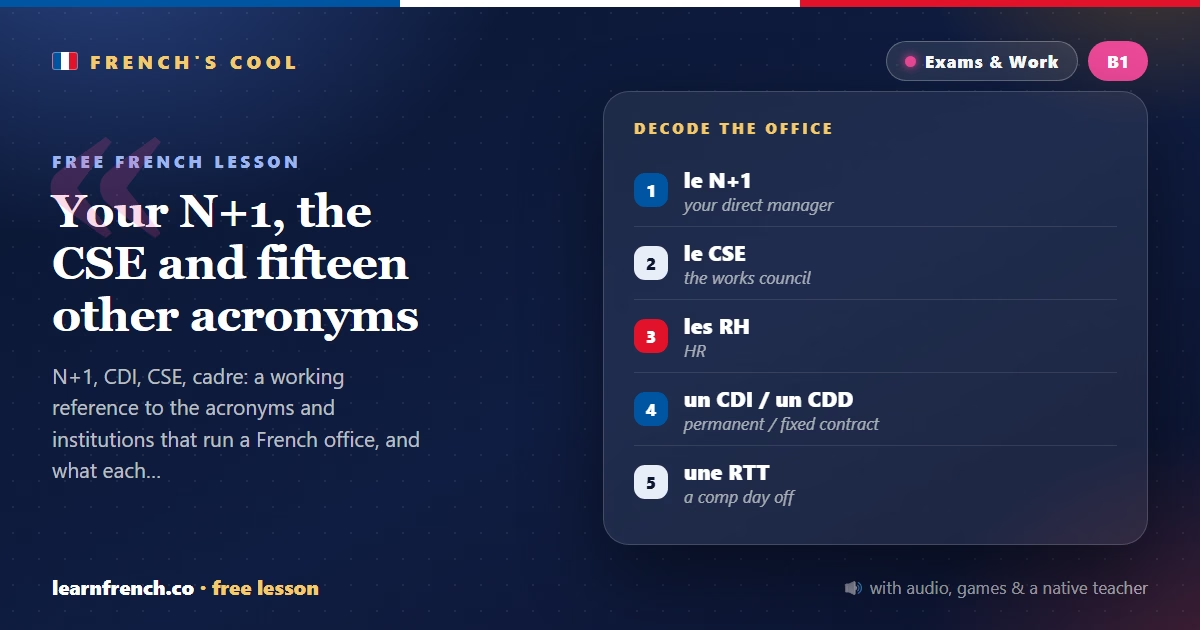
Your N+1, the CSE and fifteen other acronyms
N+1, CDI, CSE, cadre: a working reference to the acronyms and institutions that run a French office, and what each one actually means for you.
What you'll learn
Second week in the Nantes office. An email arrives from le service RH (the HR department), and it is four lines long:
🎬 This lesson in one minute
The quick version — the full lesson is below. More shorts →
Bonjour, merci de faire valider votre demande de congés par votre N+1 avant le 15. Le CSE distribuera les chèques-vacances en juin. Cordialement,
You understand every word except the three that actually carry the message. That is the particular cruelty of French office language: the grammar is easy, the vocabulary is a wall of capital letters, and nobody will explain it to you because everyone assumes you were born knowing.
So here is the reference I wish I had handed to every colleague who arrived from abroad when I worked in logistics. Keep it open in a tab.
You are N. Everything else is measured from you
On a French organigramme (org chart), your own level is N. From there:
- N+1: your direct line manager, votre supérieur hiérarchique direct.
- N+2: your manager’s manager.
- N-1: someone who reports to you.
Why speak this way? Three reasons, and they are all practical. First, job titles in France vary wildly from one company to the next: a responsable, a chef de service and a directeur de pôle may sit at exactly the same level in three different firms. The level is stable, the title is not. Second, it names a position, not a person, which is convenient when you are writing a procedure that will outlive everyone in it. HR forms genuinely have a box marked Visa N+1. Third, the alternatives are awkward: mon chef is blunt and slightly old-fashioned, mon supérieur hiérarchique sounds like a court document, and mon manager is an anglicism that half the office uses and the other half quietly resents.
Say it out loud as enne plus un. Useful sentences:
- Je dois voir ça avec mon N+1. (I need to check that with my line manager.)
- C’est mon N+2 qui décide. (My manager’s manager is the one who decides.)
One honest note: N-1 is mostly HR-speak. Spoken French prefers J’encadre cinq personnes (I manage five people).
Contracts: what you actually signed
| Term | What it stands for | What it actually means for you |
|---|---|---|
| CDI | contrat à durée indéterminée | Open-ended contract, the French default and the one landlords and banks want to see. Ending it requires a legal reason and a notice period (préavis), typically one to three months. |
| CDD | contrat à durée déterminée | Fixed-term. It is only legal for specific reasons: replacing an absent employee, a temporary peak in activity, seasonal work. Generally capped at 18 months including renewals, with a maximum of two renewals. At the end you normally receive an indemnité de fin de contrat, known to everyone as the prime de précarité, worth 10 % of your total gross pay. |
| Période d’essai | (trial period) | Either side can end the contract with very short notice. On a CDI: two months for employés et ouvriers, three for agents de maîtrise et techniciens, four for cadres, renewable once if your convention collective allows it and your contract says so. |
| Alternance | (work-study) | An umbrella word, not a contract. It covers the contrat d’apprentissage (leading to a diploma, mainly for under-30s) and the contrat de professionnalisation (leading to a professional qualification, open more widely). You alternate weeks between the training centre and the company, and your pay is a percentage of the SMIC set by age and year of study. |
| Stage | (internship) | You are a student on placement, not an employee. Beyond two months in the same academic year the company must pay a gratification, set at 15 % of the plafond horaire de la Sécurité sociale, which lands a little over 4 € an hour. Not a salary, and no unemployment rights. |
| Convention de stage | (internship agreement) | The three-way document signed by you, your school and the company. Without it the placement is illegal. This is why French companies ask a foreign intern, first thing, Vous avez une convention ? |
| Rupture conventionnelle | (negotiated termination) | You and the employer agree to end a CDI. It requires official validation, guarantees you at least the statutory severance, and, crucially, keeps your right to unemployment benefit. Half the office has done one. |
The bodies: who sits where
| Acronym | What it stands for | What it actually means for you |
|---|---|---|
| CSE | comité social et économique | The elected staff body, compulsory from 11 employees. From 50 employees it must be consulted on major decisions and gets its own budget. In daily life it is the reason you get chèques-vacances, cinema tickets and subsidised activities. Created in 2017 to replace the old délégués du personnel, comité d’entreprise and CHSCT. |
| Le CE | comité d’entreprise | Abolished, but still said constantly by anyone over forty. If a colleague says demande au CE, they mean the CSE. |
| RH | ressources humaines | The HR department. Je passe voir les RH means the people; le service RH means the function. |
| DRH | directeur / directrice des ressources humaines | Careful, it is two things: le DRH or la DRH is the head of HR, la DRH can also be the whole HR directorate. Context decides. |
| CODIR | comité de direction | The management committee that meets weekly or monthly. When someone says ça passe en comité, this is usually what they mean. |
| COMEX | comité exécutif | The top executive committee in a larger group. Above the CODIR, further from you. |
| Prud’hommes | conseil de prud’hommes | The employment tribunal, staffed by elected employer and employee representatives. Aller aux prud’hommes is the standard threat in a bad separation. |
| France Travail | (ex-Pôle emploi) | The public employment service, renamed in 2024. Where you register for unemployment benefit. |
Pay and paperwork
| Acronym | What it stands for | What it actually means for you |
|---|---|---|
| SMIC | salaire minimum interprofessionnel de croissance | The legal minimum wage, set per hour and revalued at least every 1 January. Somewhere north of 1 800 € gross a month for a 35-hour week, but look up the current figure rather than trusting any article, including this one. Pronounced as a word: smic. |
| Brut | (gross) | What French salaries are always quoted in, usually as an annual figure: 38 K€ brut annuel. If an offer gives you a number with no adjective, it is brut. |
| Net | (take-home) | Rough rule of thumb: about 78 % of brut if you are non-cadre, about 75 % if you are cadre. Income tax is then withheld on top, at source, so look for the line net à payer après impôt. |
| Bulletin de paie | (payslip) | Also called fiche de paie. Legally required every month, and you should keep every single one for life: they are your proof of contributions when you claim a pension. |
| RTT | réduction du temps de travail | Extra days off compensating hours worked above 35 per week, or the days that bring a forfait jours down to its annual limit. Not automatic and not universal: RTT exists only if a company or branch agreement creates it. Je pose un RTT vendredi. |
| CP | congés payés | 2.5 jours ouvrables per month worked, so 30 days, so five weeks. The trap: jours ouvrables counts Saturday, which is why one week off costs you six days. The verb is poser: je pose une semaine en août. |
| Mutuelle | complémentaire santé | Top-up health insurance covering what the Sécu does not. Since 2016 every employer must offer a collective scheme and pay at least half. Joining is normally compulsory, with a few exemptions. |
| URSSAF | Unions de recouvrement des cotisations de sécurité sociale et d’allocations familiales | The body that collects social contributions. As an employee you never deal with it, your employer does. As a freelancer it becomes the most important word in your life. Feminine, pronounced as a word: l’Urssaf. |
| TR | titres-restaurant | Lunch vouchers, universally called tickets resto. The employer pays between 50 % and 60 % of the face value. |
| NDF | note de frais | Expense claim. J’ai passé une note de frais. Keep the receipts. |
Cadre: the word that is not “manager”
This one deserves its own section, because the instinct to translate cadre as “manager” or “executive” will mislead you in both directions.
Cadre is a status, defined by your convention collective (the sector-wide collective agreement) and written on your contract and payslip. It is a historical category inherited from the 1947 executives’ pension scheme, and it still carries concrete consequences: a four-month période d’essai, usually a three-month préavis, frequently a forfait jours (you are paid for a number of days a year, up to 218, not for hours), an employer contribution to prévoyance insurance, access to the APEC job service, higher pension contributions and therefore a thinner net.
What it does not confer is authority over anybody. In the warehouse where I worked, the chef d’équipe ran a team of thirty on the night shift and was agent de maîtrise, not cadre. Two floors up, the transport planner sat alone with a spreadsheet, managed nobody, and was cadre. Both arrangements were completely normal.
So: cadre means something close to “salaried professional on the senior status track”. If you want to say someone runs a team, French now borrows the English word: elle est manager de l’équipe support. And cadre dirigeant is different again, a narrow legal category for senior executives who fall outside working-time rules entirely. Between the two sit the ETAM (employés, techniciens et agents de maîtrise), which is where a great many jobs actually live.
When someone tells you je suis cadre, they are telling you about their contract and their social position, not their headcount.
Spoken shortcuts
| Word | Full form | How it is used |
|---|---|---|
| PDG | président-directeur général | Strictly, the chairman of the board who is also chief executive in an SA. Loosely, everyone’s word for the very top boss. |
| DG | directeur général / directrice générale | Chief executive. DGA is the deputy. |
| Dispo | disponible | Available. Tu es dispo jeudi 14 h ? |
| Réu | réunion | Meeting. Je sors de réu. |
| Un point | (a catch-up) | A short working meeting. On fait un point demain ? Nothing to do with points or scores. |
| La boîte | (the company) | Informal but universal. Ça fait six ans que je suis dans la boîte. |
| Visio | visioconférence | Video call. Related: en présentiel (on site) and en distanciel or en télétravail (remote). |
| MAJ | mise à jour | Update. Written far more than spoken. |
| CA | chiffre d’affaires or conseil d’administration | Revenue, or the board. Only context tells you which, and the difference matters. |
Two small things that will save you embarrassment. Most of these are spelled out letter by letter (cé-dé-i, cé-esse-eu, pé-dé-gé), but SMIC and URSSAF are pronounced as words. And they carry gender: un CDI, un CDD, le CSE, le SMIC, l’Urssaf (feminine), une réu, un RTT for a single day off but la RTT for the scheme itself.
You do not need to memorise this page. You need to recognise these words fast enough not to lose the sentence around them, and that comes from meeting them in real emails, real meetings and real payslips.
That is exactly what my Professional French Foundations course does: twelve one-to-one lessons at B1, built around the French your working week actually contains, from writing to your N+1 to reading your own bulletin de paie without flinching. If you work with French colleagues, or plan to, come and talk to me.