A Weekend in Paris: The French You’ll Actually Use
Two days, one city, and just enough French to make it click. You don’t need to be fluent for a Paris weekend — you need the right phrases at the right moments . Here’s a Friday-to-Sunday walk-through, with the French you’ll actually say (tap 🔊 to hear each one), and where to dig deeper on…
What you'll learn
Two days, one city, and just enough French to make it click. You don’t need to be fluent for a Paris weekend — you need the right phrases at the right moments. Here’s a Friday-to-Sunday walk-through, with the French you’ll actually say (tap 🔊 to hear each one), and where to dig deeper on this site.
🗼 The one habit
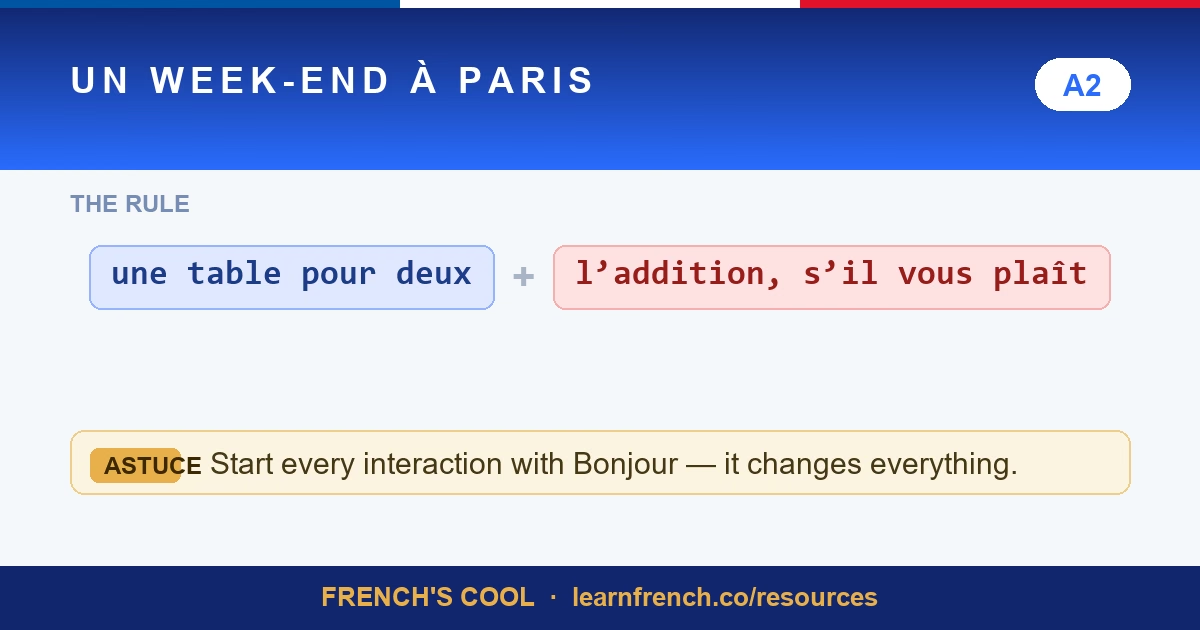
Bonjour before every request — in the café, the boulangerie, the museum queue. It’s the key that opens Parisian politeness.
Friday evening — arriving
From the airport or Gare, the métro or RER gets you in. Buy a ticket, find your line:
Full transport words on les transports and the RATP/RER acronyms.
Friday night — dinner
The whole restaurant playbook: au restaurant.
Saturday — museums & sights
Tip: many museums are free the first Sunday of the month — a very French perk (see arts & culture).
Saturday afternoon — getting around & shopping
Directions in full: la ville & directions.
Sunday — the café & goodbye
End slow, like a Parisian: a coffee, a croissant, watching the street.
Heading further into France after? Read the travel phrasebook and, if you’re staying, the moving-to-France guide.
✍️ Paris-ready quiz
A book of métro tickets = un ___ de tickets. (transport)
Show answer
carnet
« L’addition, s’il vous plaît » means… (restaurant)
Show answer
The bill, please
Museums are often free the first ___ of the month. (culture perk)
Show answer
Sunday (dimanche)
Play the Quiztap to start · quick practice from this material
Loading the quiz…
The 48-hour framework: what fits, what waits for next time
A weekend gives you roughly 20 waking hours of time in Paris — enough to see Paris properly if you treat it as two themed days rather than a checklist sprint. Day one, the classics: start early at Notre Dame (the exterior and the rebuilt spire, then the Île de la Cité streets), cross to the Latin Quarter for a café stop, walk the Jardin du Luxembourg, and give the afternoon to ONE museum — the Louvre or the musée d’Orsay, never both; short on time means choosing depth over coverage. Evening: a Seine river cruise at sunset does more for your views of Paris per euro than any rooftop. Day two, the villages: Montmartre in the morning before the crowds (the streets of Paris at their most picturesque), then the Marais for lunch and shopping, ending at the Eiffel Tower at dusk when the lights start. That’s the best of Paris in 2 days without the death-march feeling — a walking tour of two neighborhoods beats a bus tour of ten attractions every time.
The practical math: the Paris Museum Pass pays off from three museums in 48 hours — for a first weekend, skip it and book ONE timed entry instead (the queue you skip is worth more than the discount). Metro from Charles de Gaulle to central Paris runs ~50 minutes on the RER B; padding your trip to Paris with airport time honestly is the difference between a relaxed itinerary and a rushed one. Any square in Paris rewards ten unplanned minutes — build slack into the plan, because the guide to Paris that matters most is the one you improvise between fixed points. And bring the bonjour ritual from our travel phrases lesson: a touristy weekend conducted in even survival French gets warmer service at every counter, and explore Paris becomes a French-speaking exercise you didn’t have to schedule. You’ll be back to Paris anyway — everyone is — so leave the bucket list incomplete on purpose: Versailles, Sainte-Chapelle at concert hour and a 3-day Paris of slow mornings all improve with a return ticket.
FAQ
Is a weekend enough for Paris?
Enough for the essential double-bill — classics day plus villages day — and exactly the right length to fall for the city. Enough to finish Paris? Nobody’s managed that yet.
Is $1000 enough for a week in Paris?
Post-flight, yes with care: budget hotels/hostels €60–120 a night, bakery breakfasts, prix-fixe lunches (the €15–20 formule is France’s best deal) and picnic dinners. A weekend on that budget is comfortable.
What is frowned upon in Paris?
Skipping bonjour before any request, loud conversation in restaurants, eating on the métro, and demanding menu changes. Open every exchange with « Bonjour, excusez-moi… » and Paris softens noticeably.
What is a good weekend trip from Paris?
Versailles (40 min, RER C) for the palace day; Giverny in season for Monet’s gardens; Reims for champagne cellars — all doable as day-trips, all better with a booked morning slot.
The full weekend in Paris itinerary (with the French to use)
Here’s a complete weekend in Paris itinerary — a realistic Paris itinerary for two to three days that mixes the must-see sights with the exact French phrases you’ll need at each stop. It’s designed so you actually use your French while you visit Paris, not just tick off monuments.
Day 1 — the classics: Eiffel Tower & the Seine
Start big. See the Eiffel Tower early (fewer crowds), then walk the Seine river toward the Champs-Élysées and the Arc de Triomphe. A Seine boat cruise at dusk is the classic first-evening move.
- Buying a ticket: « Un billet pour la tour Eiffel, s’il vous plaît. »
- Asking a photo: « Vous pouvez me prendre en photo ? »
- On the metro: « Un carnet, s’il vous plaît » (or a Navigo pass) gets you around Paris cheaply.
Day 2 — art & old Paris: Louvre, Tuileries & the Marais
Give the morning to the Louvre (book a timed slot; head straight for the Mona Lisa, then wander). Stroll the Tuileries garden, cross to Notre-Dame on the Île de la Cité, then lose yourself in the Marais — Place des Vosges, boutiques and falafel on rue des Rosiers.
- At the musée: « Où est la sortie ? » (where’s the exit) and « Un audioguide en anglais, s’il vous plaît. »
- Ordering a pastry: « Je voudrais un pain au chocolat, s’il vous plaît. »
- In a shop in the Marais, remember rule #1: greet first — « Bonjour ! » — before anything else.
Day 3 — Montmartre, a café, and maybe Versailles
Climb to Montmartre for the Sacré-Cœur basilica and the artists’ square (Place du Tertre). Then do the most Parisian thing of all: sit in a café, order slowly, and watch the street. Have extra time? Versailles is a 40-minute train ride and an easy day trip.
- At the café: « Un café et un croissant, s’il vous plaît. » Then « L’addition, s’il vous plaît. » to pay.
- Getting to Versailles: « Un aller-retour pour Versailles, s’il vous plaît. »
Grab the essential travel phrases for every one of these moments on the travel vocabulary charts and the greetings lesson.
Getting around Paris
The metro is the fastest way around Paris — 14 lines, cheap, and a train every few minutes. Buy a carnet of tickets or a Navigo pass, keep your ticket until you exit, and walk between close sights along the Seine. Central neighborhoods like the Marais, Saint-Germain and the Tuileries area are very walkable.
Weekend in Paris itinerary FAQ
Is a weekend enough for Paris?
A weekend is enough to see the highlights — Eiffel Tower, Louvre, Notre-Dame, Montmartre and a Seine cruise — if you plan tightly and stay central. You won’t see everything, but a focused two- to three-day in Paris plan like the one above covers the essentials comfortably.
What is frowned upon in Paris?
Not saying « bonjour » before you speak, being loud, and expecting everyone to switch to English. A little French — even just bonjour, s’il vous plaît and merci — instantly changes how Parisian shopkeepers and waiters treat you. It’s the single best travel tip for Paris.
What is a good weekend trip from Paris?
Versailles (palace and gardens) is the classic half-day escape. With more time, Giverny (Monet’s garden), the Loire châteaux, or Reims in Champagne all make excellent trips around Paris.
How much French do I need for a weekend in Paris?
Very little to get by, but a handful of polite phrases transforms the trip. Learn greetings, numbers, « je voudrais… », and how to ask for directions and the bill. Everything you need is in this lesson and the linked resources.
🧰 Your Paris weekend kit
Every phrase set from this guide:
🎯 More practice — translation — put it into French
Translate into French: « A book of tickets, please. » (translation)
Show answer
Un carnet de tickets, s’il vous plaît.
Translate into French: « Which line is it for the Louvre? » (translation)
Show answer
C’est quelle ligne pour le Louvre ?
Translate into French: « A table for two, please. » (translation)
Show answer
Une table pour deux, s’il vous plaît.
Translate into French: « What do you recommend? » (translation)
Show answer
Qu’est-ce que vous me conseillez ?
Translate into French: « The bill, please! » (translation)
Show answer
L’addition, s’il vous plaît !
Planning the trip? Book a free lesson and prep the essentials →
🎮 Practise this lesson
Games built from this exact page — turn what you just read into play:
🧩 Sentence Builder rebuild these sentences
🎧 Listening Game which sentence do you hear?
🎬 This article in 20 seconds
The quick version — the full detail is below. More shorts → Open this short as a page — transcript included →