Aller — to go | French Verb Chart
On this page
🖨️ Print-friendly: use Ctrl+P (⌘P) or your browser menu to print this chart cleanly.
📚 This is the overview. « aller » is taught level by level — pick your CEFR level below for a full lesson (explanation, pronunciation, exercises & games).
Aller conjugation made simple: full conjugation charts to conjugate the French verb aller (to go) in every major tense — présent, passé composé, imparfait, futur and more — with audio for each form. Aller is the go-to irregular for the near future (« je vais + infinitive »), so this is a conjugation to master early.
Présent (Indicatif)
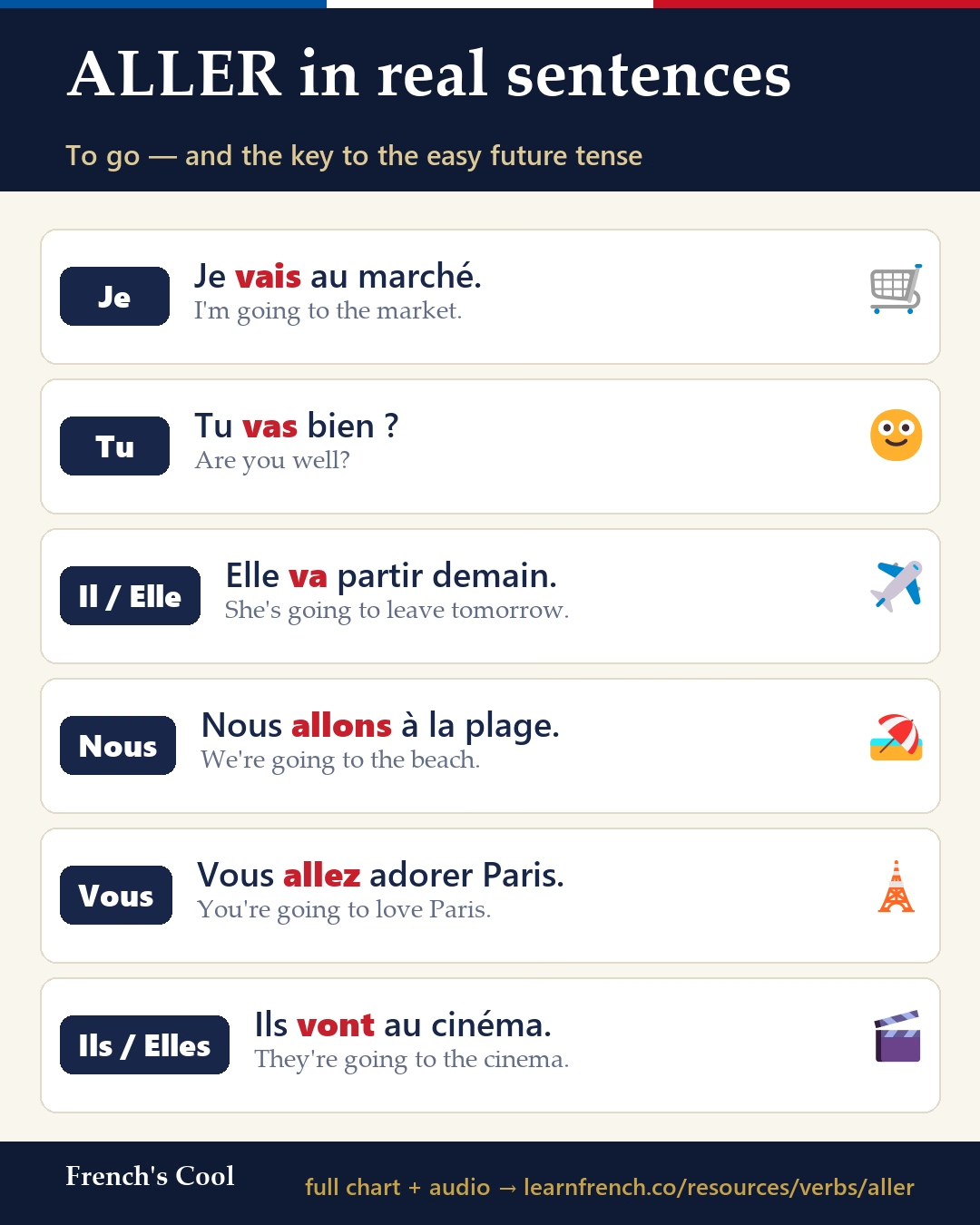
- je vaisI go
- tu vasyou go
- il / elle vahe / she goes
- nous allonswe go
- vous allezyou go
- ils / elles vontthey go
Passé composé (Indicatif)
- je suis allé(e)I went
- tu es allé(e)you went
- il / elle est allé(e)he / she went
- nous sommes allé(e)swe went
- vous êtes allé(e)(s)you went
- ils / elles sont allé(e)sthey went
Imparfait (Indicatif)
- j’allaisI was going
- tu allaisyou were going
- il / elle allaithe / she was going
- nous allionswe were going
- vous alliezyou were going
- ils / elles allaientthey were going
Futur simple (Indicatif)
- j’iraiI will go
- tu irasyou will go
- il / elle irahe / she will go
- nous ironswe will go
- vous irezyou will go
- ils / elles irontthey will go
Conditionnel présent
- j’iraisI would go
- tu iraisyou would go
- il / elle iraithe / she would go
- nous irionswe would go
- vous iriezyou would go
- ils / elles iraientthey would go
Subjonctif présent
- que j’aillethat I go
- que tu aillesthat you go
- qu’il / elle aillethat he / she goes
- que nous allionsthat we go
- que vous alliezthat you go
- qu’ils / elles aillentthat they go
Impératif, Participe & Infinitif
- allerinfinitive
- allantpresent participle
- en allantgerund (gérondif)
- allépast participle
- va · allons · allezimperative
- êtreauxiliary in compound tenses
📈 « aller » from A1 to native
The same verb grows with your level — from your first words to real native slang.
🎬 The 20-second version
Five phrases with « aller » — guess before the reveal. Practise with the free games → Open this short as a page — transcript included →
📘 How to use Aller
- Movement to a place: je vais à Paris, tu vas au marché — always with a destination (use à / au / à la).
- Futur proche: aller + infinitive = going to do — Je vais manger (I’m going to eat). The everyday way to talk about the future.
- Health & greetings: Comment ça va ? Ça va bien.
- Takes être in the passé composé: je suis allé(e).
🔑 Key forms
🔊 Common expressions
💡 Nuances & good to know
- aller builds the near future (futur proche): je vais partir = I’m going to leave.
- aller for health: ça va ? / comment allez-vous ? — and ça me va = that works for me / that suits me.
- Places: aller à + city, aller en + feminine country, aller au + masculine (au Japon).
🔊 More real-life examples
🇬🇧 Aller in plain English: the verb built from three verbs
Aller — “to go” — is the strangest of the commonly used verbs in french, because its conjugation stitches together three different Latin verbs. That is why the infinitive form aller becomes je vais in the present (from Latin vadere), j’irai in the futur simple (from ire), and keeps the all- stem (from ambulare) everywhere else. No conjugation rules produce these irregular conjugations — like the verb être and avoir, the present tense forms are pure memory: je vais, tu vas, il va, nous allons, vous allez, ils vont. Regular verbs can wait; this one cannot, and drilling its conjugated form set is the single best verb to learn after être and avoir.
Aller earns that priority twice over. First, its present builds the futur proche: aller + infinitive = going to — « je vais manger », I’m going to eat — the tense French conversation actually uses for most future plans (yes, « nous allons aller » — we’re going to go — is correct and common, if slightly doubled-sounding). Second, in the past tenses aller takes the auxiliary verb être, and the participle agrees: « je suis allé », « elle est allée », plural « ils sont allés » — the compound past (passé composé) and the plus-que-parfait (« j’étais allé ») both follow. Say « j’ai allé » and every native ear flinches: être, always, for the use of aller in the past. Add « ça va ? » — aller moonlighting as “how are you” — and you have the whole picture of why this pronoun-hopping shapeshifter appears in nearly every french exchange ever spoken. Ten minutes with the tables above to memorize the present and the two auxiliaried pasts, and you can improve your french more than an hour anywhere else in the french language.
Aller — FAQ
Why does aller become vais?
Historical accident: French fused three Latin verbs into one. Vadere gave vais/vas/va, ire gave the future ir- stem, ambulare gave all-. The result is the most suppletive verb in French — memory, not logic.
Is it « je vais » or « aller »?
« Je vais » is the conjugated present (“I go / I’m going”); aller is the infinitive (“to go”). Use aller unconjugated after another verb: « je veux aller », « je vais aller ».
Is « je suis aller » correct?
No — the auxiliary is right, the participle is wrong. Write « je suis allé » (or allée for a female speaker): -é participle, agreeing with the subject, never the infinitive -er.
Is « nous allons aller » correct?
Yes — futur proche of aller itself: “we are going to go”. French speakers say it daily; if the doubling bothers you, « on va y aller » is the smoother native favourite.
🔊 Example sentences
✍️ Practice
Elle ___ à l’école. (aller, present)
Show answer
va
Nous ___ en France l’été prochain. (aller, future)
Show answer
irons
Hier, ils ___ au cinéma. (aller, passé composé)
Show answer
sont allés
Demain, nous ___ visiter le Louvre. (futur proche)
Show answer
allons
___ -y, c’est ton tour ! (imperative)
Show answer
Vas
🎬 Video lesson
 Aller (to go) — Present Tense
🎮 Practise this with games
🎯 More practice — conjugation drill — all six tenses
je ___ (Aller — present)
Show answer
vais
tu ___ (Aller — passé composé)
Show answer
es allé(e)
il ___ (Aller — imperfect)
Show answer
allait
nous ___ (Aller — future)
Show answer
irons
vous ___ (Aller — conditional)
Show answer
iriez
Go further: this chart is one small piece — get the full picture in our guide Master the present tense — the full beginner guide.
The conjugation of aller in real sentences
The conjugation of aller matters because this irregular French verb covers several everyday jobs:
- movement: « Je vais au marché. » — I’m going to the market.
- the near future (futur proche): « On va manger à midi. » — We’re going to eat at noon.
- health and greetings: « Comment ça va ? — Ça va bien. » — How are you? — I’m fine.
- fit and suitability: « Cette robe te va bien. » — That dress suits you.
« Aller + infinitive » is the everyday spoken future — master this conjugation and you get a whole tense for free. The charts above give the full verb conjugation in every mood — indicative (present tense, passé composé, imperfect, future), conditional, subjunctive and imperative — with audio so you can conjugate aller with the right pronunciation.
Aller conjugation FAQ
What is the present tense of aller?
je vais, tu vas, il / elle va, nous allons, vous allez, ils / elles vont. Full charts for every tense are above, each form with audio.
What is the past participle of aller?
allé(e) — the passé composé is « je suis allé(e) ». Aller uses être as its auxiliary verb. Because it takes être, the past participle agrees: elle est allée, ils sont allé(e)s.
How do you say aller in the future tense?
« j’irai » — the future stem never changes across persons, only the endings do.
What does aller mean in English?
to go. It is one of the essential French verbs — drill the present first, then the passé composé; those two tenses carry most conversations.
🎮 Practise this lesson
Games built from this exact page — turn what you just read into play:
🧩 Sentence Builder rebuild these sentences
🏁 Conjugation Race type the right form
🎧 Listening Game which sentence do you hear?
🎬 All seven CEFR levels, end to end
« aller » at every CEFR level — the tense, its forms and the mechanic that makes it stick. Practise it with the free games →