Avoir — to have | French Verb Chart
On this page
🖨️ Print-friendly: use Ctrl+P (⌘P) or your browser menu to print this chart cleanly.
📚 This is the overview. « avoir » is taught level by level — pick your CEFR level below for a full lesson (explanation, pronunciation, exercises & games).
Avoir conjugation made simple: full conjugation charts to conjugate the French verb avoir (to have) in every major tense — présent, passé composé, imparfait, futur and more — with audio for each form. Avoir is the second most common French verb and the main auxiliary of the passé composé, so this is a conjugation to master early.
Présent (Indicatif)
- j’aiI have
- tu asyou have
- il / elle ahe / she has
- nous avonswe have
- vous avezyou have
- ils / elles ontthey have
Passé composé (Indicatif)
- j’ai euI had
- tu as euyou had
- il / elle a euhe / she had
- nous avons euwe had
- vous avez euyou had
- ils / elles ont euthey had
Imparfait (Indicatif)
- j’avaisI had
- tu avaisyou had
- il / elle avaithe / she had
- nous avionswe had
- vous aviezyou had
- ils / elles avaientthey had
Futur simple (Indicatif)
- j’auraiI will have
- tu aurasyou will have
- il / elle aurahe / she will have
- nous auronswe will have
- vous aurezyou will have
- ils / elles aurontthey will have
Conditionnel présent
- j’auraisI would have
- tu auraisyou would have
- il / elle auraithe / she would have
- nous aurionswe would have
- vous auriezyou would have
- ils / elles auraientthey would have
Subjonctif présent
- que j’aiethat I have
- que tu aiesthat you have
- qu’il / elle aitthat he / she have
- que nous ayonsthat we have
- que vous ayezthat you have
- qu’ils / elles aientthat they have
Impératif, Participe & Infinitif
- avoirinfinitive
- ayantpresent participle
- en ayantgerund (gérondif)
- eupast participle
- aie · ayons · ayezimperative
- avoirauxiliary in compound tenses
📈 « avoir » from A1 to native
The same verb grows with your level — from your first words to real native slang.
🎬 The 20-second version
Five phrases with « avoir » — guess before the reveal. Practise with the free games → Open this short as a page — transcript included →
📘 How to use Avoir
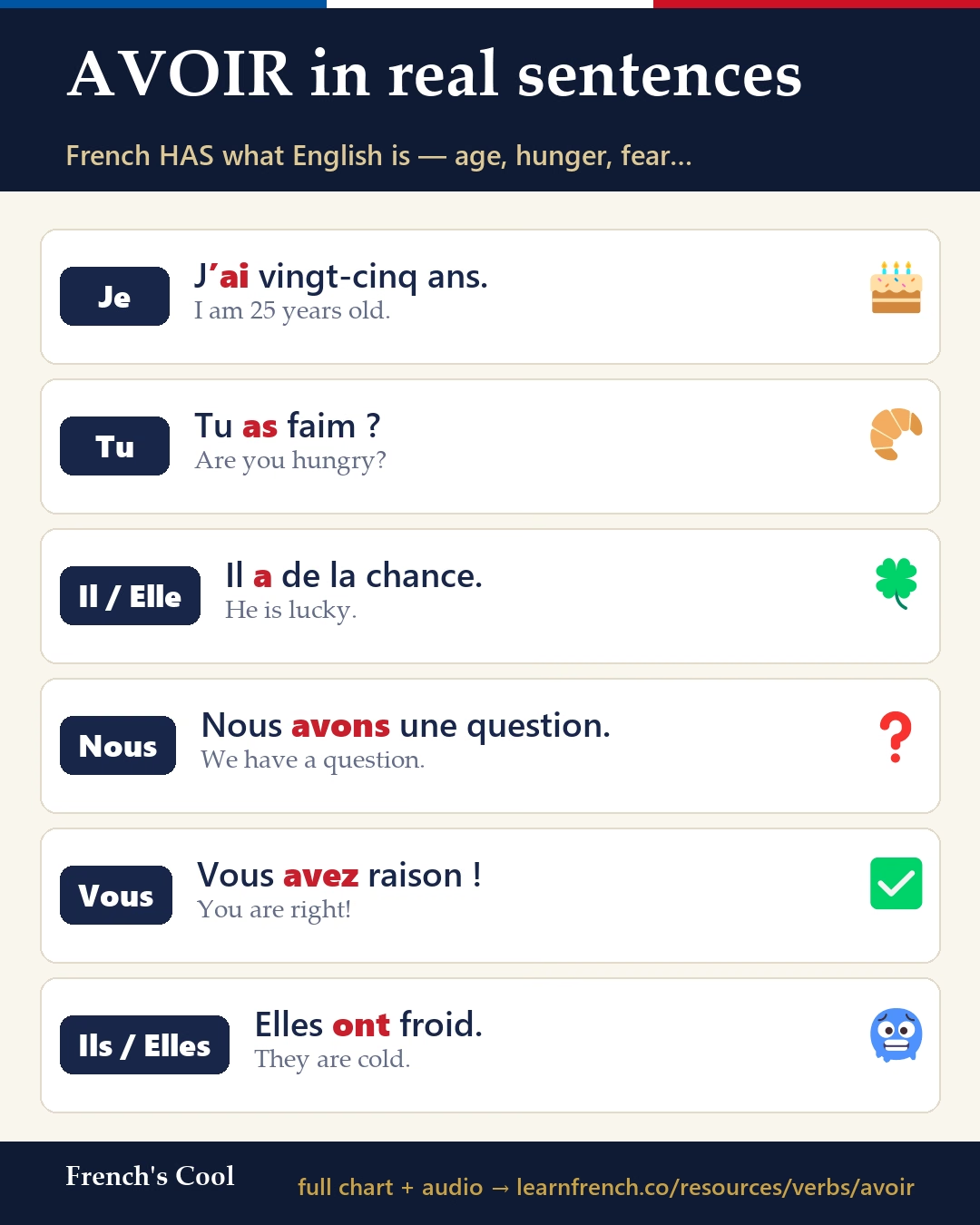
- Possession: j’ai deux frères — and age: j’ai 30 ans (French uses have, not be, for age).
- The auxiliary for most verbs in the passé composé: j’ai mangé, tu as vu.
- States that English says with be: avoir faim / soif / peur / raison / froid / chaud / sommeil.
- Il y a = there is / there are: il y a un problème.
🔑 Key forms
🔊 Common expressions
💡 Nuances & good to know
- avoir where English uses « to be »: j’ai faim / soif / froid / chaud / peur / raison, and age: j’ai vingt ans.
- il y a (there is/are) is built on avoir — and also means « ago »: il y a deux ans (two years ago).
- avoir besoin de = to need; avoir envie de = to feel like / want.
🔊 More real-life examples
🇬🇧 Avoir in plain English: one verb, half the language
Avoir means “to have” — but that definition undersells it. In french grammar, avoir is the master auxiliary: the passé composé, past perfect and every other compound verb tense of most verbs in french are built on its back. Learn this one table and you have pre-learned a piece of thousands of others — « j’ai mangé », « tu as vu », « nous avons fini » all run on the present of avoir. Like all true irregular verbs it must be memorized, not derived: j’ai, tu as, il a, nous avons, vous avez, ils ont — and the trap for every learner is ils ont (avoir) vs ils sont (être), one nasal vowel apart in pronunciation and a world apart in translation.
The compound tenses turn avoir on itself: passé composé « j’ai eu » (I had / I got — past participle eu, pronounced like « u »), pluperfect « j’avais eu » (I had had), future perfect « j’aurai eu ». The present subjunctive — que j’aie, que tu aies, qu’il ait — sounds identical across three forms, a small mercy in an irregular paradigm. And French uses avoir where English reaches for “to be”: j’ai faim, j’ai froid, j’ai vingt ans — a phrase family every vocabulary list files under idioms but which is really just avoir doing its second job, and the fastest shortcut to natural communication in everyday context. Whether you study through french courses or alone, the skill to build is the same: discuss your day in the passé composé, and let avoir’s table conjugate itself into permanence through use — that daily rhythm beats any drill a language app can sell you.
Avoir — FAQ
How do I keep « ils ont » and « ils sont » apart?
Ils ont (avoir) has the nasal “on” with a z-liaison: il-z-ON. Ils sont (être) starts with a hard s. Mnemonic: ONt = own — “they own” = they have.
What is the past participle of avoir?
« Eu » — pronounced like the single vowel « u ». J’ai eu, j’avais eu, j’aurai eu: once you can say « j’ai eu » smoothly, every compound tense of avoir follows.
Why does French say « j’ai vingt ans » and not « je suis »?
Age, hunger, thirst, heat, cold, fear and luck are all things you HAVE in French: j’ai 20 ans, j’ai soif, j’ai peur. Translating word-for-word from English (“I am hungry”) is the classic false start — file these as avoir expressions and they stop feeling odd.
🔊 Example sentences
✍️ Practice
Vous ___ un stylo ? (avoir, present)
Show answer
avez
Hier, il ___ un accident. (avoir, passé composé)
Show answer
a eu
Quand j’étais petit, j’___ un chien. (avoir, imperfect)
Show answer
avais
Nous ___ froid en hiver. (state expression)
Show answer
avons
Il y ___ un café près d’ici ? (il y a)
Show answer
a
🎬 Video lesson
 Avoir (to have) — Present Tense
🎮 Practise this with games
🎯 More practice — conjugation drill — all six tenses
tu ___ (Avoir — passé composé)
Show answer
as eu
il ___ (Avoir — imperfect)
Show answer
avait
nous ___ (Avoir — future)
Show answer
aurons
vous ___ (Avoir — conditional)
Show answer
auriez
Go further: this chart is one small piece — get the full picture in our guide Master the present tense — the full beginner guide.
The conjugation of avoir in real sentences
The conjugation of avoir matters because this irregular French verb covers several everyday jobs:
- possession: « J’ai deux sœurs. » — I have two sisters.
- age: « Elle a vingt ans. » — She is twenty (French uses avoir for age).
- sensations: « Nous avons faim et soif. » — We are hungry and thirsty.
- as auxiliary verb in the passé composé: « J’ai fini mon travail. » — I have finished my work.
Avoir is the auxiliary of most French verbs in compound tenses, which makes its conjugation doubly important. The charts above give the full verb conjugation in every mood — indicative (present tense, passé composé, imperfect, future), conditional, subjunctive and imperative — with audio so you can conjugate avoir with the right pronunciation.
Avoir conjugation FAQ
What is the present tense of avoir?
j’ai, tu as, il / elle a, nous avons, vous avez, ils / elles ont. Full charts for every tense are above, each form with audio.
What is the past participle of avoir?
eu — the passé composé is « j’ai eu ». Avoir uses avoir as its auxiliary verb.
How do you say avoir in the future tense?
« j’aurai » — the future stem never changes across persons, only the endings do.
What does avoir mean in English?
to have. It is one of the essential French verbs — drill the present first, then the passé composé; those two tenses carry most conversations.
🎮 Practise this lesson
Games built from this exact page — turn what you just read into play:
🧩 Sentence Builder rebuild these sentences
🏁 Conjugation Race type the right form
🎧 Listening Game which sentence do you hear?
🎬 All seven CEFR levels, end to end
« avoir » at every CEFR level — the tense, its forms and the mechanic that makes it stick. Practise it with the free games →