Premier, Deuxième, Troisième: French Ordinal Numbers
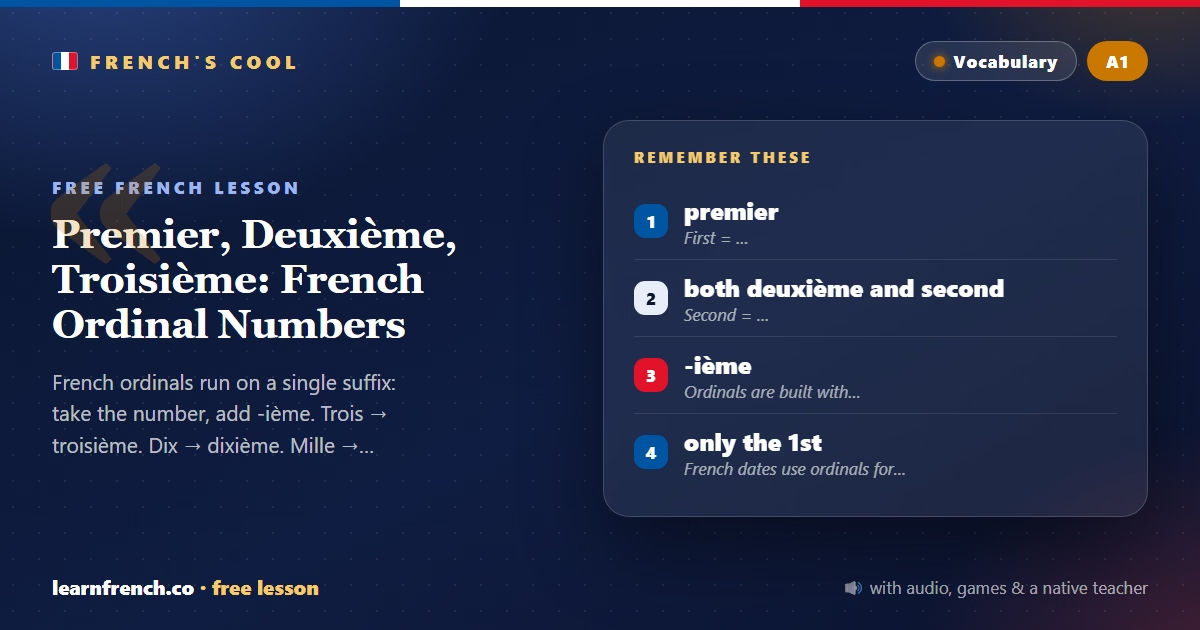
French ordinals run on a single suffix: take the number, add -ième . Trois → troisième. Dix → dixième. Mille → millième. The entire system has exactly one real rebel — premier — plus four tiny spelling adjustments. 🎬 This lesson in one minute The quick version — the full lesson is below. More shorts…
What you'll learn
French ordinals run on a single suffix: take the number, add -ième. Trois → troisième. Dix → dixième. Mille → millième. The entire system has exactly one real rebel — premier — plus four tiny spelling adjustments.
🎬 This lesson in one minute
The quick version — the full lesson is below. More shorts →
The system
| Number | Ordinal | Watch for |
|---|---|---|
| 1 | premier / première | the only real irregular — and the only one that agrees in gender |
| 2 | deuxième | « second(e) » exists too — see FAQ |
| 4 | quatrième | silent e drops: quatre → quatrième |
| 5 | cinquième | u appears to keep the hard k sound |
| 9 | neuvième | f softens to v |
| 21 | vingt et unième | only the last part changes |
Where English and French disagree
- Dates: only the 1st is ordinal — le premier mai, but le deux mai, le trois mai. Saying “le deuxième mai” marks you instantly.
- Kings and queens: same rule — François Ier (premier) but Louis XIV = Louis quatorze, not “the fourteenth”.
- Floors: le premier étage is the floor ABOVE the ground floor (rez-de-chaussée). French buildings start counting at 0, like programmers.
Abbreviations
1er / 1re, then 2e, 3e, 10e — just an e, not “-ème” or “-th” hybrids. Le 7e art = cinema; le 16e = a posh Paris arrondissement.
Common mistakes to avoid
Four traps English speakers fall into on autopilot:
- “les premiers deux jours” → les deux premiers jours — French flips the English order: cardinal first, ordinal second. Same logic for les trois dernières pages.
- “l’onzième” → le onzième — onzième refuses elision, so the article stays whole: le onzième arrondissement, la onzième minute. Huitième does the same: le huitième.
- “le vingt-unième siècle” → le vingt et unième siècle — keep the et. And unième only ever exists inside compounds; on its own, first is always premier.
- “la première étage” → le premier étage — étage is masculine. Première needs a feminine noun: la première fois, la première rue à droite.
Finding the right door: a real exchange
— Bonjour, je cherche le cabinet du docteur Morel, s’il vous plaît.
— C’est au troisième étage, deuxième porte à gauche.
— Le troisième… il y a un ascenseur ?
— Oui, au fond du couloir. Mais il s’arrête au deuxième — le dernier étage, c’est par l’escalier.
Note the pattern: au + ordinal + étage for locations, bare ordinal for doors — deuxième porte à gauche. And once étage has been said, French drops it: il s’arrête au deuxième — the bare ordinal carries the floor on its own.
In real life: school years run backwards
French secondary school counts down, not up. Pupils enter collège in sixième at age 11, then descend — cinquième, quatrième, troisième — before lycée finishes the countdown: seconde, première, and la terminale, the only year that drops ordinals altogether. So a teenager « en première » is one year from the bac, not a beginner. Ask a French kid « Tu es en quelle classe ? » and enjoy doing the mental arithmetic.
Trains run on ordinals too: you travel en première or en seconde — no article — and this is the one context where seconde beats deuxième every single time.
FAQ
Deuxième or second?
Interchangeable in practice. Style guides reserve second(e) for series of exactly two (la Seconde Guerre mondiale), deuxième when more follow — a nuance even the French shrug about. Second is pronounced “segond”.
How do I say fractions — a third, a quarter?
Ordinals moonlight as fractions from 5 up: un cinquième (1/5). But 1/2 = la moitié, 1/3 = un tiers, 1/4 = un quart — the common ones have their own words.
Where do the plain numbers live?
Counting from zéro to mille — including the famous quatre-vingt-dix-neuf — is its own lesson: French numbers 100-1000.
Quick practice
Play the Quiztap to start · quick practice from this material