How to Practise French Speaking — Even Alone
Six methods to train your spoken French without a partner — shadowing, narrating your day, 60-second monologues, recording yourself and reading aloud, all using free audio.
What you'll learn
The number one complaint we hear: “I understand French, but I can’t speak it.” The cause is almost never vocabulary — it’s that speaking is a muscle, and reading doesn’t train it. The good news: you can train it every day, entirely alone, for free. Here are the six methods that actually work, in order of power.
🎬 This lesson in one minute
The quick version — the full lesson is below. More shorts →
1. Shadowing — repeat 1 second behind
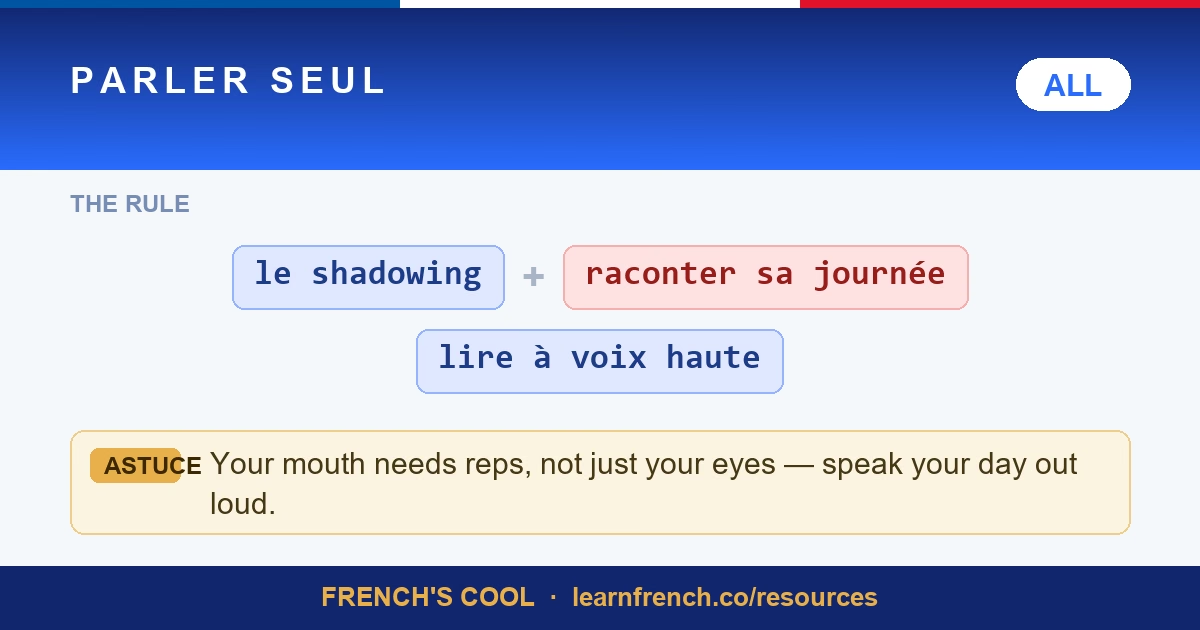
Play any French audio (every chart on this site has 🔊 buttons with a native-speed voice) and repeat what you hear while it plays, like an echo. Don’t worry about understanding everything — you’re training your mouth, rhythm and intonation, not your brain.
Try it now: press the button, then say it out loud twice. That tiny burn in your cheeks? That’s the muscle working.
New — compare the accents: every example sentence now has TWO buttons. The blue 🔊 plays the French voice; the small dashed EN? button reads the same sentence with a typical English-speaker accent — so you can hear exactly what to avoid. Listen to the mistake, then copy the French. That contrast is how your ear learns fastest.
2. Narrate your day — the reflexive workout
While doing your routine, describe it: je me lève, je me douche, je prends mon café… It drills the reflexive verbs and the present tense with zero extra time cost. Evening version: switch to the past — ce matin, je me suis levé tard…
3. The 60-second monologue
Pick a topic (your weekend, a film, your job), set a timer for one minute, and talk without stopping. Hesitation is allowed; stopping is not — use fillers like alors… en fait… bref… (that’s what natives do). Do this daily and your fluency doubles in a month.
4. Record yourself — the mirror that doesn’t lie
Once a week, record your 60-second monologue on your phone. Listen back. You’ll cringe (everyone does), but you’ll hear exactly which sounds need work — then drill them with the audio buttons on any verb chart.
5. Read aloud — borrowed fluency
Take any example sentence from our resources, play the audio, then read it aloud three times, faster each time. Reading aloud borrows perfect grammar while training pronunciation — the best effort-to-result ratio in language learning.
6. Level up: talk to a human
Solo practice builds the muscle; conversation teaches you to use it under pressure. When you’re ready — even at A1, especially at A1 — a patient native teacher accelerates everything, catches the errors you can’t hear, and gives you the confidence no app can. That’s exactly what the free trial lesson is for.
✍️ Quick quiz — did it stick?
Shadowing trains your ___, not your brain. (the muscle)
Show answer
mouth (pronunciation & rhythm)
Which verbs does narrating your morning drill? (se lever, se doucher…)
Show answer
reflexive verbs (verbes pronominaux)
In the 60-second monologue, hesitating is allowed but ___ is not. (the rule)
Show answer
stopping
Play the Quiztap to start · quick practice from this material
Loading the quiz…
The solo practice plan: a week of talking to yourself (productively)
Solo french speaking practice works when it’s structured — talking to yourself randomly fades in three days, a plan compounds. Here is a repeatable week for daily speaking, fifteen minutes a day. Monday, narration: describe what you’re doing as you do it — the daily-routine method, in the present tense. Tuesday, shadowing: speak over slow native audio a half-second behind; rhythm and liaison are trained here and nowhere else. Wednesday, self-dialogue: play both sides of a real scenario — ordering, complaining, phoning — switching voices; ridiculous and devastatingly effective for sentence structures. Thursday, voice notes: record one minute on yesterday’s topic, listen back, re-record once; the listen-back is where non-native speakers actually hear their own gaps. Friday, question hour: answer the 5 W’s aloud about your week — qui, quoi, où, quand, pourquoi. Weekend: one french movies session with the subtitle ladder, repeating the best lines aloud — très useful, mais fun.
Three multipliers make the plan stick. Speak ONLY aloud — subvocalising doesn’t train the mouth; your jaw should be tired, une vraie séance. Welcome errors: to make mistakes with no audience is precisely the luxury of solo work, so aim for flow over accuracy and let the corrections come from listen-backs. And schedule one real conversation monthly as the exam your solo work studies for — a language exchange app like Tandem, a tutor, or the free lesson with a native teacher this site exists to offer: solo methods build the muscle, real conversations calibrate it — that rhythm is how you feel more comfortable each month, from first survived exchange to genuinely conversational, without moving to a french-speaking country. Use the language you’re building daily, alone, on purpose — fluent français is mostly this unglamorous — and the practice plan above turns « I understand but can’t speak » into last year’s problem: real immersion, manufactured at home, no memorize-and-pray required.
FAQ
Is it possible to learn French alone?
To a strong B1/B2, demonstrably yes — input, speaking drills and self-correction are all solo-able. The last mile (spontaneity under pressure) needs live humans; one conversation a month covers it.
What are the 5 W’s in French?
Qui (who), quoi (what), où (where), quand (when), pourquoi (why) — plus comment (how) as the honorary sixth. Answering all six aloud about your day is a complete speaking workout.
What is the 80/20 rule in French?
A fifth of the language powers four-fifths of speech — so solo practice should recycle high-frequency verbs and your own life’s vocabulary, not tour the dictionary.
How do you say 1 to 10 in French?
Un, deux, trois, quatre, cinq, six, sept, huit, neuf, dix — and saying phone numbers aloud in French is sneaky-good solo speaking practice.
Think in French (the invisible practice)
The secret to learning to speak French alone is simple: you must practice speaking French out loud every day, even with no one to talk to. These habits let you speak French constantly and improve your French without a partner or a native speaker in the room.
The most powerful way to practise French speaking alone costs nothing and needs no time slot: narrate your thoughts in French all day. Name what you see on your commute, plan your shopping list in your head, rehearse what you’d say in a café. This inner self-talk builds the reflex to produce French fast, so that when a real conversation comes, the words are already there when you speak French for real. Fluency is speed of retrieval — and thinking in French trains exactly that.
Use AI and apps as a speaking partner
You no longer need a human to have a two-way conversation. Modern tools give you unlimited, judgement-free speaking practice:
- AI chat apps that talk back in French and correct you — roleplay ordering food, an interview, small talk.
- Speech-recognition features that score your pronunciation and flag sounds to fix.
- Text-to-speech to hear any sentence in a native accent, then shadow it.
- Voice notes to yourself — describe your day, play it back, notice one thing to improve.
Whatever tool you use, keep speaking out loud. Silent study builds recognition; only speaking builds the mouth-muscle memory of real French.
Fix your pronunciation solo
Alone, your ear is your coach. Record a short sentence, play a native version right after, and copy it until they match. Target the sounds English speakers find hardest — the French u (as in tu), the guttural r, and nasal vowels (on, an, in). Little daily pronunciation reps compound into a noticeably better accent within weeks.
Practising French speaking alone FAQ
Can you learn to speak French by yourself?
Yes. You can build real speaking ability solo through shadowing, monologues, thinking in French and AI practice partners. You’ll eventually want some real conversation to test it, but the bulk of speaking practice — the reps that build fluency — is done perfectly well alone.
How do I practise speaking French without a partner?
Shadow audio, narrate your day out loud, record 60-second monologues, read aloud, and chat with an AI app. Each one makes you produce French, which is the only thing that grows speaking skill. Combine two or three daily and you’ll hear the difference fast.
How can I improve my French pronunciation alone?
Record-and-compare: say a sentence, listen to a native version, and repeat until they match. Focus on the French u, the r, and nasal vowels. Use text-to-speech and the audio on our learning resources as your model.
🧰 Your practice kit
Every one of these has 🔊 audio to shadow — your daily gym:
🎯 More practice — translation — put it into French
Translate into French: « I’d like a coffee and a croissant, please. » (translation)
Show answer
Je voudrais un café et un croissant, s’il vous plaît.
Translate into French: « I make myself a coffee and start working. » (translation)
Show answer
Je me prépare un café et je commence à travailler.
Translate into French: « The more you practise, the more you progress. » (translation)
Show answer
Plus on pratique, plus on progresse.
Prefer a human? Book a free lesson with Xavier →
🎮 Practise this lesson
Games built from this exact page — turn what you just read into play:
🧩 Sentence Builder rebuild these sentences