Ça vs Cela vs Ceci: Which “This/That” to Use
Ça va, cela dit, ceci explique cela — the three neutral pronouns sorted by register, the fixed expressions, and why ça rules spoken French.
What you'll learn
Three little words all mean “this/that thing”: ça, cela, ceci. They differ almost purely by register — and picking the right one instantly places you as a natural speaker or a walking textbook.
🎬 This lesson in one minute
The quick version — the full lesson is below. More shorts →
Ça — the king of spoken French
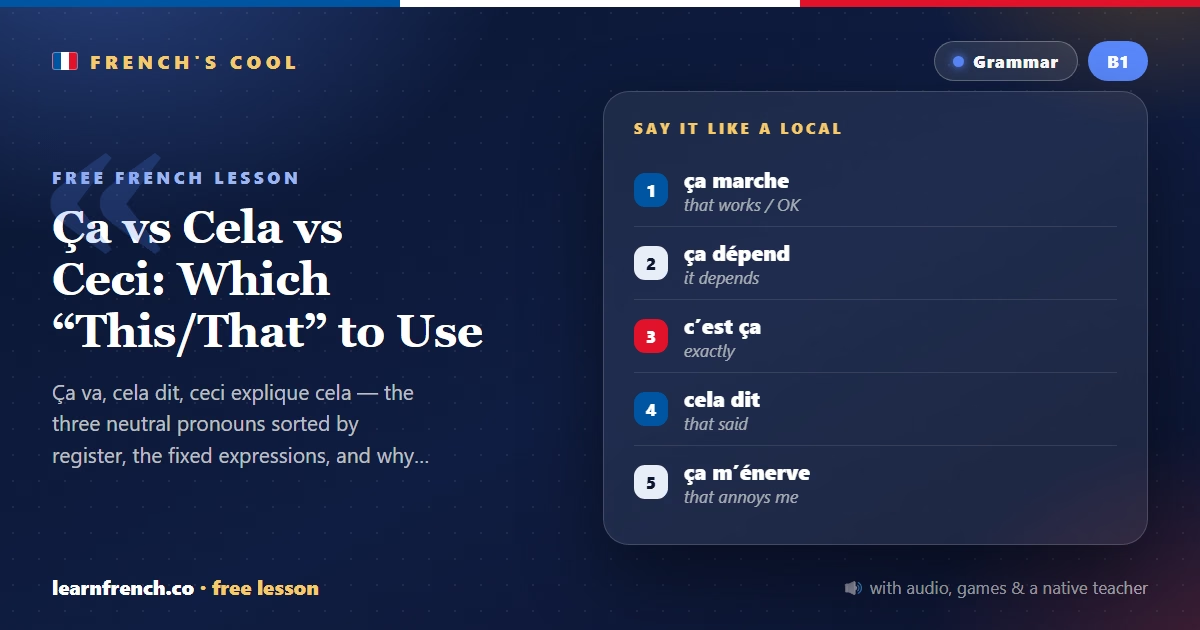
Ça is the contraction of cela and owns conversation:
- Ça va ? — How’s it going?
- Ça marche. — That works / OK.
- Ça dépend. — It depends.
- C’est ça ! — Exactly!
- Ça m’énerve. — That annoys me.
Cela — the same word in a suit
In writing and formal speech, cela replaces ça: « Cela pose un problème. » « Cela dit… » (that said…). In an email to your boss, cela; at the café, ça. Meaning: identical.
Ceci — the pointer
Ceci is rarer and points forward or at something present: « Écoutez bien ceci. » (listen to THIS, coming now). « Ceci explique cela. » (this explains that). In practice, French increasingly uses ça/cela for both.
The subject trap
Before être, they all give way to ce: c’est, ce sont — not « ça est ». But with other verbs, ça stays: ça devient difficile, ça me plaît.
Common mistakes (and the one-second fix)
Four errors I hear every single week — all easy to kill:
- « Ceci est mon frère. » → C’est mon frère. To introduce people or things, French reaches for c’est or voici — never « ceci est ».
- « Cela m’étonnerait » at the café → Ça m’étonnerait. Out loud, cela sounds like you’re reading a court ruling. Save it for the page.
- « Ça m’intéresse beaucoup » in a cover letter → Cela m’intéresse beaucoup. The reverse crime: formal writing wants the suit on.
- « Ceci dit… » → Cela dit… You’re pointing back at what was just said, so careful writing wants cela. Everyone says ceci dit anyway — write cela dit and enjoy being right.
The memory trick: -ci is here, -la is there
Look inside the words. Ceci ends in -ci, as in ici (here): the near thing, the present thing, the thing about to be said. Cela ends in -la — a là (there) that lost its accent: the further thing, the thing already said. It’s the exact duo you know from ce pull-ci (this jumper here) versus ce pull-là (that jumper there). One glance at the last syllable and the choice makes itself.
Five more ça expressions you’ll actually use
- Ça y est ! — that’s it / done / finally!
- Ça te dit ? — fancy it? THE casual way to invite someone.
- Ça ne fait rien. — never mind, no harm done.
- Ça suffit ! — that’s enough! (every French parent, daily)
- Ça alors ! — well, I never!
At the fromagerie: ça in the wild
— Bonjour ! Je peux goûter ça ?
— Bien sûr. Ça, c’est un comté de dix-huit mois.
— Mmm… ça a du goût ! J’en prends deux cents grammes.
— Très bien. Tenez, goûtez aussi ceci, c’est le petit nouveau de la région.
— Allez, va pour les deux. Ça fait combien ?
— Neuf euros vingt, s’il vous plaît.
Count them: the customer points at what’s already there with ça, and the fromager introduces the new arrival with ceci — handed forward, not yet known. The whole lesson in thirty seconds of shopping.
FAQ
Is « ça » informal-only?
Casual-to-neutral. You can say ça in any conversation; you just avoid it in formal WRITING, where cela takes over.
« C’est » or « ça est »?
Always c’est — ce replaces ça before être. The full c’est system: c’est vs il est.
What about ce, cet, cette?
Those are demonstrative ADJECTIVES (this book = ce livre); ça/cela/ceci stand alone as pronouns. Compare: ce, cet, cette, ces.
Quick practice
Play the Quiztap to start · quick practice from this material