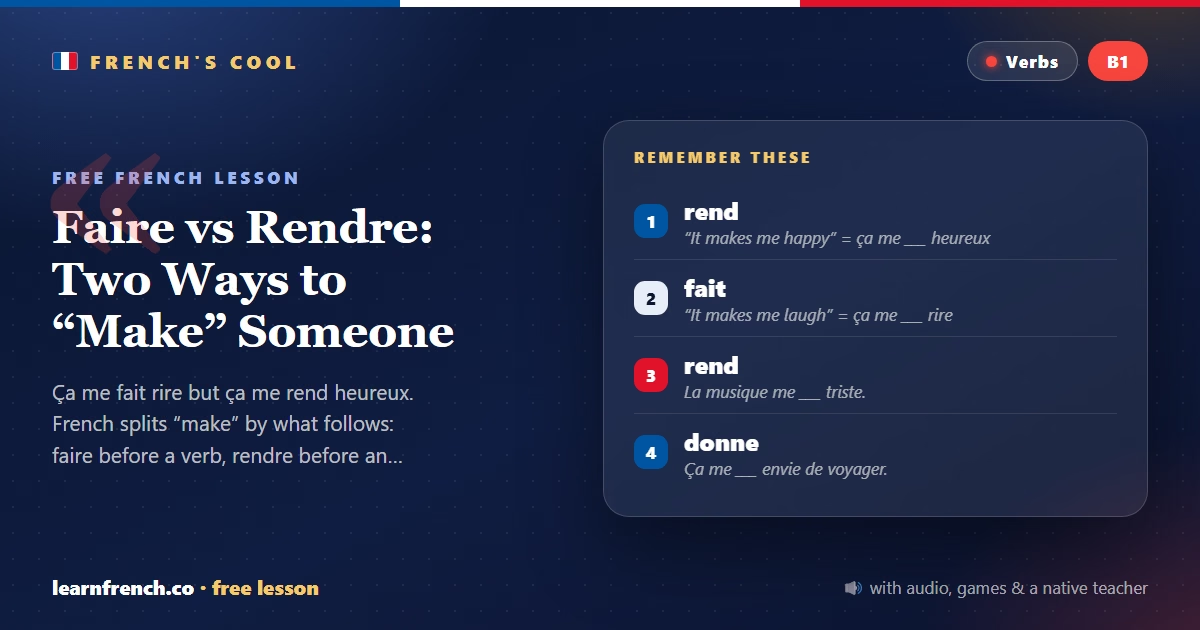
Faire vs Rendre: Two Ways to “Make” Someone
Ça me fait rire but ça me rend heureux. French splits “make” by what follows: faire before a verb, rendre before an adjective. One rule, zero exceptions.
What you'll learn
“This song makes me cry” and “this song makes me sad” use the same MAKE in English. French refuses: « ça me fait pleurer » but « ça me rend triste ». The split is mechanical — look at what comes after.
⚗️ Action → faire, state → rendre
Both mean « to make (someone)… » — the next word decides: a VERB takes faire (ça me fait rire), an ADJECTIVE takes rendre (ça me rend triste). « Make me laugh » is an action; « make me happy » is a state.
🎬 This lesson in one minute
The quick version — the full lesson is below. More shorts →
The one rule
| Followed by… | Verb | Example |
|---|---|---|
| a VERB (infinitive) | faire | Tu me fais rire. — You make me laugh. |
| an ADJECTIVE | rendre | Tu me rends heureux. — You make me happy. |
Drill the pairs
- Ça me fait pleurer · Ça me rend triste — makes me cry / makes me sad
- Ça me fait dormir · Ça me rend fatigué — puts me to sleep / makes me tired
- Ça me fait sourire · Ça me rend joyeux — makes me smile / makes me cheerful
- Le café me fait trembler · Le café me rend nerveux
Rendre’s other life
Rendre alone means to give back: « Tu me rends mon stylo ? » And se rendre à = to go to (formal), se rendre compte = to realize — three of the most useful reflexives in the language: « Je me suis rendu compte de mon erreur. »
Where faire keeps the crown
Everything verby stays with faire — including the full delegation system (faire réparer, se faire couper les cheveux) covered in faire + infinitive. If you can put “to” before the next English word, it’s faire territory.
Common mistakes I hear every week
Learners over-use faire because MAKE is the default setting in English. Here are the slips I correct most often — say the corrected version out loud:
- Not « ça me rend rire » but « ça me fait rire » — rire is a verb, so rendre is disqualified.
- Not « tu me fais jaloux » but « tu me rends jaloux » — jaloux is an adjective, and faire can’t touch it.
- Not « ce film m’a fait triste » but « ce film m’a rendu triste » — the past tense changes nothing; adjective means rendre.
- Not « ça me fait vouloir danser » but « ça me donne envie de danser » — for “makes me want to”, French skips both verbs and reaches for donner envie de.
Film night: the rule in the wild
— Alors, ce film d’hier soir ? Ça t’a plu ?
— La fin m’a fait pleurer. Et la bande-son… rien que d’y penser, ça me rend nostalgique.
— Tu pleures au cinéma, toi ? Ça me fait rire.
— Ris toujours. Les moqueurs, ça me rend grognon.
Four MAKE sentences, four correct calls: fait pleurer, rend nostalgique, fait rire, rend grognon (grumpy). Verb, adjective, verb, adjective — the rule never blinks, even mid-argument.
The English cheat code: render
English quietly owns rendre’s twin: to render. The shock rendered him speechless; the update rendered my phone useless. Render takes adjectives in English too — and it’s impossible before a verb, since nobody has ever been “rendered laugh”. So run the swap test: if render fits your English sentence, French wants rendre; if render sounds absurd, it’s faire. Same family, same behaviour, zero memorising.
Level up: rendre things, not just people
Rendre doesn’t only change your mood — it upgrades objects and situations too, with the pattern rendre + noun + adjective:
- Internet a rendu tout ça possible. — The internet made all that possible.
- Le télétravail rend les réunions plus courtes. — Remote work makes meetings shorter.
- La pluie rend la route glissante. — Rain makes the road slippery.
Watch the agreement: la route glissante, les réunions courtes. The adjective agrees with the thing being transformed — not with you.
In real sentences
Read each one aloud, then tap 🔊 and shadow the audio — rhythm first, speed later.
Drill it: faire + infinitive · bon vs bien · the faire chart
✍️ Your turn: faire or rendre?
« It makes me happy » = ? (adjective)
Show answer
Ça me rend heureux (heureuse) — state, so rendre.
« It makes me smile » = ? (verb)
Show answer
Ça me fait sourire — action, so faire.
« It made her sad » in the passé composé = ? (agreement check)
Show answer
Ça l’a rendue triste — rendre’s participle agrees with the preceding direct object.
Why is it « ça me fait plaisir » with faire? (sneaky noun)
Show answer
Plaisir is a NOUN, not an adjective — faire plaisir à is its own fixed expression (to please).
What else does rendre mean? (second life)
Show answer
To give back: je te rends ton livre demain. Context keeps the two meanings apart effortlessly.
FAQ
Why is it « ça me rend malade » but « ça me fait vomir »?
Malade is an adjective (rendre), vomir is a verb (faire). The rule holds even when the meanings feel close — check the word class, not the vibe.
Can I say « ça me fait heureux »?
No — classic learner error, instantly heard. Adjective → rendre, always: ça me rend heureux/triste/fou/dingue.
What about « ça me fait plaisir »?
Plaisir is a NOUN, and nouns ride with faire: faire plaisir, faire peur, faire mal, faire envie. Verb or noun → faire; adjective → rendre.
Which are the highest-value rendre + adjective combos?
Rendre heureux, triste, malade, fou (ça me rend fou ! = it drives me crazy), nerveux, célèbre. Learn them as pairs and the pattern generalises itself.
How does this connect to faire + infinitive from the causative lesson?
Same faire, same logic — faire + infinitive delegates or causes an action (je fais réparer, tu me fais rire). Rendre exists precisely because faire refuses adjectives. Two tools, zero overlap.
Quick practice
Play the Quiztap to start · quick practice from this material