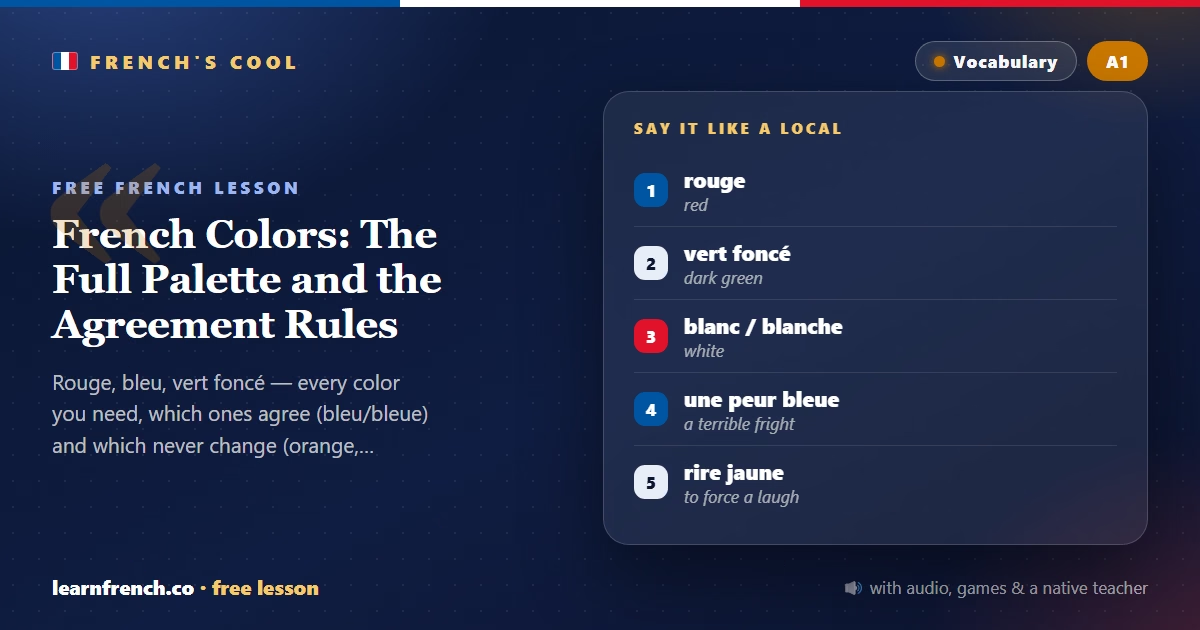
French Colors: The Full Palette and the Agreement Rules
Rouge, bleu, vert foncé — every color you need, which ones agree (bleu/bleue) and which never change (orange, marron), plus color idioms natives love.
What you'll learn
Colors are day-one vocabulary with a grammar sting in the tail: some agree, some don’t, and compounds freeze. Here’s the whole palette, sorted.
🎬 This lesson in one minute
The quick version — the full lesson is below. More shorts →
The core palette
- rouge — red · bleu(e) — blue · vert(e) — green
- jaune — yellow · noir(e) — black · blanc / blanche — white
- gris(e) — grey · rose — pink · violet(te) — purple
- marron — brown · orange — orange · beige — beige
Agreement: three families
- Regular — add -e/-s: un vélo vert, une voiture verte, des portes vertes.
- Already ending in -e — only the plural -s: rouge/rouges, jaune, rose, beige.
- Invariable — colors that are really nouns (fruits, materials) never change: des chaussures orange, des yeux marron.
Shades: compounds freeze everything
Add clair (light) or foncé (dark) and the whole expression becomes invariable: une chemise bleu clair, des jupes vert foncé — no -e, no -s, ever.
Color idioms natives actually use
- voir la vie en rose — to see life through rose-tinted glasses
- avoir une peur bleue — to be scared stiff (“a blue fear”)
- rire jaune — to force a laugh
- être vert de jalousie — green with envy (some things are universal)
- passer une nuit blanche — to pull an all-nighter
Asking about colors: the question nobody teaches
You know twelve colors — now learn to ask for one. The pattern is De quelle couleur est… ? : De quelle couleur est ta voiture ? — Elle est grise.
- Vous l’avez en bleu ? — do you have it in blue? In shops, en + color is the pattern that gets things done.
- Je préfère le vert. — a color used as a noun is always masculine: le rose, le violet, even for the pinkest pink.
In the shop: a real exchange
— Bonjour, vous auriez ce pull en vert ?
— On l’a en vert clair et en vert foncé. Quelle taille ?
— En M, s’il vous plaît. Et la chemise là-bas, elle existe en d’autres couleurs ?
— Oui : blanche, bleu marine et bordeaux.
Everything from this lesson in four lines: en vert with no article, the frozen compounds vert clair and bleu marine, and blanche agreeing with la chemise. For the full script, see clothes shopping.
Hair and eyes: a separate palette
Describing people has its own color rules — nobody’s hair is jaune in French.
- blond(e) — blond · brun(e) — dark-haired · châtain — chestnut · roux / rousse — red-haired
- Il a les cheveux bruns et les yeux marron — one agrees, one stays frozen, in the same sentence. Welcome to French.
- Grey hair is les cheveux gris, and going grey is grisonner — a whole verb, because of course there is one.
The freeze test: a memory trick
Not sure whether a new color agrees? Ask one question: is it secretly a thing? You already know orange and marron freeze — the same test covers every fruit, flower and metal on the shelf: des sacs citron, deux robes crème, des rideaux turquoise, des sandales argent.
A few rebels agree anyway — rose, mauve, pourpre: des joues roses. That’s why rose takes its -s in the agreement list above. Memorise the rebels and enjoy correcting natives.
FAQ
Why don’t orange and marron agree?
They’re borrowed nouns — an orange, a chestnut (un marron). Grammatically French treats them as “the color OF an orange”, so they stay frozen.
Where does the color go — before or after the noun?
After, always: une robe rouge. Colors are classic post-noun adjectives — see adjective placement.
How do I learn them fast?
Sing them: our Titounis color song video lesson is 2 minutes and weirdly unforgettable. Then label three objects around you right now — out loud.
Quick practice
Play the Quiztap to start · quick practice from this material