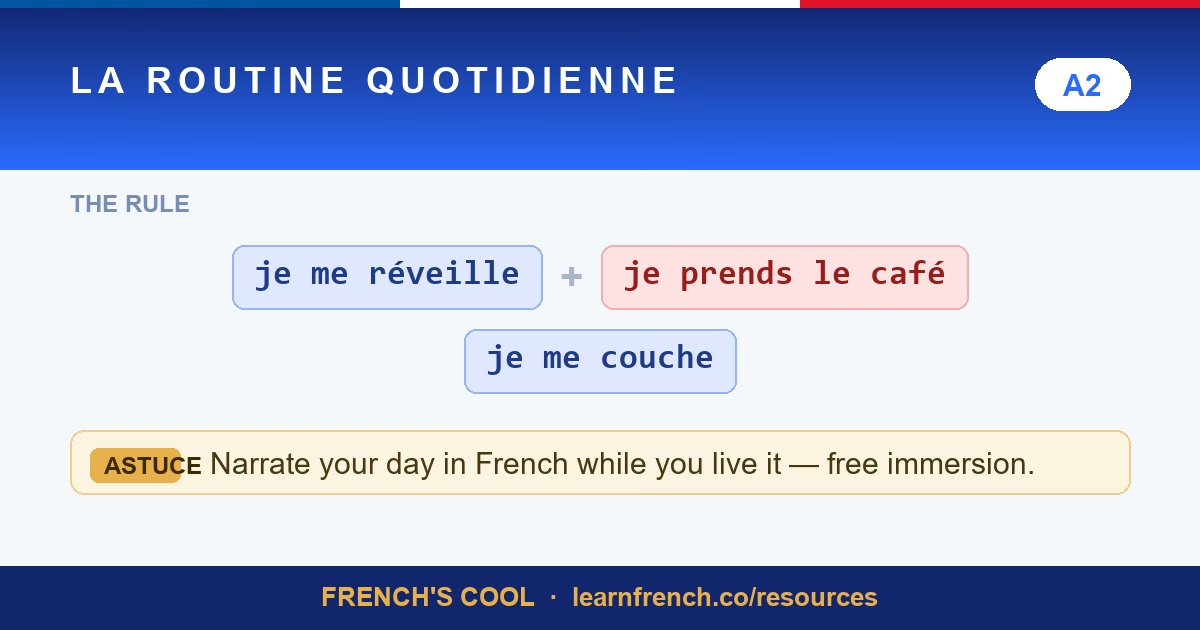
How to Talk About Your Daily Routine in French
Your daily routine is the perfect first thing to talk about in French — it bundles reflexive verbs (se lever, se laver), telling the time, and sequence words (d'abord, ensuite, enfin). Learn the pattern once and narrate your whole day. With audio and a quiz.
What you'll learn
Your daily routine is the perfect first thing to talk about in French: it’s personal, it repeats every day, and it uses a neat bundle of grammar — reflexive verbs, times, and sequence words. Learn the pattern once and you can narrate your whole day (tap 🔊 to hear each line).
🎬 This lesson in one minute
The quick version — the full lesson is below. More shorts →
🔁 The key idea
Routine verbs are mostly reflexive (you do them to yourself): se lever, se laver, s’habiller. The little me / te / se is the giveaway.
The morning
See the reflexive pattern in full on verbes pronominaux.
Telling the time
Routines need the clock. « à + heure »:
The full system (et quart, moins le quart, the 24-hour clock) is on l’heure.
Sequence words — the glue
String your day together with these:
The evening
Put it together — a mini-monologue
« D’abord, je me réveille à 7h. Ensuite, je me douche et je m’habille. Puis je vais au travail. Le soir, je dîne et je me couche vers 23h. »
Now make YOUR version — swap in your own times and verbs. That’s a full paragraph of French from one pattern.
✍️ Routine check
« I wake up » = je ___ réveille. (reflexive pronoun)
Show answer
me
first… then… = d’abord… ___… (sequence)
Show answer
ensuite (or puis)
« I get dressed » = je m’___. (reflexive verb)
Show answer
habille
Play the Quiztap to start · quick practice from this material
Loading the quiz…
The narration method: your day is the vocabulary list
Daily routine vocabulary has a superpower no other word set owns: you perform it every single day, which means the revision schedule is built into your life. Before reaching for a PDF download, a Quizlet deck or another flashcards app, try the narration method — say what you are doing, as you do it, in French: « Je me réveille… je me lève… je prends une douche… je m’habille… je prends le petit-déjeuner… je quitte la maison… je vais au travail en voiture. » Getting ready in the morning is six reflexive verbs; the commute adds transport phrases; the evening closes the loop with « je rentre, je dîne, je fais mes devoirs » (yes, homework — les devoirs — if you’re studying) « …je me couche ». One day narrated aloud = every common activity drilled in context, with example sentences you generated yourself.
Structure the week and the vocabulary doubles: « le lundi, je… » for habits, « le week-end » unlocks the weekend routine set — faire la grasse matinée, faire les courses, voir des amis — and la semaine vs le week-end contrast trains the imparfait later. This is A1 vocabulary doing B1 work: the same day-to-day verbs, recycled daily, become automatic in weeks — the beginner’s fastest honest route toward fluent narration, and the foundation every french learner builds conversation on (what did you do today? what do you usually do?). New vocabulary sticks to this skeleton naturally: each day you do something unnameable, look it up, and attach it — the comprehensive list grows itself. Two weeks of narration and you’ll notice the shift every language skills coach promises and few methods deliver: you stop translating your day into French and start living it there, one « je me dépêche ! » at a time. That is language learning by appointment with your own alarm clock — and it’s free.
FAQ
What are the main French daily routine verbs?
The reflexive core: se réveiller, se lever, se doucher, s’habiller, se coiffer, se dépêcher, se détendre, se coucher — plus prendre (le petit-déjeuner, le bus), aller, rentrer, dîner.
How do I describe my day in French?
Chain time markers with the present: « D’abord je me lève, puis je prends une douche, ensuite je vais au travail, enfin je me couche. » D’abord–puis–ensuite–enfin is the skeleton of every routine story.
What level is daily routine vocabulary?
A1 — it’s usually the first full topic after greetings, precisely because it recycles daily. The reflexive grammar it smuggles in (me/te/se) is the real lesson.
The French vocabulary of daily routine: (mostly) reflexive verbs
Almost every daily-routine action in French is a reflexive verb — the « se » that means the action comes back to you. Get the pronoun (me, te, se, nous, vous, se) in front of the verb and you can narrate a whole day:
- se réveiller — to wake up: « je me réveille à 7 h »
- se lever — to get up · se doucher — to shower · se laver — to wash
- s’habiller — to get dressed · se brosser les dents — to brush your teeth
- se maquiller / se raser — to put on make-up / to shave
- se coucher — to go to bed · s’endormir — to fall asleep
The non-reflexive ones fill the gaps: prendre le petit-déjeuner (have breakfast), aller au travail (go to work), rentrer (go home), faire à manger (make food), faire la vaisselle (do the dishes). Learn the full set on the reflexive verbs guide.
Frequency and time expressions: the French vocabulary of « when »
To make it a routine, add how often and when:
- tous les jours — every day · d’habitude — usually · souvent — often
- le matin / l’après-midi / le soir — in the morning / afternoon / evening
- d’abord … ensuite … puis … enfin — first … then … next … finally
- avant de + infinitive — before doing: « avant de partir »
- après avoir + participle — after doing: « après avoir mangé »
French daily routine FAQ
How do you describe your daily routine in French?
Chain reflexive verbs in the present tense with sequence words: « Le matin, je me réveille à 7 h, puis je me lève et je prends mon petit-déjeuner. Ensuite je vais au travail. » Present tense, this French vocabulary of « je + reflexive », a few connectors — that’s a full routine.
Why are daily routine verbs reflexive in French?
Because the action happens to yourself: you wash yourself, dress yourself, wake yourself up. When the action targets something else, the « se » disappears — « je lave la voiture » (I wash the car), no reflexive.
How do I talk about my routine in the past?
Reflexive verbs take être in the passé composé: « Ce matin, je me suis levé(e) tard. » Or use the imparfait for what you used to do: « Avant, je me couchais tôt. » Drill both on the vocabulary charts with audio.
🧰 Build your daily-routine French
The pieces you need to narrate your day:
🎯 More practice — translation — put it into French
Translate into French: « I wake up at seven. » (translation)
Show answer
Je me réveille à sept heures.
Translate into French: « I get up and I shower. » (translation)
Show answer
Je me lève et je me douche.
Translate into French: « I get dressed and have breakfast. » (translation)
Show answer
Je m’habille et je prends le petit-déjeuner.
Translate into French: « at quarter past eight » (translation)
Show answer
à huit heures et quart
Translate into French: « at noon · at midnight » (translation)
Show answer
à midi · à minuit
Want to say your routine out loud and get it corrected? Book a free lesson with Xavier →
🎮 Practise this lesson
Games built from this exact page — turn what you just read into play:
🧩 Sentence Builder rebuild these sentences
🎧 Listening Game which sentence do you hear?
🎬 Watch next: Watch a real morning routine narrated in clear French (with subtitles).