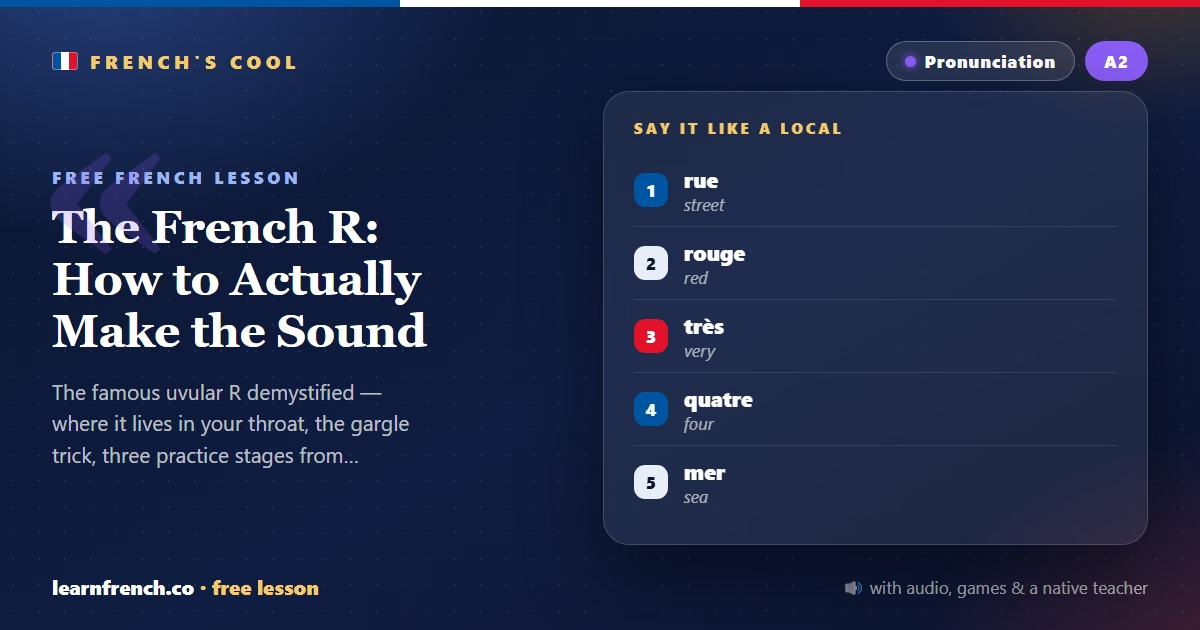
The French R: How to Actually Make the Sound
The famous uvular R demystified — where it lives in your throat, the gargle trick, three practice stages from “Paris” to “rare”, and why you must never roll it.
What you'll learn
The French R scares more learners than the subjunctive — needlessly. It’s not a tongue-tip sound at all: it lives at the back of your mouth, where you gargle. Once your throat finds it, it never forgets.
🗣️ The R lives in your throat, not on your tongue
The French R is made where you gargle — the back of the throat — while the tongue tip rests DOWN behind your bottom teeth. If your tongue tip rises (English R) or taps (Spanish R), it isn’t French yet. Gargle a tiny bit of water, feel the spot, then say « rouge » from there.
🎬 This lesson in one minute
The quick version — the full lesson is below. More shorts →
Where the sound lives
English R curls the tongue tip; Spanish R taps it. French R does neither: the tongue tip rests behind your bottom teeth and the back of the tongue rises toward the uvula. The friction back there IS the sound — softer than you think, closer to a purr than a growl.
The gargle trick (works in one bathroom session)
- Gargle a sip of water. Feel WHERE it vibrates.
- Now “gargle” without water: a soft, dry khhh, like fogging a mirror from the throat.
- Add a vowel after it: khha… ra… ra. That’s it. That’s the R.
Three practice stages
- Stage 1 — R after a vowel (easiest): par, bar, mer, pour, Paris.
- Stage 2 — R before a vowel: rue, rouge, rien, repas.
- Stage 3 — the bosses: très, quatre, arriver… and the final exam: rare, rue Richelieu, serrurerie (locksmith’s — even natives smile at this one).
The two golden rules
- Never roll it. A Spanish trill marks you instantly; a soft English R is far less noticeable than a rolled one.
- Softer is better. In fast speech the R often melts to almost nothing: « pa’ce que » for parce que. When in doubt, under-do it.
In real sentences
Read each one aloud, then tap 🔊 and shadow the audio — rhythm first, speed later.
Drill it: the pronunciation guide · nasal vowels · liaison rules
✍️ Your turn: train the throat
Where exactly is the French R articulated? (feel it)
Show answer
At the back of the throat (uvula area) — the gargling spot, with the tongue tip anchored behind the bottom teeth.
Which position is EASIEST to start practising R? (between vowels)
Show answer
Between vowels: Paris, mari, heureux — the vowels carry you through the R. Start there, not with « rue ».
Is the final r pronounced in « parler »? (-er endings)
Show answer
No — -er infinitives end in /e/: parlé sound. But final r IS pronounced in bonjour, sur, hiver.
What single habit most betrays an anglophone R? (the tip)
Show answer
Letting the tongue tip rise. Pin it down behind your lower teeth and the English R physically cannot happen.
Merci — how strong should the R be? (less than you think)
Show answer
Feather-light: after a consonant like this, it is barely a breath of friction. Over-rolling the R sounds more foreign than under-doing it.
FAQ
My R sounds like I’m clearing my throat. Too much?
Yes — dial the friction down 50%. The French R is a whisper of a gargle, not a cat cough. Whisper-practise: if you can say « rue » quietly, the placement is right.
Is the R ever silent?
In -er verb infinitives and métier-type words the R+E ending says “é”: parler = “parlé”, boulanger. Final -r elsewhere usually sounds: pour, mer, hiver. The CaReFuL rule lives in silent letters.
What should I drill after the R?
The nasal vowels — the other half of the French accent: nasal vowels, then the full pronunciation guide.
Will I be understood with an English R?
Yes — the French decode it instantly, it just flags you as anglophone. A Spanish rolled R is actually more disruptive. Aim for the throat R gradually; comprehension never depends on it.
Any everyday trick to practise?
The kkh→R slide: say a hard k, hold the air friction (like clearing your throat gently), then voice it — that buzz IS the French R. Ten seconds a day in the shower does more than an hour of theory.
Quick practice
Play the Quiztap to start · quick practice from this material