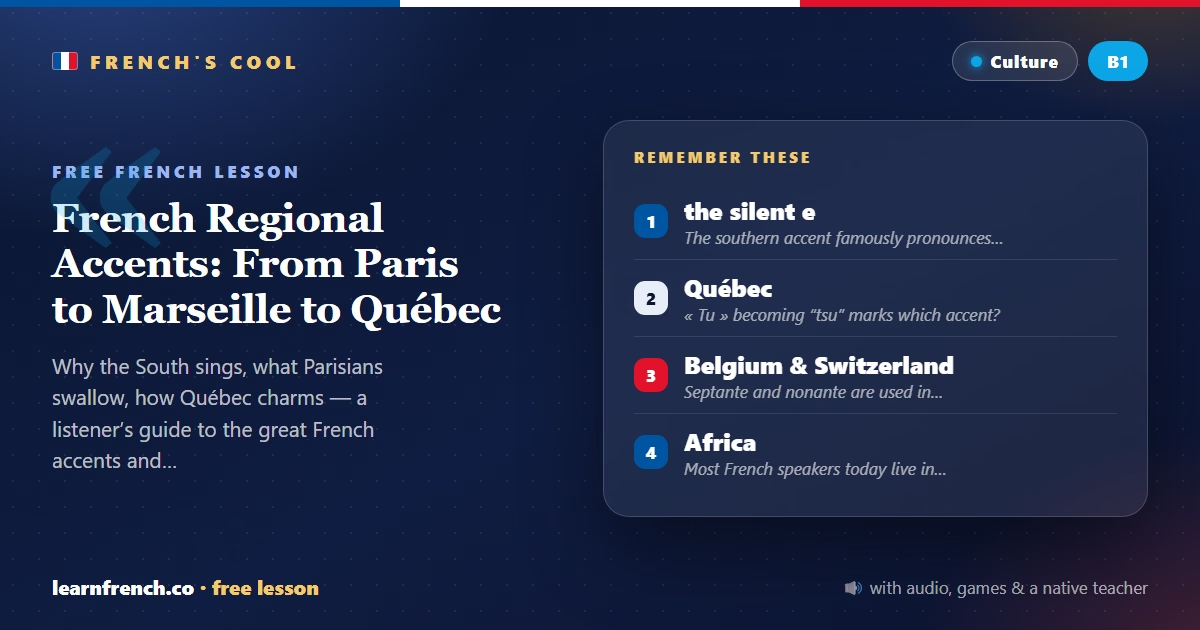
French Regional Accents: From Paris to Marseille to Québec
Why the South sings, what Parisians swallow, how Québec charms — a listener’s guide to the great French accents and the features that give each one away.
What you'll learn
There is no single “French accent” — there’s a chorus. Learning to recognise the big ones turns confusing audio into geography, and makes natives light up when you notice.
🎬 This lesson in one minute
The quick version — the full lesson is below. More shorts →
Paris & the standard
The textbook accent — fast, clipped, with the famous swallowed syllables: « j’sais pas », « t’inquiète ». Media French is essentially this, at speed.
Le Midi — the singing South
- Marseille, Toulouse, Nice: melody everywhere, and the silent e comes ALIVE: « une baguetteuh ».
- Nasals soften: « pain » sounds closer to “pang”.
- Signature word: « peuchère ! » (bless him/poor thing) and the universal « con » as friendly punctuation (really).
Le Nord — the warm ch’ti
Lille and around: « ch » replaces « c » sounds (moi → mi, ça → cha), vowels flatten. The film Bienvenue chez les Ch’tis made the accent a national treasure.
Québec — the time capsule
- Vowels diphthong: « père » → “paèr”; t/d soften before i/u: « tu » → “tsu”, « dire » → “dzire”.
- Old French survivals + anglicisms in the same sentence: « J’ai parké mon char » (I parked my car).
- The sacred words are church-based: tabarnak, câlisse — handle with extreme care.
Belgium & Switzerland
Clear, measured, learner-friendly — and blessed with septante/nonante for 70/90 (Switzerland adds huitante for 80). Many say these are the easiest accents to understand.
Africa — the future of French
From Dakar to Abidjan to Kinshasa: crisp consonants, open vowels, and fast-moving slang (nouchi exports to Paris yearly). With most French speakers now in Africa, these accents ARE modern French.
Overheard at a Marseille café
— Alors, il est parti où, Vincent ?
— Il est monté à Paris, peuchère. Pour le travail.
— À Paris ? Avec ce soleil ? Il est fada !
— Eh oui. Allez, une petite anisette ?
Hear the give-aways even on the page: every syllable gets its moment in the sun (« une petiteuh anisetteuh »), the sentence rises and falls like a song, and fada (crazy — affectionately) stamps it as pure South. In Paris, the same exchange would be twice as fast and half as musical.
Common mistakes with accents
- “Correcting” a Belgian’s septante to soixante-dix — don’t. Septante is correct, older, and frankly more logical. Adopt it while you’re there.
- Imitating whatever accent surrounds you. A learner attempting the Marseille melody sounds like parody — let the music train your ear long before you let it near your mouth.
- Calling Québécois “old French” to a Québécois. It kept treasures Paris dropped and has invented plenty since — and yes, they’ve heard the joke before.
- Freezing when you don’t understand. One honest « Pardon, vous pouvez répéter plus lentement ? » works from Lille to Kinshasa — and every accent softens for a learner who asks nicely.
Train your ear in five minutes a day
You don’t need to move to Marseille — you need repetition on familiar content, where the words stay the same and only the music changes.
- La météo — weather forecasts recycle the same fifty words everywhere, so the accent is the only variable left. Compare a French, a Belgian and a Québécois forecast on the same day.
- Sport interviews — post-match rugby from Toulouse is the southern accent at full emotional throttle.
- Radio — RTBF for Belgium, Radio-Canada for Québec, RFI’s correspondents for Dakar and Abidjan. Five minutes, one region, every day.
Rotate regions weekly. Within a month you’ll place a speaker in seconds — a party trick that doubles as real comprehension.
FAQ
Which accent should I learn?
Standard/Paris for input volume — then keep YOUR accent charming. Aim for clear, not native: clarity beats camouflage.
Why can’t I understand Québécois films?
Diphthongs + tsu/dzi + different vocabulary. Watch with French subtitles first — even the French do.
Where can I hear these side by side?
Our video lessons mix hexagonal and Belgian voices; the francophone tour lives in the francophone world guide.
Quick practice
Play the Quiztap to start · quick practice from this material