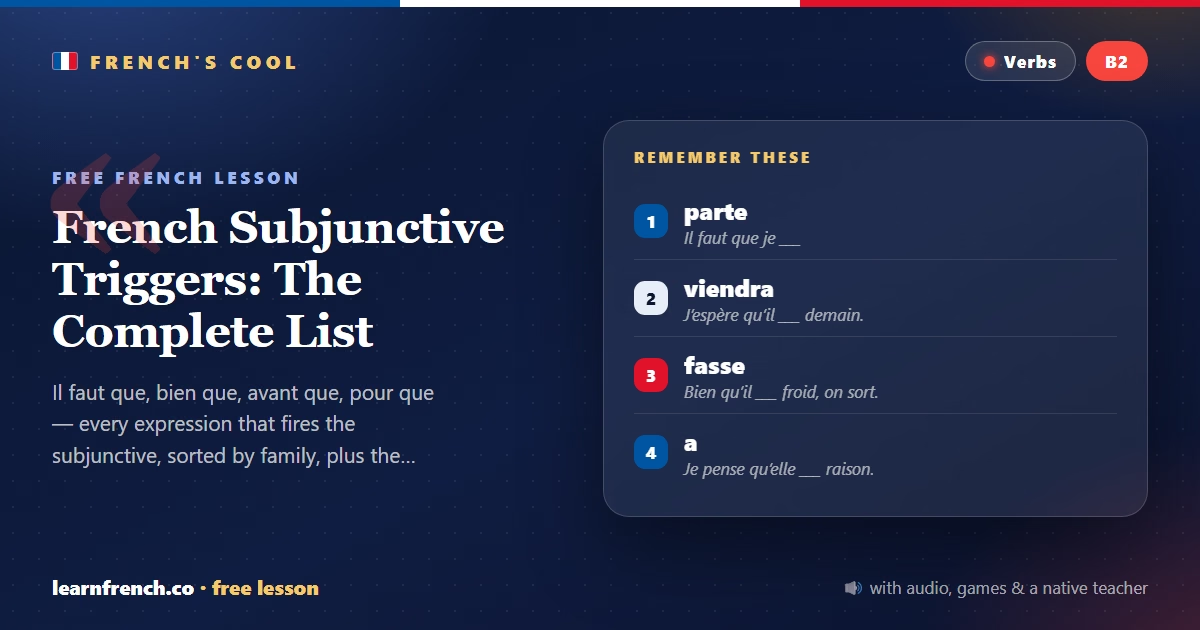
French Subjunctive Triggers: The Complete List
Il faut que, bien que, avant que, pour que — every expression that fires the subjunctive, sorted by family, plus the impostors that look like triggers but take the indicative.
What you'll learn
You know how to FORM the subjunctive — the real skill is knowing WHEN. Good news: the triggers come in five families, and once you own the families, the mood fires itself.
🔑 Trigger + que + new subject = subjunctive
The subjunctive fires when three things line up: a trigger of will, emotion or doubt (je veux, il faut, j’ai peur, je ne pense pas) + que + a different subject: je veux que tu viennes. Same subject? The infinitive takes over: je veux venir.
🎬 This lesson in one minute
The quick version — the full lesson is below. More shorts →
Family 1: wanting and needing
- vouloir que: je veux que tu viennes
- il faut que: il faut que je parte — the most-used trigger in French
- aimer que, préférer que, souhaiter que, exiger que
Family 2: emotion
- être content / triste / surpris que: je suis ravi que tu sois là
- avoir peur que, regretter que, c’est dommage que
Family 3: doubt and denial
- douter que, ne pas croire que, ne pas penser que: je ne pense pas qu’il ait raison
- il est possible que, il se peut que — possibility is doubt in disguise
Family 4: the conjunction squad
- bien que / quoique (although): bien qu’il pleuve
- pour que / afin que (so that): pour que tu comprennes
- avant que (before), jusqu’à ce que (until), à condition que, sans que, à moins que (unless)
Family 5: superlative + le seul/premier/dernier
C’est le meilleur film que j’aie vu. · C’est la seule personne qui me comprenne.
The impostors (indicative!)
- espérer que → indicative: j’espère qu’il viendra
- penser/croire que (affirmative) → indicative: je pense qu’il a raison
- après que → officially indicative (though natives waver)
- parce que, pendant que, si → never subjunctive
Common mistakes that give you away
Four errors I hear every single week — fix these and you jump a level.
- Not il faut que je vais — il faut que j’aille. The big irregulars (aille, sois, aie, fasse, puisse, sache) carry most real subjunctive sentences, so drill them first.
- Not il faut que je partirai — il faut que je parte. There is no future subjunctive: the present form covers future events too.
- Not je suis content que tu es là — que tu sois là. Emotion triggers the mood even when the fact is one hundred per cent real: you are obviously there.
- The stray ne: avant qu’il ne parte means before he leaves, not before he doesn’t. After avant que, à moins que and de peur que, that little ne is decoration, not negation.
A café argument: the triggers in the wild
— Je ne pense pas qu’il soit trop tard pour réserver.
— Moi, j’ai peur que tout soit complet un samedi. Il faut qu’on appelle maintenant.
— D’accord, mais attends que je finisse mon café.
— Bien qu’on soit pressés ? Bon. Je réserve avant que tu ne changes d’avis.
Six triggers in four lines: doubt (je ne pense pas que), fear (j’ai peur que), necessity (il faut que), expectation (attendre que) and two conjunctions, bien que and avant que. That density is normal spoken French — book a table, argue about timing, and the subjunctive turns up uninvited.
How natives dodge it (legally)
Teacher’s secret: French people sidestep the subjunctive all day, and you can too.
- il faut + infinitive when the subject is general: il faut réserver tôt — no que, no mood, no stress.
- peut-être que + indicative instead of il est possible que: peut-être qu’il viendra.
- In casual speech, même si + indicative often replaces bien que: même s’il pleut, on sort.
When a form escapes you mid-sentence, reroute through one of these. It isn’t cheating — it’s fluency.
In real sentences
Read each one aloud, then tap 🔊 and shadow the audio — rhythm first, speed later.
Drill it: the conditional · si-clauses · the être chart
✍️ Your turn: pull the trigger
Il faut que je ___ (faire) mes devoirs. (irregular stem)
Show answer
fasse — il faut que is the highest-frequency trigger in spoken French.
Je pense qu’il ___ / je ne pense pas qu’il ___ (venir). (belief flips)
Show answer
vient (indicative — affirmed belief) / vienne (subjunctive — doubted).
« I hope you’re well » — subjunctive? (the famous exception)
Show answer
No: j’espère que tu vas bien — espérer takes the INDICATIVE, unlike souhaiter.
« I want to leave » = je veux que je parte? (same subject)
Show answer
Je veux partir — one subject, no que, no subjunctive.
The four irregulars to memorise first? (cover 80%)
Show answer
que je sois (être), que j’aie (avoir), que je fasse (faire), que j’aille (aller) — add puisse and sache and you’re armed.
FAQ
Why does espérer take the indicative?
French treats hope as an expectation, not a doubt. Yes, it’s arbitrary — memorise the exception and enjoy correcting natives on après que.
Same subject in both halves?
Then no que-clause at all — use the infinitive: je veux PARTIR (not je veux que je parte). The subjunctive needs two different subjects.
Where do I learn the forms?
The formation and the je-veux-que drill live in the subjunctive made simple; the moods map is in the complete tense guide.
Is the subjunctive dying out?
Not remotely — il faut que tu viennes, je veux que tu saches, avant qu’il parte are everyday spoken French. What HAS faded is the imperfect subjunctive (qu’il vînt) — that one lives only in literature.
Can I legally avoid it while I learn?
Often: il faut que je parte → je dois partir; avant qu’il parte → avant son départ. Real French does this too. But the top triggers are so frequent that learning six irregular stems is cheaper than permanent evasion.
Quick practice
Play the Quiztap to start · quick practice from this material