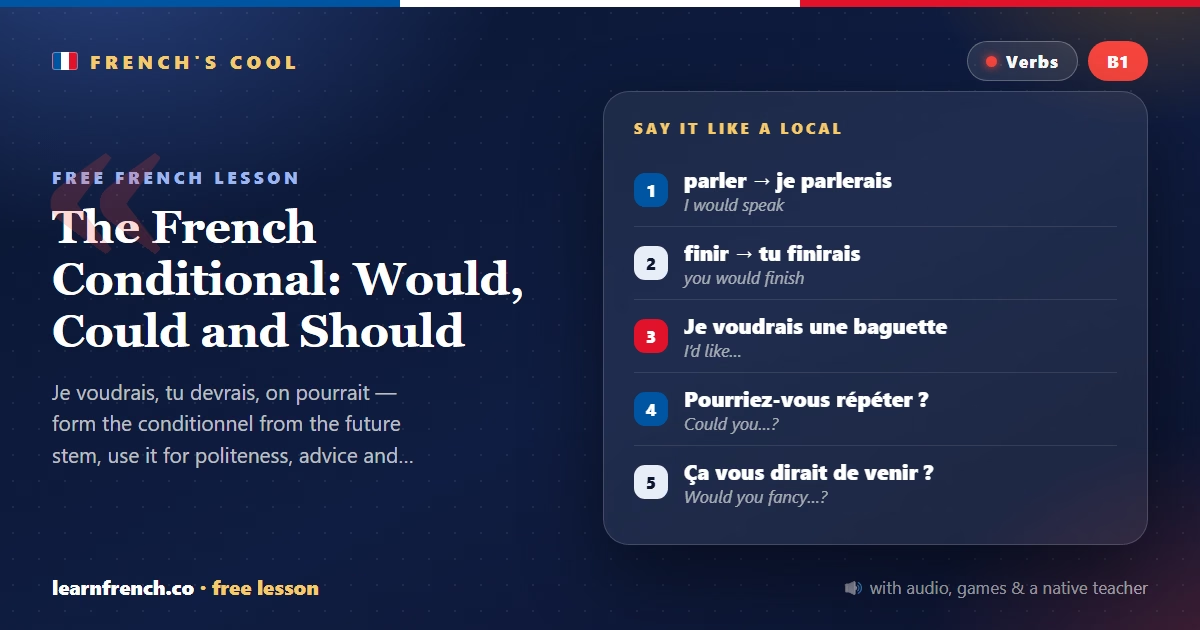
The French Conditional: Would, Could and Should
Je voudrais, tu devrais, on pourrait — form the conditionnel from the future stem, use it for politeness, advice and hypotheticals, and stop mixing it up with the future.
What you'll learn
You already use the conditional every time you order a coffee: « Je voudrais un café. » One tense covers would, could and should — and it recycles pieces you already know.
🔮 Future stem + imparfait endings
The conditional is built from parts you already own: the futur stem plus the imparfait endings — je parlerais, tu voudrais, il serait. Know the future of a verb and its conditional comes free.
🎬 This lesson in one minute
The quick version — the full lesson is below. More shorts →
Formation: future stem + imparfait endings
Take the future stem (usually the infinitive) and add -ais, -ais, -ait, -ions, -iez, -aient:
- parler → je parlerais — I would speak
- finir → tu finirais — you would finish
- Irregular stems match the future exactly: être → ser- (je serais), avoir → aur- (j’aurais), aller → ir- (j’irais), pouvoir → pourr-, devoir → devr-, vouloir → voudr-, faire → fer-.
Use 1: politeness — the customer tense
- Je voudrais une baguette. — I’d like…
- Pourriez-vous répéter ? — Could you…?
- Ça vous dirait de venir ? — Would you fancy…?
Use 2: advice with devoir
Devoir in the conditional = should: « Tu devrais dormir. » (You should sleep.) Past regret: « Tu aurais dû me le dire. » (You should have told me.)
Use 3: hypotheticals with si
Si + imparfait, conditional in the other half: « Si j’avais le temps, je voyagerais. » (If I had time, I would travel.) The si-half never takes the conditional.
Future or conditional? Listen to the ending
« Je parlerai » (future, “-é” sound) vs « je parlerais » (conditional, “-è” sound). In writing the -s decides; in speech many natives blur it — context carries you.
In real sentences
Read each one aloud, then tap 🔊 and shadow the audio — rhythm first, speed later.
Drill it: si-clauses · the pouvoir chart · the devoir chart
✍️ Your turn: soften it
Order politely: « je ___ un croissant ». (not veux)
Show answer
voudrais — je veux is a demand, je voudrais is a request.
« Could you repeat? » (vous) = ? (pouvoir)
Show answer
Vous pourriez répéter ?
Complete the si-clause: Si j’avais de l’argent, je ___ (acheter) cette maison. (never si + conditional)
Show answer
j’achèterais — si takes the imparfait, the result takes the conditional.
« We should call them » = ? (devoir)
Show answer
On devrait les appeler.
Why is it « elle a dit qu’elle viendrait » and not « viendra »? (reported speech)
Show answer
The future of a past moment is the conditional — the French « would come ».
FAQ
Is « je voudrais » more polite than « je veux »?
Much. Je veux un café sounds like a demand; je voudrais (or je vais prendre) is the standard polite register in shops and cafés.
How do I say « could have » and « should have »?
Conditionnel passé: j’aurais pu (I could have), j’aurais dû (I should have), j’aurais aimé (I would have loved). Aurais/serais + participle.
Where do I learn the si patterns properly?
All three si-patterns with examples: French si clauses. The future it borrows its stems from lives in the complete tense guide, and for near-future plans see futur proche.
What is the difference between je voudrais and j’aimerais?
Both are polite wishes. Je voudrais is the workhorse for ordering and asking; j’aimerais leans dreamier — wishes about life rather than about the menu. You can swap them without being wrong.
How do I keep je serai and je serais apart?
One letter on paper, and in careful speech a slightly more open vowel in serais. In real life, context does the work — a si-clause or a polite request signals the conditional long before the vowel does.
Quick practice
Play the Quiztap to start · quick practice from this material