Jour vs Journée, An vs Année: The Pairs English Doesn’t Have
Why does French have BOTH « jour » and « journée » for day, « an » and « année » for year? Because it splits each concept in two: the masculine short form counts units of time, the feminine -ée form…
What you'll learn
Why does French have BOTH « jour » and « journée » for day, « an » and « année » for year? Because it splits each concept in two: the masculine short form counts units of time, the feminine -ée form fills them with lived content. Once you feel that split, all four pairs snap into place.
🌅 Units count, -ée stretches
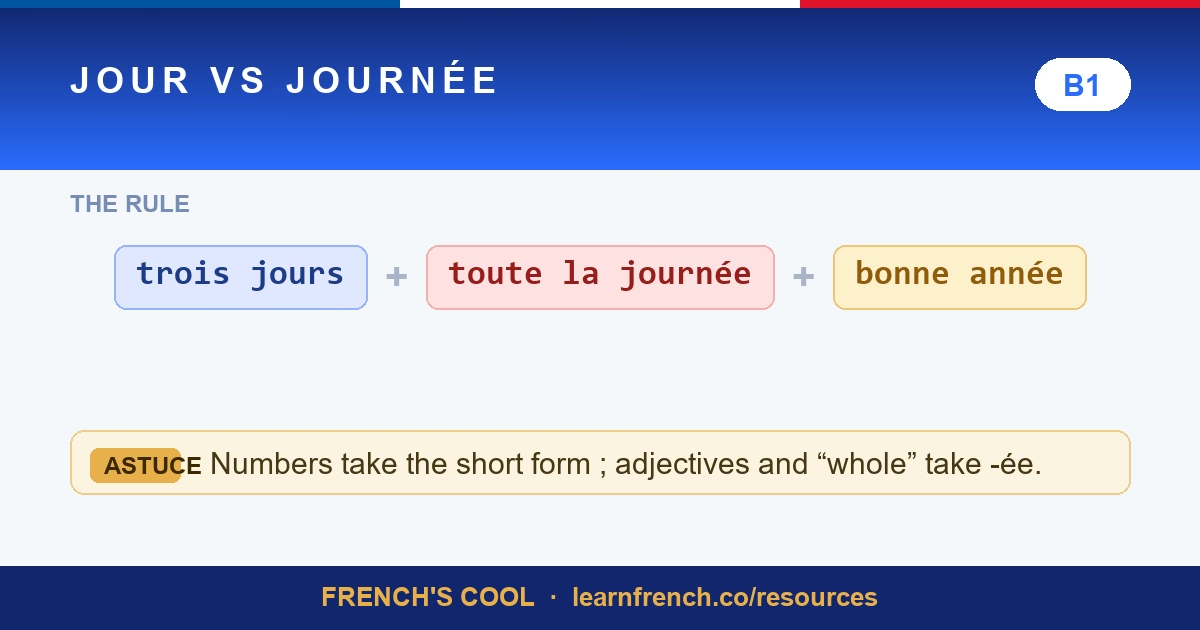
Jour, an, matin, soir are countable units and points: trois jours, ce matin. Journée, année, matinée, soirée are the stretch you live through and fill: toute la journée, une bonne soirée. Numbers → short form; « toute la… » → -ée form.
🎬 This lesson in one minute
The quick version — the full lesson is below. More shorts →
The four pairs
| Unit (counting) | Duration (experiencing) |
|---|---|
| un jour — trois jours | une journée — toute la journée |
| un an — j’ai vingt ans | une année — une bonne année |
| un matin — chaque matin | une matinée — dans la matinée |
| un soir — ce soir | une soirée — une belle soirée (also: a party!) |
The two rules of thumb
- After a number → short form: deux jours, trois ans, quatre matins. (That’s why age is ALWAYS ans: j’ai trente ans.)
- With an adjective or “whole/all” → -ée form: une longue journée, toute la matinée, une excellente année.
Greetings get it right for you
Bonjour (hello — you’re at the START, greeting the unit) vs Bonne journée ! (have a good day — you’re wishing them the whole EXPERIENCE, on your way out). Same pair at night: bonsoir on arrival, bonne soirée when leaving.
Common mistakes to stop making today
Four errors I hear every single week. Fix them now and you’ll sound a year ahead of your level.
- Not « toutes les journées » — choose tous les jours (every day — counting) or toute la journée (all day long — one stretch). Il court tous les jours ; il a plu toute la journée. Same logic a size up: tous les ans vs toute l’année.
- Not « cet an » — it’s cette année. Annoyingly, ce matin and ce soir keep the short forms, but the year flips. Memorise it and move on.
- Not « demain matinée » — say demain matin. After hier, demain and the days of the week, French sticks to the short form: hier soir, lundi matin.
- Not « bon journée » — the -ée forms are all feminine: bonne journée, toute la matinée. If you stretch the word, stretch the agreement too.
Overheard at the coffee machine
— Alors, ces vacances ?
— Géniales. On est partis huit jours en Bretagne.
— Huit jours ! Et la pluie ?
— Pas une goutte. On a passé des journées entières à la plage, et le dernier soir, on a fait une soirée crêpes chez des amis.
Hear the split? Huit jours counts the trip. Des journées entières savours the hours inside it. Le dernier soir points at a slot on the calendar — and une soirée crêpes is the party that filled it.
Set phrases worth stealing
These expressions are fixed — the French never hesitate here, so steal them as they are.
- Quelle journée ! — what a day! If you felt every minute of it, it has to be journée.
- Un jour, je… — one day, I’ll… Dreams count in units: un jour, j’irai vivre à Nantes.
- De nos jours — nowadays.
- Du jour au lendemain — overnight, from one day to the next.
- Dans les années 80 — in the eighties. A decade is a container of lived time, so it takes -ée.
The stretch trick
Still hesitating in real time? Use your mouth as the memory aid. Jour is one quick syllable — a tick on the calendar. Journée takes longer to say, because the time takes longer to live. So ask yourself one question: am I counting boxes, or telling the story inside one? Boxes → short form. Story → stretch it into -ée.
In real sentences
Read each one aloud, then tap 🔊 and shadow the audio — rhythm first, speed later.
Drill it: dates in French · temps, fois, heure · days & months chart
✍️ Your turn: unit or stretch?
« two days » = deux jours or deux journées? (counting)
Show answer
Deux jours — numbers take the unit. Deux journées exists only when you stress the filled time (deux journées entières de travail).
« all evening » = ? (the stretch)
Show answer
Toute la soirée.
Greeting arriving vs leaving? (the classic mix-up)
Show answer
Arriving: bonjour / bonsoir. Leaving: bonne journée / bonne soirée — wishing them a good rest-of-it.
« Happy New Year » = bon an? (-ée again)
Show answer
Bonne année ! — the wish covers the year as lived experience. (L’an survives in le Nouvel An and j’ai trente ans.)
« in the morning » as a habit = ? (article does it)
Show answer
Le matin: le matin, je ne parle pas beaucoup — the bare article makes it generic.
FAQ
Is it « l’an prochain » or « l’année prochaine »?
Both are correct; l’année prochaine is more common in speech. But New Year fixed phrases pick sides: le Nouvel An, but bonne année !
Why « dans la matinée » and not « dans le matin »?
Because you mean somewhere INSIDE the stretch of morning — duration → matinée. « Le matin » alone means “in the mornings” as a habit: je cours le matin.
What does « faire la grasse matinée » mean?
Literally “to do the fat morning” — to sleep in. One of the most beloved French expressions, and it HAS to be matinée: you’re savouring the duration.
All the calendar vocabulary lives on the time words chart and the months & seasons page; saying the date correctly is covered in the dates lesson.
An vs année — same rule?
Same instinct: an counts (deux ans, à dix-huit ans, le Nouvel An), année stretches and gets described (une bonne année, l’année scolaire, ces dernières années). With numbers, an wins except in cette année-là style phrases.
Matinée and soirée also mean events, right?
Yes — une soirée is also a party (on organise une soirée) and faire la grasse matinée is the beloved institution of sleeping in. The -ée forms carry the lived, social side of time.
Quick practice
Play the Quiztap to start · quick practice from this material