A1 to B2: What the French Levels Really Mean (Your Roadmap)
What are the CEFR French levels? The CEFR — the Common European Framework of Reference for Languages — is the international standard that describes language proficiency on a single scale. For French it defines six CEFR levels from A1 to C2 : A1 and A2 (basic user), B1 and B2 (independent user), and C1 and…
What you'll learn
What are the CEFR French levels?
The CEFR — the Common European Framework of Reference for Languages — is the international standard that describes language proficiency on a single scale. For French it defines six CEFR levels from A1 to C2: A1 and A2 (basic user), B1 and B2 (independent user), and C1 and C2 (proficient user). Each level (niveau) sets out exactly what you can do — understand, speak, read and write — so you can measure real progress rather than guess. Here’s the full roadmap.
A1, A2, B1, B2… you see these codes on every course, exam and job posting — but what do they actually mean? They come from the CEFR (the European language framework), and understanding them turns “I want to be fluent” into a concrete, motivating roadmap. Here’s each level in plain English: what you can do, how long it typically takes, and exactly what to work on.
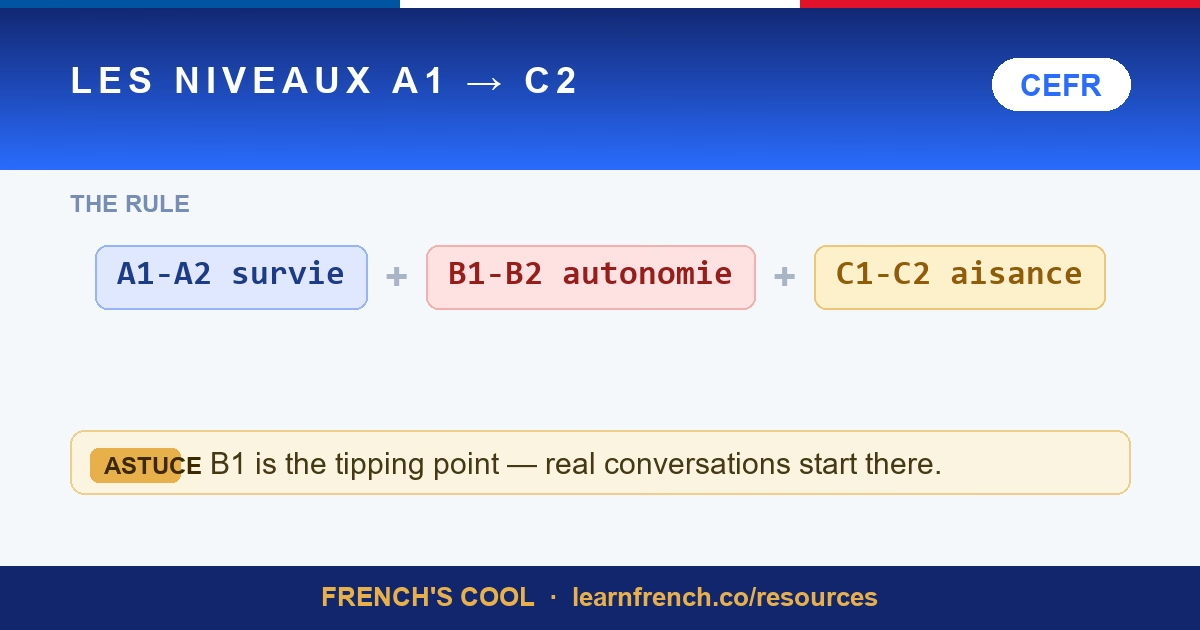
A1 — The survivor (0 → 3 months)
You can: introduce yourself, order food, ask simple questions, survive politely as a tourist.
Work on: greetings and politeness, être & avoir, numbers, articles, and the present tense of the top 20 verbs. About 80–100 hours of study.
A2 — The everyday speaker (3 → 8 months)
You can: handle daily life — shopping, directions, small talk about family and work, simple past events.
Work on: the past tenses, daily-routine reflexives, directions, negation, and the futur proche. ~180–200 total hours.
B1 — The independent speaker (8 → 18 months)
You can: hold real conversations, tell stories, explain opinions, travel without stress, watch simple shows. This is the level where French starts being fun.
Work on: object pronouns, relative pronouns, the futur simple, comparisons, and listening volume (series, podcasts). ~350–400 total hours.
B2 — The confident speaker (18 → 30 months)
You can: work in French, argue a point, understand native speed, use humour. B2 is the level universities and employers ask for — and the DELF B2 proves it.
Work on: the subjunctive, nuanced connectors, debate practice, and writing. ~600–650 total hours.
C1 — The proficient speaker (30 months +)
At C1 you use French flexibly for social, academic and professional life. You understand long, demanding texts, grasp implicit meaning, and express yourself with spontaneity and near-fluency — rarely searching for words. You can read a complex text, follow fast native conversation, and write clear, well-structured pieces. This is the level many universities and employers in France ask for.
C2 — Mastery (near-native)
C2 is the top of the CEFR scale: effortless comprehension of virtually everything you read or hear, and precise, nuanced expression close to a native speaker. C2 doesn’t mean « perfect » or accent-free — it means you can handle any situation, including subtle humour and idiom. Very few learners need C2; B2–C1 is « fluent » for almost all real-world purposes.
Three truths about levels
- Hours beat years. 30 minutes daily gets you to A2 in months; one class a week takes years for the same result.
- Skills are uneven. You can read at B1 and speak at A2 — normal! Speak early to keep them close.
- Levels unlock motivation. “Reach A2 by June” is a plan; “become fluent” is a wish. Test yourself against the can-do lists above every few months.
✍️ Quick quiz — did it stick?
What level do most employers and universities require? (the exam level)
Show answer
B2
Which tense family unlocks A2? (talking about yesterday)
Show answer
the past tenses (passé composé & imparfait)
Better for progress: 30 min daily or 3h on Sunday? (consistency)
Show answer
30 min daily
Play the Quiztap to start · quick practice from this material
Loading the quiz…
The levels in human terms (with the official wording decoded)
The CEFR — the Council of Europe’s Common European Framework — defines six common reference levels for every foreign language, and all french course syllabi, DELF exams and Alliance Française placements map onto them. Here is what the levels of french mean when the language is spoken to you across a real table. A1: you understand and use everyday expressions spoken slowly and clearly — introduce yourself, ask and answer questions about where you live. A2: routine tasks — shopping, directions, simple exchanges about familiar things. B1 level: the traveller’s threshold — you handle most situations while travelling, describe experiences and give brief reasons; language use becomes independent if unpolished. B2: the independence certificate — spontaneous interaction with native speakers without strain on either side, arguments defended, news followed. C1: fluent, flexible, implicit meaning caught; academic and professional life is fully in French. C2: near-native precision — summarise, reconstruct, joke; a degree of fluency most natives don’t test well on either.
Two honest notes the official descriptors skip. First, proficiency levels are skill profiles, not staircases — most learners are B2 readers while still B1 speakers, and that asymmetry is normal: spoken and written skills grow at different speeds, and your native language’s distance from French sets the pace. Second, the hours: roughly 80–100 guided hours per level early on, doubling as you climb — which is why the A1-to-B2 road is usually two to three years of steady language learning, not the twelve weeks of app marketing. Use the levels according to their real purpose: placing yourself honestly (read a level’s descriptors and ask « can I already do this, in speaking french, today? »), picking material one notch above your comfort, and knowing what a certificate claims about the language skills behind it. The framework’s quiet genius is that levels provide a shared truth: a B2 in Lyon, Lagos or Lima can use the language the same way — and once you know where you stand, every hour of study finally has an address.
FAQ
What level of French is considered fluent?
Conversationally fluent maps to B2; professionally fluent to C1. « Fluent » isn’t a CEFR word — pick the level whose real-world descriptors match your goal.
How long does each CEFR level take?
Typical guided-hours: A1 ~80–100, A2 +100–120, B1 +150–180, B2 +200+, then C-levels on immersion and use. Intensity compresses the calendar, never the hours.
What CEFR level do universities and visas require?
French universities generally ask B2 (DELF B2 or TCF equivalent); long-stay and residence tracks vary from A2 to B1. Check the specific programme — and note DELF diplomas never expire.
French CEFR levels FAQ
What are the CEFR French levels from A1 to C2?
Six levels: A1 (beginner) and A2 (elementary) are the basic user; B1 (intermediate) and B2 (upper-intermediate) are the independent user; C1 (advanced) and C2 (mastery) are the proficient user. Together they cover the whole journey from first words to near-native fluency.
Which CEFR level is considered fluent in French?
There’s no official « fluent » badge, but B2 is the widely accepted threshold for confident, independent French — enough to work, study and socialise comfortably. C1 and C2 add polish, nuance and ease with complex text.
How do I know my French CEFR level?
Compare what you can actually do against each level’s description above, or take a recognised test (DELF/DALF, TCF, TEF) that certifies your language proficiency on the A1 to C2 scale. Our how-long-to-learn-French guide maps typical timelines to each level.
🧰 Your practice kit
Wherever you are on the ladder, these are your next rungs:
🎯 More practice — translation — put it into French
Translate into French: « Hello! My name is Sarah and I’m learning French. » (translation)
Show answer
Bonjour ! Je m’appelle Sarah et j’apprends le français.
Translate into French: « Yesterday I went to the market and bought strawberries. » (translation)
Show answer
Hier, je suis allée au marché et j’ai acheté des fraises.
Translate into French: « In my opinion, it’s the most beautiful moment of the trip. » (translation)
Show answer
À mon avis, c’est le plus beau moment du voyage.
Prefer a human? Book a free lesson with Xavier →
🎮 Practise this lesson
Games built from this exact page — turn what you just read into play:
🧩 Sentence Builder rebuild these sentences
🎬 This article in 20 seconds
The quick version — the full detail is below. More shorts → Open this short as a page — transcript included →