The French Past Tenses: Passé Composé & Imparfait, Finally Clear
The complete guide to the French past tenses — how passé composé and imparfait work as a team, the movie trick for choosing, the five classic mistakes, and a 2-week practice plan.
What you'll learn
Ask any intermediate learner what finally made French “click”, and the past tenses come up every time. English has one simple past — I ate — but French splits that job between two tenses that work as a team: the passé composé and the imparfait. Once you see how the team works, half of French storytelling falls into place. This guide gives you the complete picture.
🎬 This lesson in one minute
The quick version — the full lesson is below. More shorts →
The two players
1. The passé composé — what happened
The passé composé reports completed events: things that happened once, at a moment, and moved the story forward. It is built with avoir (or être) + past participle:
Most verbs use avoir. A small famous group — movement and change-of-state verbs (aller, venir, partir, arriver…) plus all reflexive verbs — uses être, and the participle then agrees: elle est arrivée.
2. The imparfait — what was going on
The imparfait paints the background: descriptions, habits, feelings, weather — anything that “was” or “used to be” with no clear endpoint. Take the nous form of the present, drop -ons, add the endings -ais, -ais, -ait, -ions, -iez, -aient:
The movie trick — how to choose in one second
Picture your story as a film scene:
- 🏞️ The imparfait is the scenery — the camera pans over what was already happening: il pleuvait, je lisais, la maison était calme…
- 🎬 The passé composé is the action — the events that make the plot move: soudain, on a frappé à la porte.
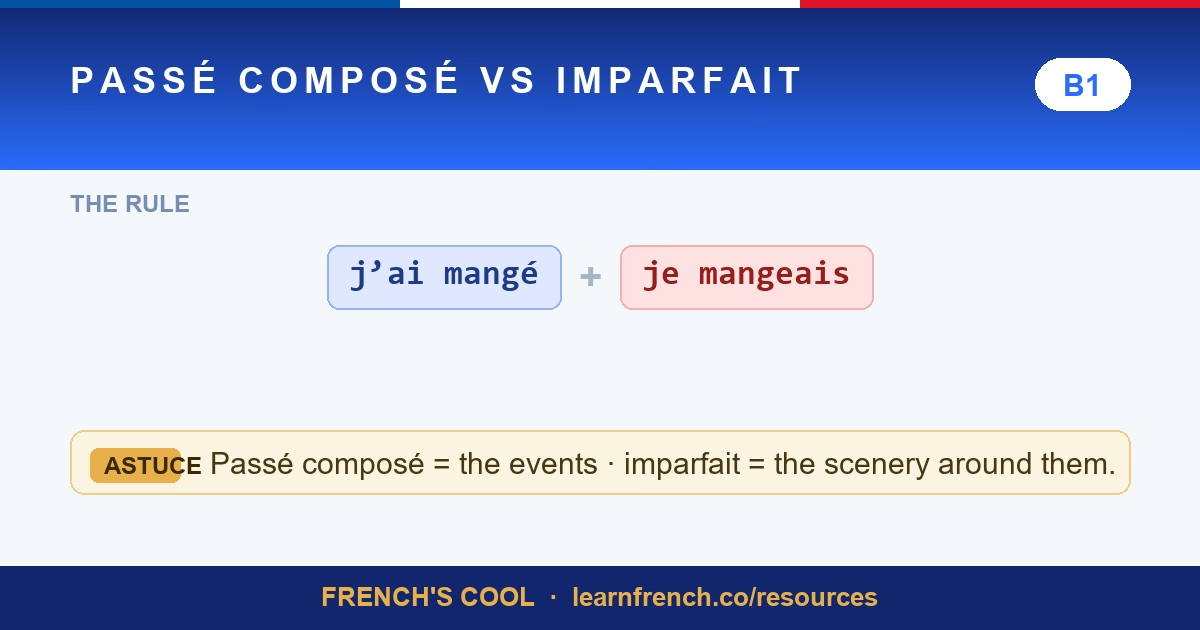
That single sentence contains the whole system: dormais (background, imparfait) interrupted by a sonné (event, passé composé). Our PC vs imparfait chart gives you the full decision table and the signal words (hier, soudain → PC · souvent, chaque jour → imparfait).
The five mistakes everyone makes
- Translating “was” as imparfait automatically. “The film was great” said as a verdict after watching = le film était génial… but “the party was great, thanks!” as a completed judgement = la soirée a été géniale. Ask: background or wrapped-up event?
- Forgetting être-verb agreement: elle est allée, ils sont partis.
- Forgetting reflexive agreement: elle s’est levée — but no agreement before a body part: elle s’est lavé les mains.
- Using imparfait for a chain of events. First… then… after that → that’s a plot, use the passé composé.
- Avoiding the past entirely! You can’t speak French without it — start with your day: ce matin, je me suis levé à 7 h, j’ai bu un café…
Your 2-week practice plan
- Days 1–3: master the participles of être, avoir, faire, prendre, voir (été, eu, fait, pris, vu).
- Days 4–7: narrate your day aloud each evening in the passé composé — 5 sentences.
- Days 8–10: add the scenery: redo the same stories with one imparfait background line each.
- Days 11–14: do the exercises on the PC vs imparfait and reflexive verbs charts, then tell a childhood memory (imparfait) with one surprise event (PC).
🎬 Video lesson
 Passé composé et Imparfait — 10 exemples faciles
✍️ Quick quiz — did it stick?
passé composé of voir → j’ai ___ (participle)
Show answer
vu
Background, habits and descriptions use the ___ (tense)
Show answer
imparfait
Elle est ___ (aller) au marché. (agreement!)
Show answer
allée
Play the Quiztap to start · quick practice from this material
Loading the quiz…
The decision path: which past tense, and why
Doing the past tense in French is always a two-step decision. Step one: is the past action a completed event or a background state? Events take le passé composé — a compound tense built in two parts: conjugate the auxiliary (the verb avoir for most verbs, être for movement and reflexives) in the present tense, then add the past participle: j’ai vu, elle est partie. States, habits and scenery take the imperfect tense — one word, no auxiliary: je regardais, il pleuvait — the tense that covers English’s past progressive (“was watching”) and “used to”. The two are often used alongside each other in the same sentence, which is exactly what our passé composé vs imparfait page drills in depth.
Step two, for the passé composé only: agreement. With être the participle agrees with the subject (elles sont arrivées); with avoir it agrees only when a direct object jumps in front of the verb: la lettre que j’ai écrite. That single rule is most of what separates written French grammar from spoken — you hear it rarely, examiners look for it always. Beyond the big two, the system rounds out with the plus-que-parfait (imperfect auxiliary + participle — “had done”, for the past behind the past) and the passé simple, the literary tense that replaces the passé composé in novels: il vit, elle alla. Recognise it when studying french texts; no french tutor will ever ask you to speak it.
So how many french past tenses matter? Four for reading, three for writing, two for talking — and the two conversational ones obey one story-logic: composé moves the plot, imperfect paints the set. Conjugate ten of your own past events aloud tonight — five with avoir, five with être — and this corner of french verb conjugation becomes muscle memory before the week is out. Master the french past and you can tell stories; and telling stories, every teacher knows, is where learners become french speakers.
FAQ
How do you do past tense in French?
For events: present-tense auxiliary + past participle (j’ai mangé, je suis allé). For background and habits: the one-word imperfect (je mangeais). Decide event-vs-background first; the grammar follows.
What are the 4 types of past tense?
Passé composé (completed events), imparfait (states and habits), plus-que-parfait (past before the past) and passé simple (the literary stand-in for the passé composé). Speech uses the first two constantly, the third occasionally, the fourth never.
How many past tenses are in French?
Five if you add the rare passé antérieur — but conversation runs on passé composé + imparfait. Learn those two deeply rather than five shallowly.
Is it « je vais » or « aller »?
Je vais is the conjugated present of aller — and « je vais + infinitive » (futur proche) is the everyday future: je vais manger. Aller unconjugated appears only after another verb or preposition. Full chart on our aller page.
How many past tenses does French have?
Four you will meet, two you actually need. In order of importance:
- Passé composé — completed actions; the everyday past: j’ai mangé.
- Imparfait (imperfect) — background, habits, descriptions: je mangeais.
- Plus-que-parfait (pluperfect) — the « past before the past »: j’avais mangé (I had eaten). Formed exactly like the passé composé but with the auxiliary in the imparfait.
- Passé simple — the literary past. You only read it (novels, history): il mangea, ils furent. Nobody uses it in conversation — recognise it, never produce it.
How to form the past participle
The passé composé is a two-part tense: avoir/être in the present + past participle. The participle comes from the infinitive:
- -er → -é : parler → parlé
- -ir → -i : finir → fini
- -re → -u : vendre → vendu
The irregulars are frequent enough to learn as a set: être → été, avoir → eu, faire → fait, prendre → pris, voir → vu, mettre → mis, dire → dit, pouvoir → pu, vouloir → voulu, venir → venu.
Avoir or être: which auxiliary?
Most verbs take avoir. A small famous club takes être: the movement/change-of-state verbs (aller, venir, arriver, partir, monter, descendre, naître, mourir, rester, tomber, retourner…) plus every reflexive verb (je me suis levé). With être, the participle agrees: elle est allée, ils sont partis. Full list with audio: the être verbs.
Negation and questions in the past
« Ne … pas » wraps around the auxiliary only: « Je n’ai pas mangé » — never around the participle. Questions work like the present: « Tu as mangé ? », « Est-ce que tu as mangé ? », or formal « As-tu mangé ? ».
French past tense FAQ
What’s the fastest rule of thumb?
If you could film it happening once, passé composé. If it was the scenery, a habit or an ongoing state, imparfait. That one sentence solves most cases — the movie trick above is the long version.
Do I need the passé simple in conversation?
No. In speech and email the passé composé does its job. You will meet the passé simple in books — il fut, il eut, il alla — so learn to recognise those forms and move on.
Is « je vais » a past tense?
No — « je vais » is the present of aller (I go / I am going). It builds the near future (« je vais manger » = I’m going to eat), not the past. The past of aller is « je suis allé(e) ».
The three French past tenses at a glance
Spoken French really uses three past tenses: the passé composé (completed actions), the imparfait (description and habit) and, more rarely, the plus-que-parfait (the earlier past). The passé simple is a written past tense you only need to recognise. Master the passé composé and imparfait and you can talk about the past in almost any situation. The French past tense that trips learners up most is choosing between those two — so learn them as a pair.
Irregular past participles you must know
Regular past participles are predictable (-er → -é, -ir → -i, -re → -u), but the most common verbs have irregular ones. Because these verbs appear constantly, learning their past participle is the fastest way to speak the French past tense correctly:
| Infinitive | Past participle | Example (passé composé) |
|---|---|---|
| avoir | eu | j’ai eu |
| être | été | j’ai été |
| faire | fait | j’ai fait |
| voir | vu | j’ai vu |
| prendre | pris | j’ai pris |
| mettre | mis | j’ai mis |
| dire | dit | j’ai dit |
| venir | venu | je suis venu(e) |
| pouvoir | pu | j’ai pu |
| vouloir | voulu | j’ai voulu |
| boire | bu | j’ai bu |
| écrire | écrit | j’ai écrit |
Common passé composé mistakes to avoid
- Wrong auxiliary. Movement and change-of-state verbs take être, not avoir: « je suis allé », never « j’ai allé ».
- Forgetting agreement. With être, the past participle agrees: « elle est allée », « ils sont partis ».
- Using the wrong past tense. Use the passé composé for completed actions and the imparfait for description and habit — mixing them up is the classic error.
- Negation placement. « ne » and « pas » wrap the auxiliary: « je n’ai pas vu », not « je n’ai vu pas ».
🧰 Your practice kit
This guide gave you the big picture — now drill each piece with these free interactive charts (audio + exercises included):
🎯 More practice — translation — put it into French
Translate into French: « Yesterday I saw Marie at the market. » (translation)
Show answer
Hier, j’ai vu Marie au marché.
Translate into French: « We arrived at noon. » (translation)
Show answer
Nous sommes arrivés à midi.
Translate into French: « When I was little, we spent summers at my grandmother’s. » (translation)
Show answer
Quand j’étais petit, on passait l’été chez ma grand-mère.
Translate into French: « The weather was nice and people were smiling. » (translation)
Show answer
Il faisait beau et les gens souriaient.
Translate into French: « I was sleeping when the phone rang. » (translation)
Show answer
Je dormais quand le téléphone a sonné.
Prefer a human? Book a free lesson with Xavier →
🎮 Practise this lesson
Games built from this exact page — turn what you just read into play:
🧩 Sentence Builder rebuild these sentences
🎧 Listening Game which sentence do you hear?
Keep going: One layer deeper lies the past-before-the-past: the plus-que-parfait.