How to Write an Email in French: Openings, Closings, Templates
Madame, Monsieur… Cordialement — the exact openings, closings and connector phrases for professional French emails, plus a template you can reuse today.
What you'll learn
French emails run on formulas — which is excellent news: learn the fixed pieces and every email assembles itself. Here is the machine.
📧 An email is a frame you fill
French emails run on fixed formulas: an opener, your business, a closer. Learn two complete frames — Bonjour + Cordialement for everyday professional mail, and Madame, Monsieur + Je vous prie d’agréer… for formal letters — and you can write to anyone in France.
🎬 This lesson in one minute
The quick version — the full lesson is below. More shorts →
L’objet — the subject line
Short and noun-based: « Demande d’information », « Candidature — poste de graphiste », « Suite à notre appel ». No full sentences, no « Bonjour ! ».
Openings, by distance
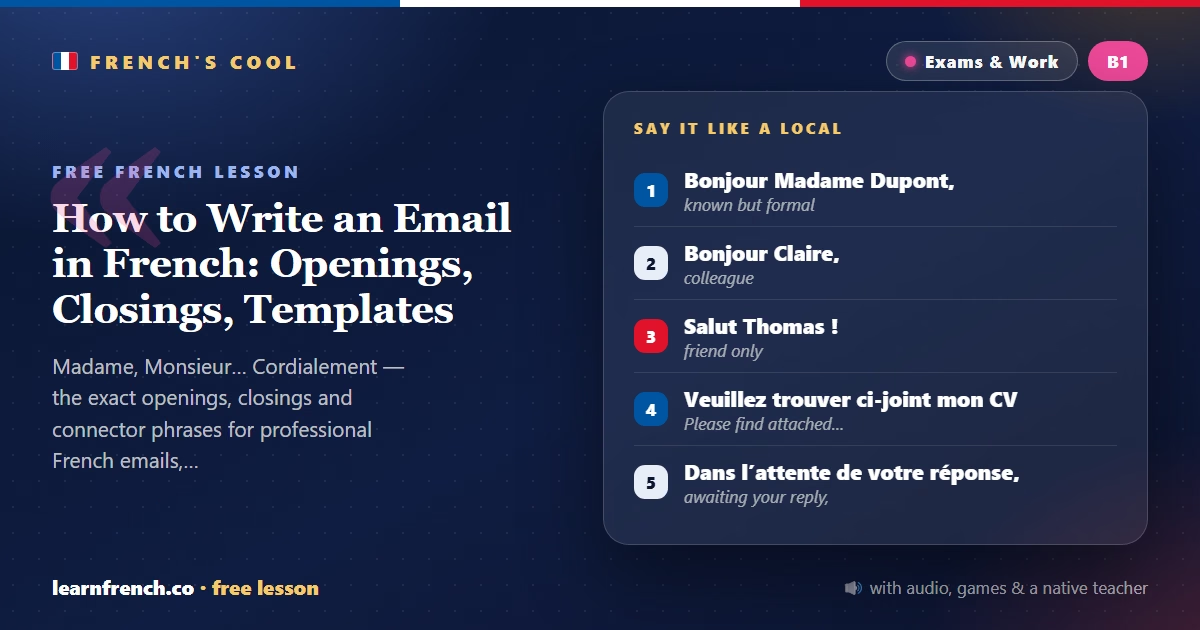
- Madame, Monsieur, — unknown reader (the safe default; note: no « Cher »)
- Bonjour Madame Dupont, — known but formal
- Bonjour Claire, — colleague
- Salut Thomas ! — friend only
The body: connector phrases that do the work
- Je me permets de vous contacter au sujet de… — I’m reaching out about…
- Suite à notre conversation téléphonique… — Following our call…
- Je vous écris afin de… — I’m writing (in order) to…
- Veuillez trouver ci-joint mon CV. — Please find attached…
- Je reste à votre disposition pour tout renseignement. — I remain available…
- Dans l’attente de votre réponse, — awaiting your reply,
The Cordialement ladder
- Je vous prie d’agréer, Madame, Monsieur, l’expression de mes salutations distinguées. — maximum formality (cover letters, administration)
- Cordialement, — the universal professional close (90% of emails)
- Bien cordialement, / Bien à vous, — warm-professional
- Bonne journée ! / À bientôt, — casual
A template you can reuse
Objet : Demande d’information — cours de français
Madame, Monsieur,
Je me permets de vous contacter au sujet de vos cours en ligne. Pourriez-vous m’indiquer vos disponibilités pour le mois de septembre ?
Je reste à votre disposition pour tout renseignement complémentaire.
Cordialement,
Emma Wilson
In real sentences
Read each one aloud, then tap 🔊 and shadow the audio — rhythm first, speed later.
Drill it: the French CV · tu or vous at work · professional apologies
✍️ Your turn: fill the frame
« Please find attached… » = ? (one word)
Show answer
Ci-joint : vous trouverez ci-joint le document.
« Following up on our meeting… » = ? (suite)
Show answer
Suite à notre réunion… — the standard follow-up opener.
You don’t know if your reader is a man or woman. Opener? (cover both)
Show answer
Madame, Monsieur, — on two words, exactly like that.
Rank the closers: Cordialement / Bien à vous / Je vous prie d’agréer… (warmth vs weight)
Show answer
Cordialement = neutral default; Bien à vous = a shade warmer; Je vous prie d’agréer, Madame, Monsieur, mes salutations distinguées = full formal letters only.
Writing to a friend — opener and closer? (drop the frame)
Show answer
Salut Léa / Coucou + Bises, À bientôt or just A+ — the formal frame would read as irony.
FAQ
Is « Cher Monsieur » wrong?
Cher/Chère implies you know the person. Cold email → Madame, Monsieur (both words, comma, new line). Once a relationship exists, Cher Monsieur Dupont is fine.
Tu or vous in work emails?
Vous until the other side switches — even if the meeting was friendly. The whole social logic is in tu vs vous.
Where do I get the spoken-meeting equivalents?
Phone and meeting formulas are in business French phrases, the wider workplace guide is French for work, and if the email is a job application, read the French job interview next.
Is « Cher Monsieur » like English « Dear Sir »?
Close, but cher carries a touch of warmth in French — it suits people you already correspond with. First contact with a stranger is safer as plain Madame, / Monsieur, — formal, correct, and never presumptuous.
How fast can I drop the formality in a thread?
Mirror the other person, one step behind. If they sign Bien à vous, you may too; if they switch to first names, follow. In French business mail the other side always de-formalises first.
Quick practice
Play the Quiztap to start · quick practice from this material