Business French: 30 Phrases for Emails & Meetings
Working in French? Essential business French phrases for professional emails, meetings and calls, from an ex-industry teacher.
What you'll learn
Whether you’re relocating to a French company, dealing with French clients, or simply want to contribute in meetings, professional French runs on a surprisingly small set of phrases. Master these and you’ll sound polished and confident — long before your grammar is perfect.
🎬 This lesson in one minute
The quick version — the full lesson is below. More shorts →
Opening an email
- Bonjour Madame / Monsieur, — the standard professional opening (use the name if you know it: Bonjour Madame Dupont,)
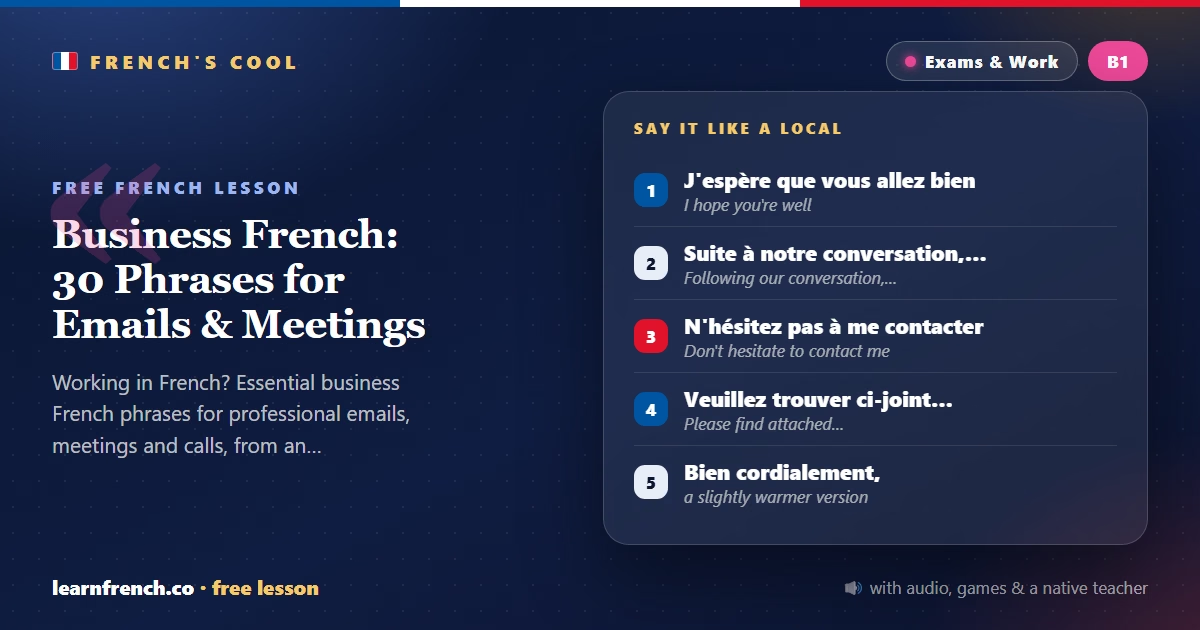
- J’espère que vous allez bien. — I hope you’re well.
- Je me permets de vous écrire au sujet de… — I’m writing to you regarding…
- Suite à notre conversation,… — Following our conversation,…
- Pour faire suite à votre message,… — In response to your message,…
The body: making requests politely
French professional culture values the conditional — it softens requests and sounds respectful.
- Pourriez-vous… ? — Could you…? (far better than the blunt Pouvez-vous)
- Je vous serais reconnaissant(e) de… — I would be grateful if you would…
- N’hésitez pas à me contacter. — Don’t hesitate to contact me.
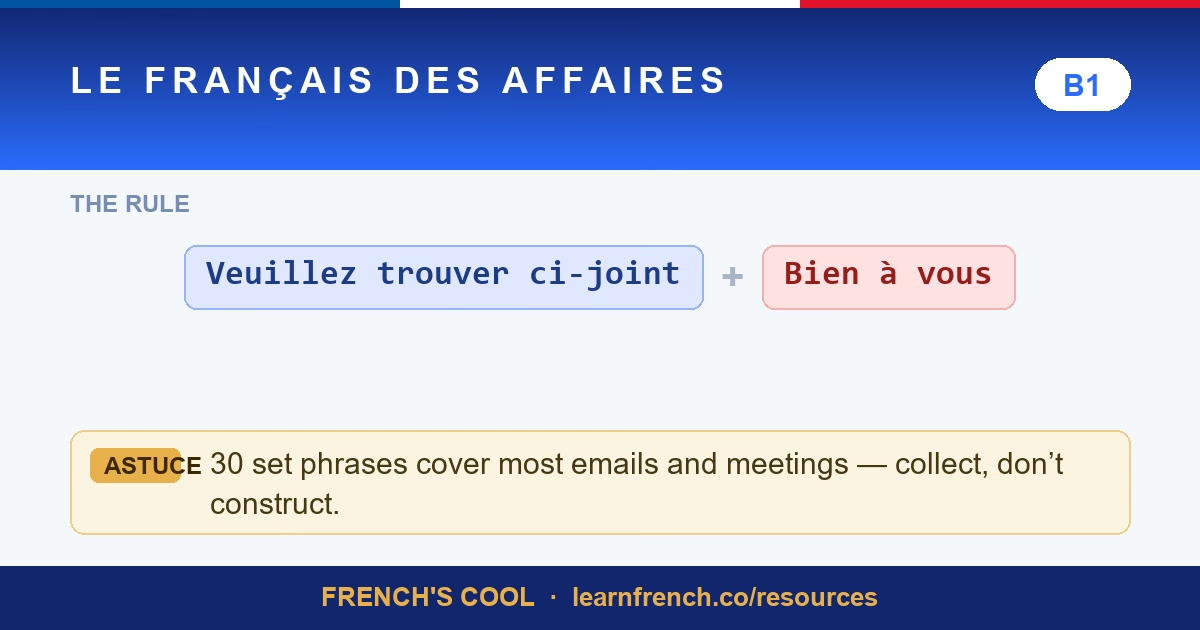
- Veuillez trouver ci-joint… — Please find attached…
- Je reste à votre disposition. — I remain at your disposal (a classic, expected closing line).
Closing an email
French sign-offs are more formal than English ones. The safe, universal choice:
- Cordialement, — Kind regards (the everyday professional default)
- Bien cordialement, — a slightly warmer version
- Je vous prie d’agréer, Madame, Monsieur, mes salutations distinguées. — the very formal closing for letters and first contact
In a meeting
- Je voudrais ajouter quelque chose. — I’d like to add something.
- Si je peux me permettre… — If I may…
- Je suis d’accord / Je ne suis pas tout à fait d’accord. — I agree / I don’t entirely agree.
- Pouvez-vous préciser ? — Could you clarify?
- Pour résumer,… — To sum up,…
- On se recale la semaine prochaine ? — Shall we touch base next week? (informal team talk)
On the phone
- Allô ? / Bonjour, [name] à l’appareil. — Hello? / Hello, [name] speaking.
- Pourrais-je parler à… ? — Could I speak to…?
- Un instant, je vous prie. — One moment, please.
- Pouvez-vous me rappeler ? — Can you call me back?
A word on register: tu vs vous at work
In a professional first contact, always start with vous. Many French companies are relaxed and switch to tu within the team, but you let the more senior person or the local norm lead. When in doubt, vous is never wrong.
A sample email you can adapt
Bonjour Madame Dupont,
J’espère que vous allez bien. Pour faire suite à notre réunion, vous trouverez ci-joint le compte-rendu. Pourriez-vous me confirmer les prochaines étapes avant vendredi ? Je reste à votre disposition pour toute question.
Cordialement,
[Votre nom]
Practise it with a real teacher
Reading about French is one thing — saying it out loud, with someone who corrects you gently and adapts to your level, is what makes it stick. Your first 20-minute lesson with Xavier is free, with no card and no commitment. Book your free lesson and let’s put this into practice.
🎬 Video lesson
 French for Business: 10 Phrases You NEED to know
✍️ Quick quiz — did it stick?
Polite request: je ___ un rendez-vous. (conditional of vouloir)
Show answer
voudrais
Formal email sign-off: ___ (one word)
Show answer
Cordialement
a meeting → une ___ (workplace word)
Show answer
réunion
Play the Quiztap to start · quick practice from this material
Loading the quiz…
The culture code: what the vocabulary won’t tell you
French business culture runs on forms that no vocabulary list teaches, and business partners read them before they read your grammar. The handshake: brief, daily, everyone in the room — colleagues who have worked together for years still shake each morning. Vous, permanently: business etiquette keeps vous long after Anglophone workplaces would first-name; wait for « on peut se tutoyer » and treat it as a promotion. Titles and job titles: emails open with « Monsieur le Directeur » territory formality — the essential french business email close « Je vous prie d’agréer mes salutations distinguées » looks baroque and is completely standard. And lunch: business in France still happens at the table; the déjeuner is a working institution, and discussing the deal before dessert is the real faux pas.
The workplace phrases that carry a business trip: « Je vous présente… » (introductions), « Pouvez-vous préciser ? » (can you clarify — the polite power move of every réunion), « On se tient au courant » (we’ll keep each other posted), « Je reviens vers vous » (I’ll get back to you — French people conjugate the same corporate verbs as everyone else). Add the vocabulary for companies and roles above — l’entreprise, la société, le PDG, le chiffre d’affaires — and the words and expressions for negotiating deadlines (un délai is a deadline, NOT a delay: the false friend that has rescheduled a thousand projects), and you can work in France without the native french speaker safety net. The strategy for language learning here is register-first: french speakers forgive vocabulary gaps instantly and register slips slowly, so practice french formality until it’s automatic, and let the technical words and phrases accumulate from your own field — nobody’s business world needs all of them, everyone’s needs the culture code.
FAQ
How formal should my business French emails be?
More formal than feels natural: full greetings, vous throughout, and a ceremonial closing formula. « Cordialement » is the safe modern sign-off; save « Bien à vous » for established contacts.
What’s the most important business French phrase?
« Pouvez-vous préciser, s’il vous plaît ? » — it buys thinking time, flatters the speaker, and replaces a dozen situations where English would bluff. Close second: « Je reviens vers vous ».
Do I need business French to work with French companies?
Meetings increasingly run in English, but the relationship layer — greetings, lunch, email courtesy — runs in French. Handling that layer in French is what French business partners actually remember.
These are the French phrases that make you operational in a French business environment — and the French vocabulary below is what a good tutor drills first.
Core French business vocabulary
The nouns that carry every workday — learn them with their genders:
- une réunion — a meeting · un rendez-vous — an appointment
- une entreprise / une société — a company · le siège — headquarters
- un devis — a quote · une facture — an invoice · un contrat — a contract
- un délai — a deadline (false friend: NOT « delay »!) · un dossier — a file/project
- le chiffre d’affaires — revenue · un compte rendu — minutes/report
- embaucher — to hire · démissionner — to resign · gérer — to manage
French workplace culture in five rules
- Vous by default. Colleagues may switch to tu quickly; clients and hierarchy usually stay vous.
- Bonjour is non-negotiable — greet the room when you arrive; skipping it reads as rude.
- Lunch matters. The déjeuner is protected time and often where the real business happens.
- Formality in writing. French business emails keep ceremonious closings (« Cordialement » at minimum) even between colleagues.
- Debate is normal. A vigorous discussion in a French business meeting is engagement, not conflict.
Business French FAQ
Are English words common in French business settings?
Very — « un meeting », « un call », « le deadline », « asap » are everywhere, especially in tech and marketing. Recognise them, but keep the French equivalents for formal writing: a client email says « réunion », not « meeting ».
How do I say « meeting » in a French business context?
« Une réunion » is the standard word; « un rendez-vous » is a one-on-one appointment; casual offices also say « un point » (a quick check-in): « On fait un point demain ? »
How formal should my business French be?
More formal than English, especially in writing. When unsure, use vous, full sentences and « Cordialement » — nobody was ever penalised in France for being slightly too polite.
How do I prepare for a job interview in French?
Prepare your introduction, your « parcours » (career story) and questions to ask back — we built a dedicated guide: French for job interviews. For meetings, emails and interviews with feedback, that is exactly what professional French lessons are for.
Essential business French vocabulary by theme
The heart of business French is vocabulary. Below are the core French business terms — the français des affaires — grouped by theme so you can learn the French words for your own role first. Keep the business vocabulary you actually use close, and add the rest over time.
The office and the people
| French | English |
|---|---|
| le bureau | the office / the desk |
| l’entreprise / la société | the company |
| le / la collègue | colleague |
| le / la responsable | manager / person in charge |
| le PDG | CEO |
| le service | department |
| l’équipe | the team |
| le / la client(e) | client / customer |
| le / la stagiaire | intern |
Meetings and presentations
| French | English |
|---|---|
| une réunion | a meeting |
| l’ordre du jour | the agenda |
| un compte-rendu | minutes / report |
| une présentation | a presentation |
| un projet | a project |
| une échéance / un délai | a deadline |
| une prise de décision | decision-making |
| faire le point | to review / take stock |
Email, phone and admin
| French | English |
|---|---|
| un courriel / un mail | an email |
| une pièce jointe | an attachment |
| mettre en copie (Cc) | to copy in |
| rappeler | to call back |
| un rendez-vous | an appointment |
| un dossier | a file / case |
| une facture | an invoice |
| un devis | a quote / estimate |
Money and business
| French | English |
|---|---|
| le chiffre d’affaires | turnover / revenue |
| le bénéfice | profit |
| le budget | budget |
| un contrat (CDI / CDD) | permanent / fixed-term contract |
| la livraison | delivery |
| négocier | to negotiate |
| un objectif | a target / objective |
| le marché | the market |
15 useful business French phrases
Beyond the vocabulary, these ready-made business French phrases cover most professional situations:
- Je me permets de vous relancer au sujet de… — I’m following up regarding…
- Pourriez-vous me faire un retour avant vendredi ? — Could you get back to me before Friday?
- Je reviens vers vous dès que possible. — I’ll get back to you asap.
- N’hésitez pas à me contacter. — Don’t hesitate to contact me.
- Nous restons à votre disposition. — We remain at your disposal.
- Je vous propose de fixer un rendez-vous. — I suggest we set up a meeting.
- Comme convenu, veuillez trouver ci-joint… — As agreed, please find attached…
- Je vous prie de m’excuser pour ce retard. — Please accept my apologies for the delay.
- Auriez-vous un moment cette semaine ? — Would you have a moment this week?
- Nous sommes ravis de collaborer avec vous. — We’re delighted to work with you.
- Pouvez-vous préciser votre demande ? — Could you clarify your request?
- Je vous tiens au courant. — I’ll keep you posted.
- C’est noté, je m’en occupe. — Noted, I’ll handle it.
- Nous devons respecter l’échéance. — We must meet the deadline.
- Je vous remercie par avance. — Thank you in advance.
Drill these and the French words above on the vocabulary charts, and pair them with our French for work guide.
More business French vocabulary: HR, negotiation and describing work
Once you own the core business vocabulary, these French terms round out most professional conversations. They’re the words a French-speaking colleague uses every day — worth adding as you learn French for work.
Recruitment and HR
| French | English |
|---|---|
| les ressources humaines (RH) | human resources (HR) |
| un entretien d’embauche | a job interview |
| un CV / une lettre de motivation | résumé / cover letter |
| embaucher / recruter | to hire / recruit |
| une candidature | an application |
| un salaire / une rémunération | salary / pay |
| une augmentation | a pay rise |
| la formation | training |
Negotiation and deals
| French | English |
|---|---|
| négocier | to negotiate |
| une offre | an offer |
| un accord | an agreement |
| un partenariat | a partnership |
| les conditions | the terms |
| un compromis | a compromise |
| signer un contrat | to sign a contract |
| une remise | a discount |
Describing work and people
| French | English |
|---|---|
| efficace | efficient |
| fiable | reliable |
| polyvalent(e) | versatile / multi-skilled |
| motivé(e) | motivated |
| disponible | available |
| une compétence | a skill |
| l’expérience | experience |
| une tâche | a task |
Pronouncing business French terms
A quick note on pronunciation: many French business words are near-cognates of English but sound very different. Un projet is « pro-jay » (silent t), un budget is « bud-jay », un client is « klee-yon » (nasal, no hard t), and une réunion is « ray-oo-nyon ». Getting these high-frequency French terms right instantly makes your business French sound more professional. Hear them on the audio vocabulary charts.
🧰 Your practice kit
This guide gave you the big picture — now drill the details with these free interactive charts (each with audio examples and exercises):
Prefer a human? Book a free lesson with Xavier →
Keep going: For the written side — openings, Cordialement, templates — see how to write an email in French.