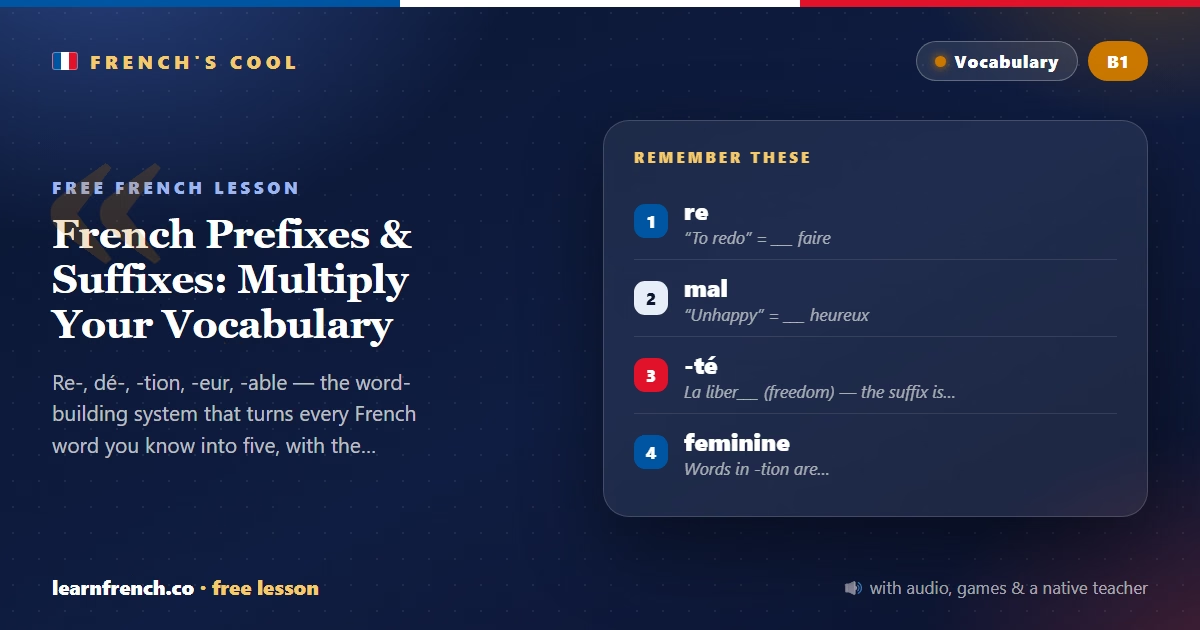
French Prefixes & Suffixes: Multiply Your Vocabulary
Re-, dé-, -tion, -eur, -able — the word-building system that turns every French word you know into five, with the patterns English secretly shares.
What you'll learn
French vocabulary isn’t a list — it’s a construction kit. Learn a dozen prefixes and suffixes and every new word you meet comes with four free relatives.
🎬 This lesson in one minute
The quick version — the full lesson is below. More shorts →
The power prefixes
- re- (again): faire → refaire, lire → relire, venir → revenir
- dé-/dés- (undo): faire → défaire, bloquer → débloquer, agréable → désagréable
- in-/im- (not): possible → impossible, utile → inutile
- mal- (badly): heureux → malheureux, honnête → malhonnête
- sur- (over) / sous- (under): estimer → surestimer, sous-estimer
The noun-makers
- -tion (action): informer → l’information — thousands shared with English
- -eur/-euse (doer): vendre → le vendeur, la vendeuse
- -age (process): laver → le lavage, passer → le passage
- -té (quality): beau → la beauté, libre → la liberté
- -ette (small!): une maison → une maisonnette, une fille → une fillette
The adjective-makers
- -able/-ible: faire → faisable, lire → lisible
- -eux/-euse: la chance → chanceux, le courage → courageux
- -if/-ive: le sport → sportif, créer → créatif
Watch the genders they carry
Suffixes decide gender: -tion, -té, -ette → feminine; -age, -ment, -eur (things) → masculine. Learn the suffix, get the article free — the system behind le or la.
Common mistakes
Five slips I hear every week — and the quick fix for each.
- « inpossible » → impossible — in- becomes im- before b, m and p: imbuvable, immangeable, impatient
- « re-ouvrir » → rouvrir — before a vowel, re- shrinks to r- or ré-: rentrer, rallumer, réutiliser
- « désheureux » → malheureux — dé- undoes an action, mal- flips a quality; you can’t un-do happiness
- « un solution » → une solution — the suffix owns the gender, always; -tion never betrays you
- « lisable » → lisible — -able vs -ible isn’t guessable, so memorise the -ible ones as you meet them (visible, compréhensible)
At the repair shop: the kit in action
— Bonjour, mon téléphone est bloqué et l’écran est cassé.
— On peut le débloquer tout de suite. Pour l’écran, il faudra revenir demain.
— Il est réparable, au moins ?
— Tout à fait. Vous repassez demain matin, le remplacement prend une heure.
Count the builder words: débloquer (dé- undoes the block), revenir and repasser (re- — coming back, twice), réparable (-able — fixable), remplacement (-ment turns a verb into a thing). One ordinary exchange, five words you never had to learn separately.
In real life: re- has a social life
Cross a colleague for the second time today? Re-bonjour ! — or just re ! in a chat window, which is a complete greeting all by itself. On the phone, je te rappelle (I’ll call you back) is re- + appeler hiding in plain sight. And French recycles it into everyday plans: on se refait un ciné ? — fancy the cinema again? All friendly, all informal — perfect with mates, risky in a cover letter.
A memory trick: strip before you translate
Meet an unknown word, peel it like an onion: prefix off, suffix off, what’s left? Irremplaçable looks scary until you strip it: ir- (a cousin of in-, used before r) + remplac(er) + -able → can’t be replaced. Same with redémarrage: re- + démarr(er) + -age → the process of starting again — a reboot. Do this three times a day and “unknown” French words quietly stop existing.
FAQ
Can I invent words with these?
Cautiously, yes — natives do it constantly (re-tester, dé-stresser). If it sounds plausible, you’ll be understood; worst case you’ll be charmingly corrected.
Why is it « redevenir » but « redécouvrir »?
Re- attaches to the whole verb, including already-prefixed ones: re+devenir, re+découvrir. Stack away.
Which family gives the most for free?
-tion: French and English share thousands (nation, solution, situation…). Full list of freebies in vocabulary that sticks — and the traps in false friends.
Quick practice
Play the Quiztap to start · quick practice from this material