Le or La? How to Guess the Gender of French Nouns
Is it le or la? Gender feels random, but noun endings give you a very good guess — -ment/-age/-eau lean masculine, -tion/-té/-ette lean feminine. The patterns, the traps (l'eau, la page), and the tricks that make gender automatic. With audio and a quiz.
What you'll learn
« Is it le or la? » is the question that haunts every French learner. Here’s the reassuring truth: while gender is unpredictable in theory, the ending of a noun gives you a very good guess most of the time. Learn a handful of patterns and you’ll be right far more often than wrong — and you’ll know which words to double-check.
🎬 This lesson in one minute
The quick version — the full lesson is below. More shorts →
🔑 The one rule above all
Never learn a noun alone. Learn it with its article: not « table » but « une table ». Store the gender in the sound, from day one.
Endings that are usually masculine
You can often guess the gender of a French noun from its ending. No rule is perfect — every list has exceptions — but these noun endings tell you whether a word is masculine or feminine most of the time. Learn the endings first, then the famous exceptions.
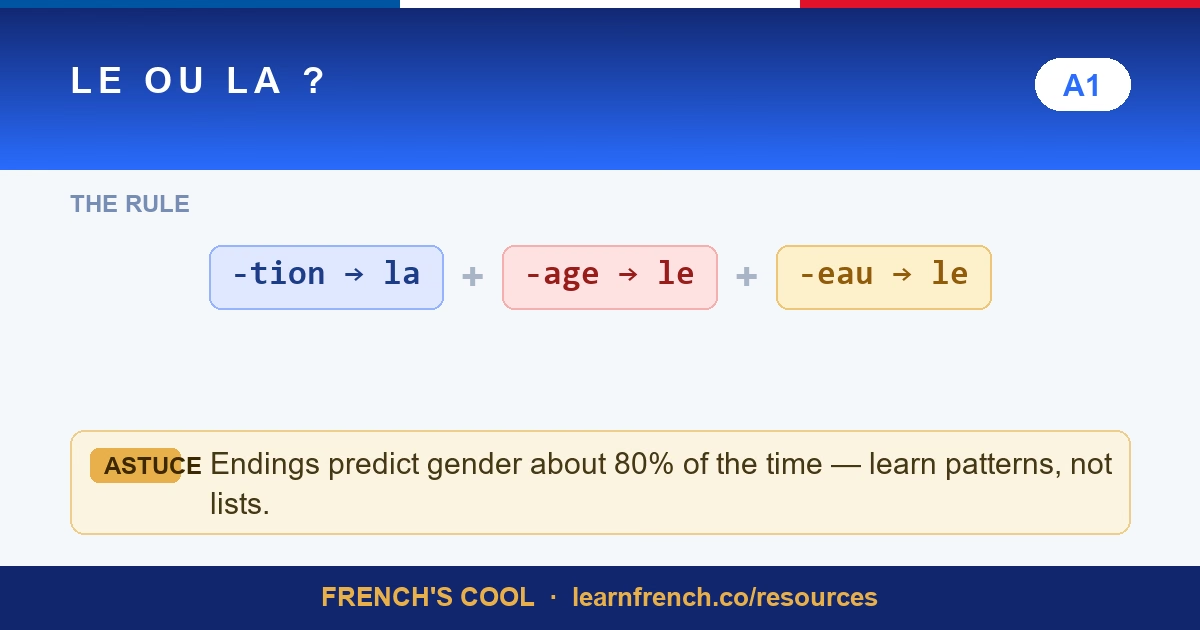
These endings point to le / un:
Also common: -isme (le tourisme), -eur for jobs (le professeur), -in/-on (le vin, le pain).
Endings that are usually feminine
These point to la / une:
Also: -ance/-ence (la chance, la science), -ure (la voiture), -ude (la certitude).
The traps to memorise
A few very common words break the patterns — learn these by heart:
The tricks that help
- Say it out loud with « une ». If « une table » sounds right, you’ve stored it. Sound beats rules.
- Colour-code your notes: blue for masculine, red for feminine. Your memory is visual.
- Learn in pairs: when a word has a masculine and feminine form (un ami / une amie), learn both.
- Play the game: our Un ou Une? drills gender until it’s a reflex.
The full ending charts are on le genre des noms.
✍️ Le or la?
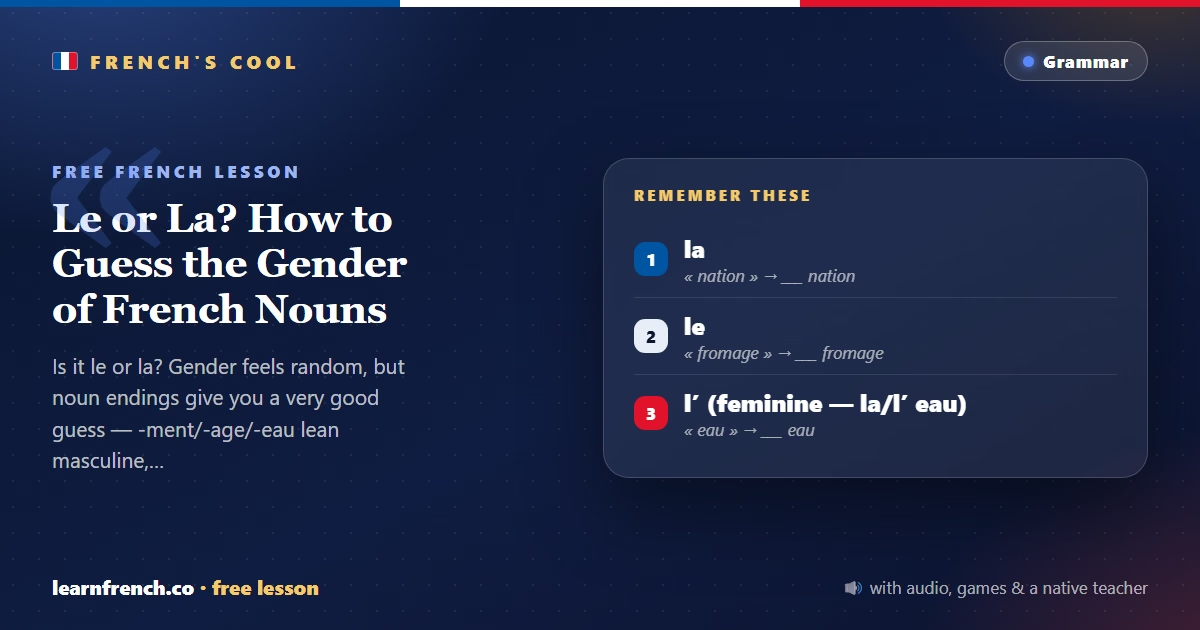
« nation » → ___ nation (-tion)
Show answer
la
« fromage » → ___ fromage (-age)
Show answer
le
« eau » → ___ eau (careful!) (exception)
Show answer
l’ (feminine — la/l’ eau)
Play the Quiztap to start · quick practice from this material
Loading the quiz…
Reading the ending: the 80% shortcuts
You cannot guess the gender of nouns in french from meaning — but you CAN read it off the noun’s ending with startling accuracy, and this is the skill the guessers never build. Reliably feminine word endings: -tion/-sion (la nation), -té (la liberté), -ette (la baguette), -ance/-ence (la France, la différence), -ure (la voiture), -elle, -ie, -euse. Reliably masculine: -age (le fromage), -ment (le moment), -eau (le bureau), -isme (le tourisme), -oir, -et, -ing (le parking). Each rule runs 80-95% true; learn the dozen endings and you determine the gender of most new words in french before the dictionary loads. The famous exceptions are few enough to enjoy: le problème, le système (Greek imports staying masculine despite the -e), la page, l’eau (feminine!), and the shape-shifters un/une livre, un/une tour — different meanings by gender alone.
Why are gendered nouns there at all? Not biology — grammatical gender is a sorting system inherited from Latin, and only animals carry an animal’s biological gender into their french word gender (le chat/la chatte). For everything else, gender in french is a property of the WORD: une sentinelle (a sentry, usually male) is feminine, un mannequin (a model, often female) is masculine. That is why the working advice for learning french stands: never store a bare noun — store article + noun as one sound, la-table, le-livre, and let french speakers’ own habit become yours. The gender then drives everything that agrees: articles in french (un/une, le/la), the french adjectives that follow the noun they modify (un pull vert, une robe verte), and pronouns. Plural nouns hide the cue — les and des cover both genders — one more reason the singular article is the version to memorize. Master the endings, befriend the exceptions, and the le-or-la panic quietly disappears from your French — replaced by a party trick: calling the gender of words you have never seen.
FAQ
How do you tell the gender of a French noun?
Check the ending first: -tion, -té, -ette, -ance, -ure lean feminine; -age, -ment, -eau, -isme, -oir lean masculine. Then store the article with the word — the ending predicts, the article confirms.
Why are French nouns gendered?
Inheritance: Latin’s three genders collapsed into two, and every noun had to land somewhere. It’s grammar, not ideology — the moon is feminine and the sun masculine in French, and German reverses both.
What are the 4 genders of nouns?
That’s an English-grammar frame (masculine, feminine, common, neuter). French keeps exactly two — every noun is le or la, no neuter, no escape hatch.
What are the 20 gender nouns?
A practice set worth storing with articles: le livre, la table, le problème, la page, le fromage, la nation, le moment, la liberté, le bureau, la voiture, le tourisme, la baguette, le parking, la différence, l’eau (f), le système, la santé, le voyage, la culture, le langage.
Why are French nouns gendered at all?
Blame Latin. French inherited a grammatical gender system where every noun is masculine or feminine — nothing to do with real-world sex (a beard, la barbe, is feminine; make of that what you will). English dropped its genders centuries ago; French kept two. There is no third, neuter gender — when French needs a neutral pronoun it borrows the masculine (« c’est beau »), and the emerging inclusive pronoun iel exists but has no effect on noun gender.
Gender changes the whole sentence
The reason gender matters is agreement — the noun drags everything with it:
- Articles: le / la (definite), un / une (indefinite article), ce / cette
- Adjectives: un pull vert → une robe verte
- Past participles with être: il est parti → elle est partie
- Pronouns: il / elle refer back with the noun’s gender, not the object’s « sex »
Get the gender wrong and the error echoes through the sentence — which is exactly why learning une voiture as one chunk beats learning voiture alone. See how adjectives follow along in adjective agreement.
Same word, two genders, two meanings
A small set of nouns changes meaning with its article — the classic dictée traps:
- le livre (book) / la livre (pound)
- le tour (turn, tour) / la tour (tower)
- le poste (job, TV set) / la poste (post office)
- le mode (method, mode) / la mode (fashion)
- le voile (veil) / la voile (sail, sailing)
People and professions
For humans, grammar usually follows the person: un étudiant / une étudiante, un boulanger / une boulangère. Many profession names now have accepted feminine forms (une avocate, une ingénieure, une autrice), and note that after « être » French drops the article: « Elle est médecin » — no une.
French noun gender FAQ
How can you tell the gender of a French noun?
Three tools, in order: (1) the word endings above — they predict correctly about 80% of the time; (2) memorise the noun with its article from day one; (3) when in doubt in conversation, mumble the article and keep going — comprehension survives a wrong gender.
Is French noun gender really that important?
For being understood: rarely fatal. For sounding right: yes — it drives articles, adjectives and pronouns. Treat it as pronunciation for grammar: build the habit early and it stops costing attention.
Are there gender-neutral nouns?
Every noun has a fixed grammatical gender, but many refer to any person: une personne (always feminine, even for a man), une victime, un individu. The grammar is fixed; the reference is free.
🧰 Master French gender
The pages and game that make le/la automatic:
Want gender drilled with a teacher until it sticks? Book a free lesson with Xavier →
🎮 Practise this lesson
Games built from this exact page — turn what you just read into play:
🧩 Sentence Builder rebuild these sentences
🎧 Listening Game which sentence do you hear?