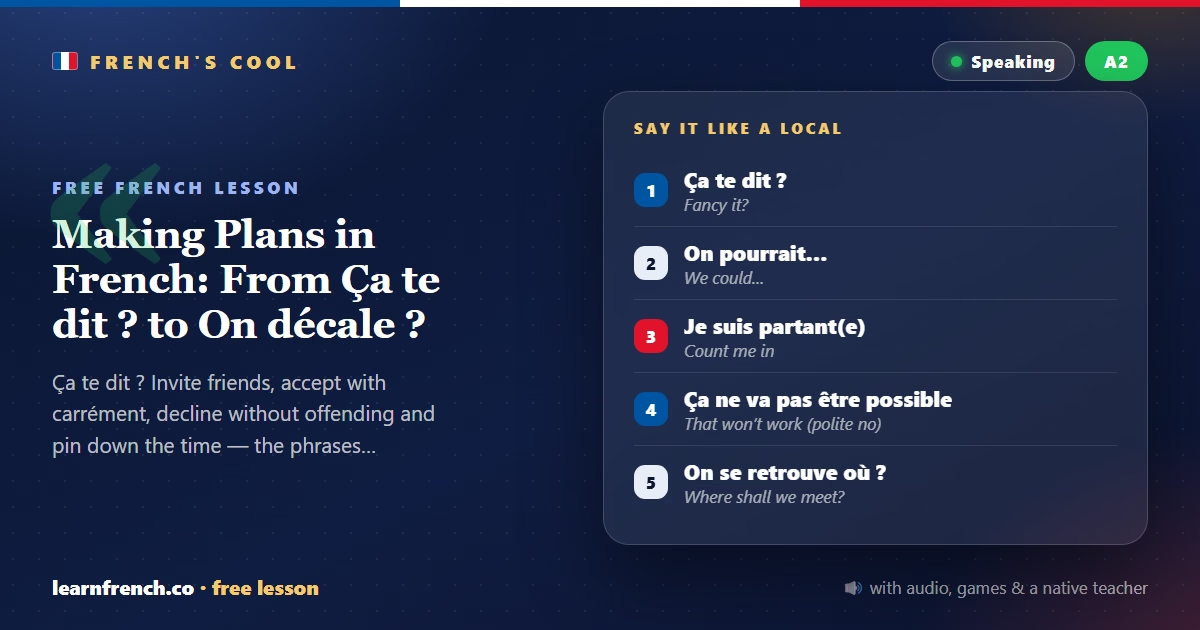
Making Plans in French: From Ça te dit ? to On décale ?
Ça te dit ? Invite friends, accept with carrément, decline without offending and pin down the time — the phrases French people actually use to make plans.
What you'll learn
Textbooks hand you « Voulez-vous aller au cinéma avec moi ? » — a sentence no French person has texted since the invention of the phone. Real plans run on ça te dit, on pourrait and a volley of short messages. Here’s the full toolkit, from first invitation to last-minute rescue.
🎬 This lesson in one minute
The quick version — the full lesson is below. More shorts →
Inviting: ça te dit ?
The all-purpose friendly invitation is ça te dit de + infinitive — literally “does that say anything to you?”, really “fancy it?”.
- Ça te dit d’aller au ciné ? — fancy going to the cinema? Note the elision: de becomes d’ before a vowel.
- Ça vous dit ? — how about it? (to a group, or to anyone you vouvoie)
- Ça te dirait de venir samedi ? — the conditional dirait softens it even further
No inversion, no est-ce que, no stress. Your tone does the work.
Suggesting: on pourrait… et si on allait… ?
- On pourrait se faire un resto. — we could do a restaurant. Se faire + noun is gloriously spoken French.
- Et si on allait voir un film ? — how about a film? After et si, French uses the imparfait: allait, never va.
- Pourquoi pas jeudi ? — why not Thursday?
One trap while you’re at it: assister à un concert means to attend it, not to help backstage. To help someone is aider. File it under false friends and move on.
Saying yes like you mean it
A flat oui sounds like you’re doing them a favour. Pick something warmer:
- Avec plaisir ! — with pleasure; warm and safe everywhere
- Carrément ! — totally! the enthusiastic yes you’ll hear constantly
- Je suis partant. — I’m in; a woman says je suis partante
- Volontiers. — gladly; a touch more polished
- Ça marche. — that works; the phrase that seals a plan
Declining without killing the friendship
The French polite no has three parts: soften, give a reason, offer a next time.
- Ça ne va pas être possible. — that’s not going to work; neutral and blame-free
- J’aurais bien aimé, mais je travaille. — I’d have loved to, but I’m working
- Une autre fois, peut-être ? — another time, maybe? Add it only if you mean it — the French remember.
Pinning down the where and when
- On se retrouve où ? — where shall we meet? Se retrouver is the verb for meeting people you already know.
- On se retrouve à quelle heure ? — what time are we meeting?
- On dit 19 h devant le cinéma ? — shall we say 7 pm outside the cinema?
- Ça me va. — works for me
Planning a cinema night: a real exchange
— Ça te dit d’aller au ciné vendredi soir ?
— Carrément ! Il y a quoi en ce moment ?
— On pourrait voir la comédie qui vient de sortir. La séance est à 20 h 15.
— Parfait. On se retrouve où ?
— Devant le cinéma à 20 h ? On prend les billets sur place.
— Ça marche. Si je suis en retard, je t’envoie un message.
Notice the machinery: an invitation (ça te dit), a suggestion (on pourrait), the two fixing questions, and ça marche to close. Six lines, plan made.
By text: late, moving, cancelling
French plans are confirmed — and wobbled — by message. The survival kit:
- Je suis en retard, désolé ! — I’m late, sorry (désolée from a woman)
- Je suis à la bourre. — running late; casual and very common
- On décale ? — shall we push it back? Décaler is the verb of the rescued plan: on décale à 21 h ?
- Je dois annuler, pardon. — I have to cancel, sorry
- On se rattrape bientôt ? — shall we make up for it soon?
Real French texts compress hard — decode slt and dsl with French text speak before Friday night.
FAQ
Can I use ça te dit with people I vouvoie?
Yes — just switch the pronoun: ça vous dit de déjeuner ? works perfectly with colleagues. The conditional ça vous dirait is smoother still.
Does assister à ever mean to assist?
No. Assister à = to attend (a film, a match, a meeting); helping someone is aider. It’s a classic among the French false friends — English speakers offer help, French speakers just take a seat.
Why do the French write 20 h 15 instead of 8.15 pm?
Anything written — timetables, cinema listings, texts — runs on the 24-hour clock. Get quick at converting with telling the time in French.
Quick practice
Play the Quiztap to start · quick practice from this material