French for Absolute Beginners: Your First 40 Words & Phrases
New to French? Start here. Essential French words and phrases for absolute beginners, with tips on how to actually remember them.
What you'll learn
Starting a new language is exciting — and a little overwhelming. The good news: you don’t need thousands of words to start using French. You need a small, high-value set you can say with confidence. After teaching 500+ students, these are the first words I give every beginner, grouped the way you’ll actually use them.
🎬 This lesson in one minute
The quick version — the full lesson is below. More shorts →
Greetings and politeness (your first impression)
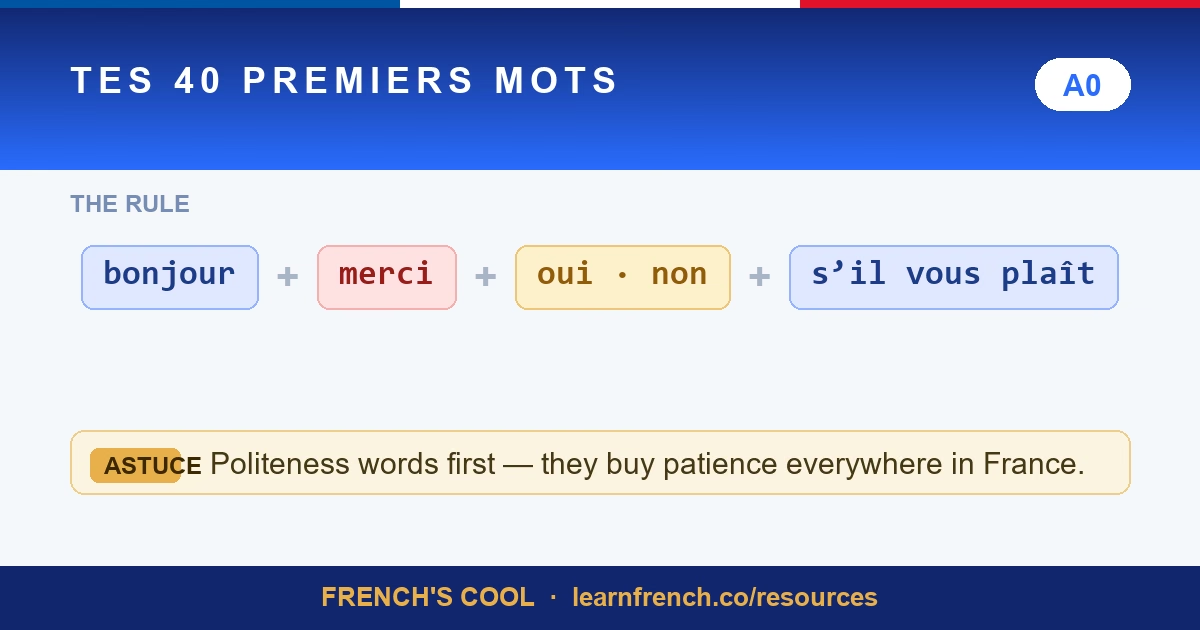
In France, politeness opens every door. Lead with these and people warm to you immediately.
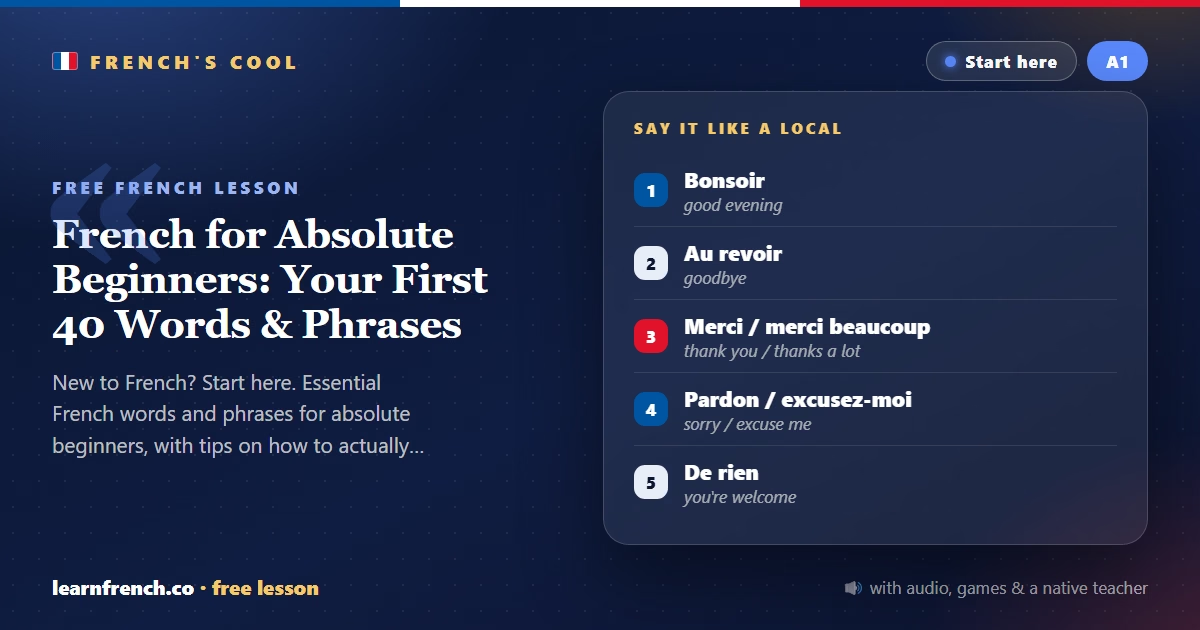
- Bonjour — hello / good day (the single most important word in French)
- Bonsoir — good evening
- Salut — hi / bye (friends only)
- Au revoir — goodbye
- Merci / merci beaucoup — thank you / thanks a lot
- S’il vous plaît — please (formal) · s’il te plaît (informal)
- Pardon / excusez-moi — sorry / excuse me
- De rien — you’re welcome
The phrases that keep a conversation alive
You will not understand everything at first — nobody does. These phrases let you stay in the conversation instead of freezing.
- Oui / non — yes / no
- Peut-être — maybe
- Je ne comprends pas — I don’t understand
- Pouvez-vous répéter ? — can you repeat?
- Comment dit-on… ? — how do you say…?
- Je ne sais pas — I don’t know
- Parlez-vous anglais ? — do you speak English?
Five little verbs that do the heavy lifting
French has a handful of verbs you’ll use in almost every sentence. Learn just the je (I) form first — you can build a lot with it.
- être (to be) → je suis — I am
- avoir (to have) → j’ai — I have
- aller (to go) → je vais — I go / I’m going
- vouloir (to want) → je voudrais — I would like (the polite form — use this when ordering)
- pouvoir (to be able) → je peux — I can
With these you can already say things like Je voudrais un café, s’il vous plaît (I’d like a coffee, please).
Question words
Six words unlock the ability to ask for almost anything: qui (who), quoi (what), où (where), quand (when), comment (how), combien (how much / how many), pourquoi (why).
Everyday glue words
je, tu, vous (I, you informal, you formal) · le / la / un / une (the / a) · et (and) · mais (but) · ici (here) · là (there). Small words, but they hold every sentence together.
How to actually remember them
- Speak them out loud — reading silently isn’t enough; your mouth needs the practice.
- Group by situation, not alphabetically — your brain stores ‘café words’ together.
- Learn five a day and reuse yesterday’s five in a new sentence.
- Use them the same day — order a coffee, greet a colleague, label things at home.
Pronunciation: three quick wins
- Most final consonants are silent: Paris, petit, beaucoup.
- The French r comes from the back of the throat, not the tongue tip — think of a soft gargle.
- Nasal sounds (bon, vin, un) let air through the nose; they feel strange at first and then become automatic.
Practise it with a real teacher
Reading about French is one thing — saying it out loud, with someone who corrects you gently and adapts to your level, is what makes it stick. Your first 20-minute lesson with Xavier is free, with no card and no commitment. Book your free lesson and let’s put this into practice.
🎬 Video lesson
 French basic conversation & greetings
✍️ Quick quiz — did it stick?
« Hello » en français ? (greeting)
Show answer
Bonjour
I am → je ___ (être)
Show answer
suis
Thank you very much → merci ___ (politeness)
Show answer
beaucoup
Play the Quiztap to start · quick practice from this material
Loading the quiz…
Your first 30 days: the path, mapped
The fastest way to start learning french is to make the first month boringly specific. Week one — sound and survival: greetings (bonjour, merci, ça va), numbers 1–20, and the pronunciation basics — get your mouth around the R and the u early, before habits form. Listen to french daily from day one, even at zero comprehension: ten minutes of easy french audio or french podcasts tunes the ear that everything else builds on. Week two — the present tense: être, avoir, aller + the -er verb pattern; suddenly you can say who you are, what you have, where you go. Week three — questions and answers: est-ce que, the question words, et toi? — because conversation is turn-taking, and questions in french are the wheel that keeps it turning. Week four — the glue: articles (le/la/un/une and the du/des partitives that English lacks), core adjectives, and your first fifty-word self-introduction, out loud, imperfect, done. That’s genuine A1 territory in a month — the basics that every french course sells, sequenced for momentum: comprehension first, production close behind, grammar always in service of a sentence you actually want to say.
The beginner’s resource stack, all free online: this site’s lessons in order (they’re sequenced for exactly this path), the games arcade for drilling that doesn’t feel like drilling, french pronunciation audio on every chart, and one podcast at beginner speed for the commute. Want to learn faster? Add a weekly conversation anchor — a french tutor or the free lesson with a native french teacher this site exists to offer — because the first steps into speaking are the ones a real human accelerates most; easier to learn with feedback is not a slogan, it’s the whole story of getting started. Two traps to skip: app streaks that never make you speak french aloud (read french, listen to french, but SAY french daily — subtitle-watching alone builds a silent expert), and grammar completionism (the passé composé can wait a month; wanting to say something can’t). Beginners who follow a path like this hit conversational A2 within a season and intermediate level within a year — proficiency is mostly sequencing plus showing up, and day one of the sequence is today: bonjour is already French vocabulary, and you knew it before you started. Every fluent french learner you’ll ever envy began with exactly these first steps — the comprehension grows in weeks, the confidence follows, and the french grammar and expression that look impossible from day zero assemble themselves one pronoun, one adjective, one small victory at a time. Lawless French, YouTube and a hundred good resources can supplement; the path above is the spine that keeps a beginner from drowning in them.
FAQ
What is the best way to learn French for beginners?
A fixed daily quarter-hour: audio input + one micro-topic + saying something aloud. Sequence beats intensity — the 30-day path above exists so each day knows its job.
What are 50 French words to start with?
Greetings (8), numbers 1–20, pronouns (je, tu, il, elle, nous, vous), être/avoir/aller conjugated, and the glue: oui, non, merci, pardon, et, mais, très, bien. That’s a functioning starter kit of ~50.
How do you say 1 to 10 in French?
Un, deux, trois, quatre, cinq, six, sept, huit, neuf, dix — day-two material on the path, and the numbers chart on this site adds audio.
What is the 80/20 rule in French?
The small core (greetings, core verbs, numbers, question words) powers most early conversation — which is why the first 30 days above ignore everything else on purpose.
Is French hard to learn for English speakers?
Honestly? Less than you fear. English and French share thousands of near-identical words — table, important, impossible, restaurant — so as a beginner you already recognise a huge slice of the vocabulary. French has no case system, and the grammar you need for everyday conversation is small. The two things that take practice are pronunciation (those nasal vowels) and noun gender (le / la) — and both come with exposure, not memorisation. Most of my English-speaking learners are holding simple conversations within a few months.
The 80/20 rule for beginner French
You don’t learn French by learning everything — you learn the 20% of words that appear in 80% of sentences. That is exactly why the list above is short: a handful of greetings, five workhorse verbs (être, avoir, aller, faire, vouloir), the question words, and the glue words carry most real conversations. Master those first, then add vocabulary by theme — food, travel, numbers — and you will say far more with far less.
How do you say the numbers 1 to 10 in French?
Numbers are one of the fastest wins for a beginner — you will use them for prices, times and phone numbers on day one.
- 1 — un · 2 — deux · 3 — trois · 4 — quatre · 5 — cinq
- 6 — six · 7 — sept · 8 — huit · 9 — neuf · 10 — dix
Want the full set with audio? Here is French numbers 0–100, and the interactive Les Nombres chart.
Beginner French FAQ
Can I learn French by myself?
Yes — the free lessons, charts and audio on this site are built for exactly that. Apps and even AI chatbots are useful for drilling vocabulary. The one thing self-study can’t do is correct your accent and unstick you when you are confused, which is why most learners pair self-study with a few lessons with a real teacher.
What is the best way to learn French as a beginner?
Little and often beats long, rare sessions. Fifteen focused minutes a day — a few new words said out loud, plus one short piece of listening — will take you further than a two-hour cram once a week. Speak from day one, even badly; that is how it sticks.
How long until I can hold a simple conversation?
With steady practice, most beginners manage short everyday exchanges within 2–3 months. For the full picture, see how long it takes to learn French.
Do I need a tutor, or is an app enough?
An app builds vocabulary; a tutor builds fluency — real conversation, instant correction, and a plan built around you. Many learners start with an app and add lessons once they actually want to speak.
🧰 Your practice kit
This guide gave you the big picture — now drill the details with these free interactive charts (each with audio examples and exercises):
Prefer a human? Book a free lesson with Xavier →