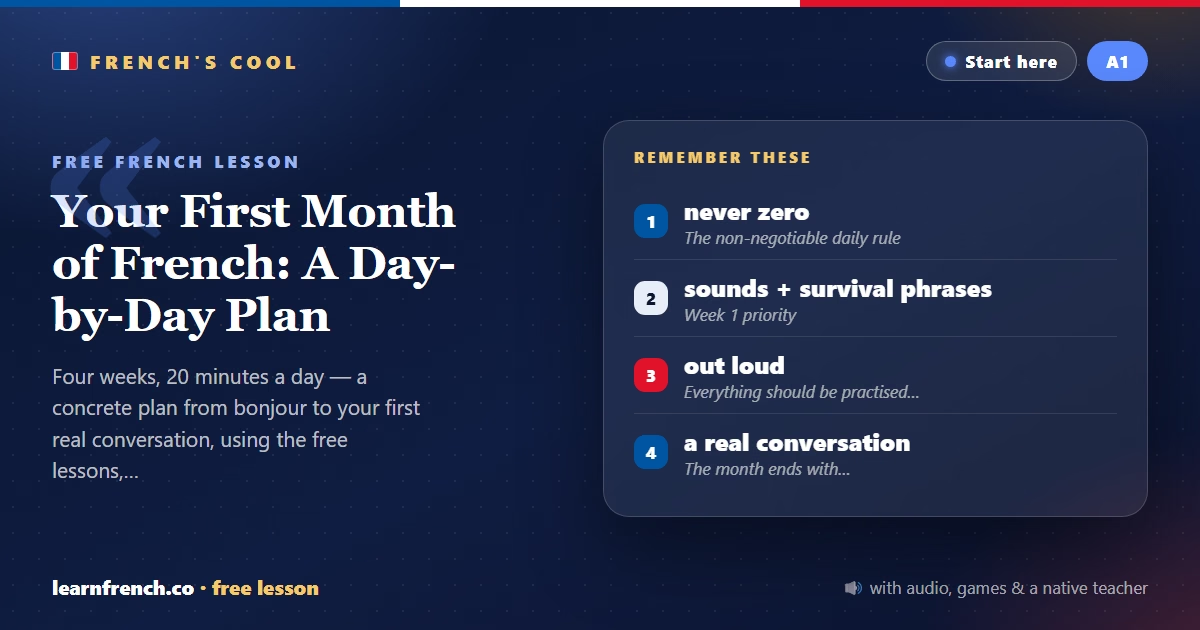
Your First Month of French: A Day-by-Day Plan
Four weeks, 20 minutes a day — a concrete plan from bonjour to your first real conversation, using the free lessons, charts, games and videos on this site.
What you'll learn
Motivation fades in week two; plans survive. Here is a first month that fits in 20 minutes a day and ends with you holding a real (small) conversation.
🎬 This lesson in one minute
The quick version — the full lesson is below. More shorts →
Week 1 — Sounds and survival
- Day 1-2: greetings + introduce yourself. Say everything OUT LOUD.
- Day 3-4: the pronunciation guide + the R in the bathroom mirror.
- Day 5-7: numbers 0-100 + your first games session. Count everything you see.
Week 2 — The engine room
- present tense + avoir expressions (j’ai faim beats philosophy).
- le or la + du/de la at an imaginary bakery.
- Daily: one Word of the Day — say it in a sentence about YOUR life.
Week 3 — Real input
- One video lesson per day — start with the Titounis and shorts, no shame, they work.
- narrate your routine while doing it: je me lève, je fais le café…
- Grab questions — conversations are built from them.
Week 4 — Put it together
- the first-conversation script, rehearsed out loud twice.
- Play the games marathon as your week-4 exam.
- Then do the real thing: a free 20-minute lesson with Xavier — the deadline that makes the month stick.
The three rules that make it work
- Never zero: awful day? One Word of the Day still counts.
- Voice first: everything out loud — silent French isn’t French yet.
- Same time daily: attach it to coffee, commute or lunch. Habit beats willpower.
What day 30 sounds like
This is the whole target — no more, no less. Your lines are in bold:
— Bonjour ! Je m’appelle Sam. Et vous ?
— Moi, c’est Xavier. Enchanté ! Vous êtes d’où ?
— Je suis de Manchester. J’apprends le français depuis un mois.
— Un mois seulement ? Bravo ! Vous aimez le français ?
— Oui, beaucoup. Mais parlez lentement, s’il vous plaît !
Five lines, all built from weeks 1 to 4, glued together out loud. And parlez lentement, s’il vous plaît (speak slowly, please) is your safety net — it keeps the exchange in French instead of politely collapsing into English.
Common month-one mistakes
Everyone makes these. Make them once, fix them, move on.
- je suis faim → j’ai faim — week 2 warned you: hunger, age and luck are things you HAVE in French. Same logic for j’ai 30 ans.
- je m’appelle est Sam → je m’appelle Sam — m’appelle is already the verb; no extra est.
- Pronouncing final letters: vous rhymes with who, not with loose. When in doubt, drop the last consonant and you’ll be right more often than not.
- Translating word by word. Comment ça va ? is one chunk — learn chunks whole and your mouth stays ahead of your grammar.
In real life: the bonjour contract
France runs on a small social contract, and month one is when you sign it:
- Walking into a bakery, a small shop, a waiting room? Bonjour first, business second — skipping it reads as rude, not efficient.
- One bonjour per person per day. Meet again at 4 pm? A smile and re-bonjour (natives say it half-jokingly) does the job.
- Strangers, shopkeepers and waiters get vous by default. The day someone offers on peut se tutoyer (we can switch to tu), consider it your first medal.
FAQ
20 minutes really enough?
For month one, yes — daily contact beats weekend marathons (the math here). You can always do more on good days.
What if I miss days?
Miss one, resume; miss three, restart the week — not the month. The plan bends; it doesn’t break.
What comes after month one?
The A1→B2 roadmap takes over, and podcasts join the commute.
Quick practice
Play the Quiztap to start · quick practice from this material