Ne… Pas and Beyond: French Negation Made Simple
Saying 'not' in French is two words — ne… pas — wrapped around the verb. Once you have that, every negative works the same way: ne… jamais (never), ne… rien (nothing), ne… personne (nobody), the de rule, and the false friend ne… que (only). With audio and a quiz.
What you'll learn
« How do I say not in French? » Two little words: ne… pas, wrapped around the verb. Once you’ve got that, every other negative works the same way — just swap the second word. Here’s the whole system, from « I don’t » to « never », « nothing » and « only ».
🎬 This lesson in one minute
The quick version — the full lesson is below. More shorts →
🚫 The core pattern
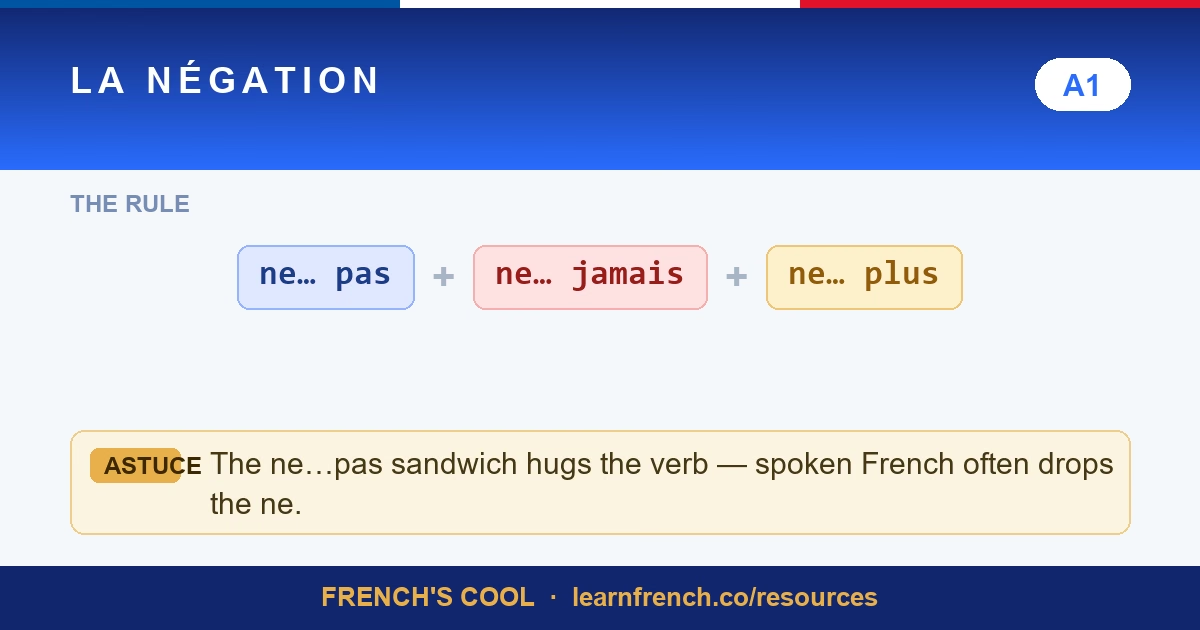
ne + verb + pas. The verb sits in the middle: « je ne sais pas » (I don’t know). In casual speech the « ne » often drops — « je sais pas » — but write it!
The basic negative: ne… pas
Before a vowel, ne → n’: « je n’aime pas ».
Swap « pas » for a different negative
Same frame (ne … X), new meaning:
The full set — jamais, plus, rien, personne, aucun — is on la négation.
The « de » rule after a negative
After a negative, un / une / du / des → de:
The false friend: ne… que = ONLY
Careful — ne… que looks negative but means only (there’s no « pas »):
More on ne… que.
In the passé composé
The two words hug the auxiliary: « je n’ai pas mangé ». (Except personne: « je n’ai vu personne ».)
✍️ Negation check
Make it negative: « Je sais. » → « Je ___ sais ___. » (the frame)
Show answer
ne… pas
« I have a dog » → negative: « Je n’ai pas ___ chien. » (the de rule)
Show answer
de
« Je n’ai que dix euros » means… (false friend)
Show answer
I have ONLY ten euros
Play the Quiztap to start · quick practice from this material
Loading the quiz…
The sandwich, the family, and the article that shrinks
The rule for making a sentence negative is a two-word sandwich: ne before the conjugated verb, pas after it. Je suis → je ne suis pas; nous sommes → nous ne sommes pas; vous avez → vous n’avez pas (ne elides before a vowel). The affirmative sentence keeps its exact word order — negation in french wraps the verb, it never reshuffles the sentence, which makes this one of the friendliest rules a beginner meets. With an infinitive verb, both halves move together in front: « ne pas toucher » — the sign on every French museum wall. And pas is pronounced “pah” — the s is silent, always.
Beyond pas, French swaps in another negative word for each meaning, keeping ne as the anchor: ne…jamais (never), ne…plus (no longer), ne…rien (nothing), ne…personne (nobody), ne…que (only). Each negative adverb slots exactly where pas sat — je ne fume plus, elle ne dit rien — except personne, which follows the participle in compound tenses: je n’ai vu personne. One elegant bonus: these negation expressions don’t stack with pas — jamais REPLACES it, so *je ne vais pas jamais* is the error the games below will drill out of you.
Two final rules complete the system. First, the shrinking article: after a negative, the indefinite and partitive articles (un, une, des, du, de la, de l’) all collapse to de — j’ai un chien → je n’ai pas de chien, il boit du café → il ne boit pas de café. The noun stays, its article slims down; only être resists (ce n’est pas une bonne idée). Second, register: modern french conversation routinely drops the ne and keeps the second half — « je sais pas », « c’est pas grave ». Understand it everywhere, write it nowhere: in exams and emails the full sandwich stands. Learn the pattern once with the pronoun set — je, tu, lui and the rest change nothing about the sandwich — and use negation as your free grammar win: 2 words, every tense, no exceptions worth fearing, and instantly double the sentences you can build in the français you already own. That is why every learner should conjugate the negative on day one, not chapter nine.
FAQ
What is the rule for negation in French?
Ne + conjugated verb + pas. Elide ne to n’ before vowels, move both before an infinitive (ne pas fumer), and swap pas for jamais/rien/plus/personne to change the meaning.
What are the three types of negation?
Total (ne…pas), partial (ne…jamais, ne…plus, ne…guère) and restrictive (ne…que — “only”). All use the same two-slot sandwich around the verb.
How do I make « je suis » negative?
« Je ne suis pas » — and the family follows: tu n’es pas, il n’est pas, nous ne sommes pas, vous n’êtes pas, ils ne sont pas. Spoken French compresses it to « j’suis pas ».
What are common mistakes with French negation?
Doubling negatives (*pas jamais*), forgetting the article change (*je n’ai pas un chien*), leaving ne out in writing, and putting pas before the verb English-style. The pas de rule alone fixes the most visible one.
How do you make « je suis » negative?
Wrap the two words ne … pas around the verb: « je ne suis pas » (I am not). Before a vowel, ne shrinks to n’: « je n’ai pas » (I don’t have), « elle n’est pas là ». That is the whole engine of French negation — everything else in French grammar is a variation on it: you negate the verb, and the rest follows.
The negation adverbs of French grammar: rien, personne, jamais, plus
Keep ne, swap pas for a more precise negative:
- ne … rien — nothing: « Je ne vois rien. »
- ne … personne — nobody: « Il n’y a personne. »
- ne … jamais — never: « Je ne fume jamais. »
- ne … plus — no longer / no more: « Je n’ai plus faim. »
- ne … aucun(e) — not any / none · ne … ni … ni — neither … nor
Two of these can even be the subject: « Personne ne comprend », « Rien ne marche » — the word goes first but the ne stays before the verb.
Negating with tenses and infinitives
In the passé composé, ne … pas wraps the auxiliary only: « Je n’ai pas mangé » — never around the participle. Before an infinitive, both words come together in front: « Il m’a dit de ne pas partir » (he told me not to leave). And the negative eats the article — this is the partitive rule: after a negative, un/une/des/du all become de: « J’ai une voiture » → « Je n’ai pas de voiture ».
French negation FAQ
Do French people really drop the « ne »?
In casual spoken French, constantly: « j’sais pas », « c’est pas grave », « t’inquiète ». The pas (or rien/jamais) carries the negation, so the ne quietly vanishes. In writing and formal speech, you always keep it. Understand both; write the full form.
What are the three types of negation?
Broadly: ne … pas (simple no), the adverbial negatives (ne … rien / personne / jamais / plus), and restrictive « ne … que » — which is a false friend meaning « only », not a negative at all: « Je n’ai que dix euros » = I have only ten euros.
How do you answer « oui » to a negative question?
You don’t — you use « si ». « Tu ne viens pas ? — Si, je viens ! » « Si » exists precisely to contradict a negative. Drill the full system, level by level, from A1 to native slang.
🧰 Master French negation
The pages that drill saying no:
🎯 More practice — translation — put it into French
Translate into French: « I don’t understand. » (translation)
Show answer
Je ne comprends pas.
Translate into French: « He isn’t here. » (translation)
Show answer
Il n’est pas là.
Translate into French: « I have a dog. → I don’t have a dog. » (translation)
Show answer
J’ai un chien. → Je n’ai pas de chien.
Translate into French: « I drink coffee. → I don’t drink coffee. » (translation)
Show answer
Je bois du café. → Je ne bois pas de café.
Translate into French: « I have only ten euros. » (translation)
Show answer
Je n’ai que dix euros.
Want negation drilled until it’s automatic? Book a free lesson with Xavier →
🎮 Practise this lesson
Games built from this exact page — turn what you just read into play:
🧩 Sentence Builder rebuild these sentences
🎧 Listening Game which sentence do you hear?