French Punctuation: The Space Before ?! and Other Surprises
You can conjugate the subjunctive and still look like a foreigner in writing — because French punctuation plays by its own rules.
What you'll learn
You can conjugate the subjunctive and still look like a foreigner in writing — because French punctuation plays by its own rules. Spaces appear before question marks, quotes grow wings, and decimal points become commas. Five surprises, five fixes.
⌨️ Two-part marks get a space in front
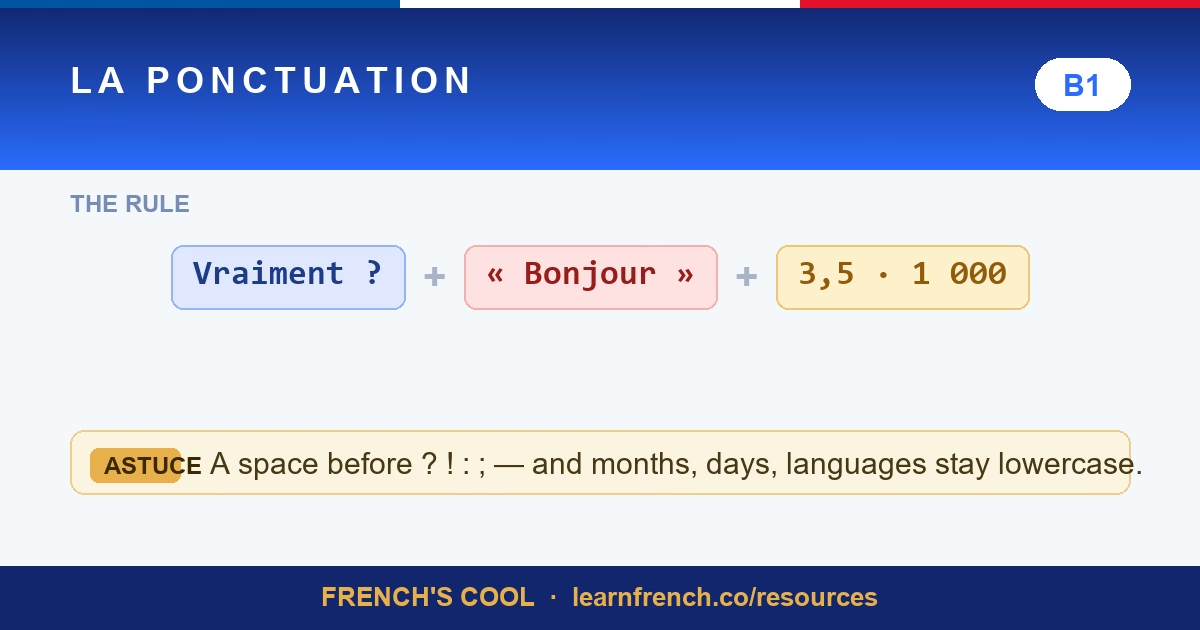
French typographic law: a (thin) space goes BEFORE every two-part mark — ? ! : ; and the guillemets « ». Decimals take a comma (15,50 €), thousands take a space (10 000), and days and months stay lowercase. Your spell-checker isn’t broken; French really does this.
🎬 This lesson in one minute
The quick version — the full lesson is below. More shorts →
1. The space before “double” punctuation
Any mark made of two parts — ? ! : ; — takes a space BEFORE it in French: « Vraiment ? », « Attention ! », « Voici la règle : ». (Typographically a thin non-breaking space, but a normal one passes.) Single marks — . , — hug the word like in English.
2. Guillemets, not quotation marks
French quotes are « angled » with spaces inside: « Bonjour », dit-elle. Nested speech in novels often drops to a dash dialogue style — one dash per speaker, no closing quotes for pages. Reading French fiction, the dashes ARE the quotation marks.
3. Numbers: the great comma swap
Decimals use a comma: 3,5 (trois virgule cinq). Thousands use a space: 1 000 000. So 1,500 in French is one-and-a-half, not fifteen hundred — a genuinely expensive misunderstanding, unpacked in numbers 100–1000.
4. Capital letters are shy
- Days & months: lowercase — lundi, janvier (see dates)
- Languages: lowercase — je parle français
- Nationalities: noun capital, adjective lowercase — un Français, un livre français
- je: never capitalised mid-sentence (English’s ego-capital I is a curiosity to the French)
5. Accents on capitals
Officially yes: À bientôt, États-Unis. French keyboards make it awkward, so natives often skip them — but l’Académie wants them, and « SALE » vs « SALÉ » (dirty vs salted) shows why. Accent basics in the accent marks lesson.
In real sentences
Read each one aloud, then tap 🔊 and shadow the audio — rhythm first, speed later.
Drill it: typing French accents · French text-speak · writing French emails
✍️ Your turn: punctuate like a French editor
Which marks take a space before them? (two-part rule)
Show answer
? ! : ; and » (closing guillemet) — anything made of two parts or heights. Comma and full stop hug the word.
Write three and a half euros in figures. (decimal)
Show answer
3,50 € — comma for decimals; the dot is anglophone.
Ten thousand in French figures = ? (thousands)
Show answer
10 000 — a space, never a comma (10,000 reads as ten to the French eye).
French quotation marks are…? (not inverted commas)
Show answer
Les guillemets : « comme ça », with spaces inside. Straight quotes survive in casual typing, but print French uses guillemets.
Which of these is capitalised: lundi, janvier, français, Noël? (less than English)
Show answer
Only Noël — days, months and language names stay lowercase; proper names and holidays keep their capitals.
FAQ
Do I have to type the space before « ? » in texts?
Casual texting forgives everything. But in emails, essays and anything printed, the space is standard French typography — its absence reads as foreign.
How do I type « and » on my keyboard?
Windows: Alt+0171 / Alt+0187. Mac: Option+7 / Shift+Option+7. Phones: long-press the straight quote. Or write straight quotes and let editors survive.
Why does French write M. for Monsieur but Mme without a dot?
The rule: abbreviation keeps its dot only if the last letter is cut. M(onsieur) → M. but M(adam)e keeps its final e → Mme. Elegant, once you see it.
The full ruleset — dashes, ellipses, spacing — lives on the French punctuation chart.
Do the French really type the space before ? in texts?
In quick messages it often disappears, and nobody minds. In anything printed or professional — emails included — it stays. French keyboards even insert a non-breaking space automatically before the mark.
How do I type « » and the é on my keyboard?
Every layout has a route — and we’ve mapped them all (Windows, Mac, phone) in the typing-accents lesson linked below. Once set up, guillemets are one keystroke.
Quick practice
Play the Quiztap to start · quick practice from this material