French Homophones: The Words That Trip Up Even Native Speakers
French is full of words that sound identical but are spelled differently — a/à, et/est, son/sont, ces/ses/c'est, ou/où, on/ont, leur/leurs. Even natives mix them up. The simple replacement tests that get every pair right. With audio and a quiz.
What you'll learn
Ask a French person to write « les chevaux qu’il a vus » and half will hesitate. French is full of words that sound identical but are spelled differently — homophones — and even natives trip on them. The good news for learners: there’s a simple replacement test for almost every pair. Master these and your written French will look sharper than most people’s.
🎬 This lesson in one minute
The quick version — the full lesson is below. More shorts →
a vs à
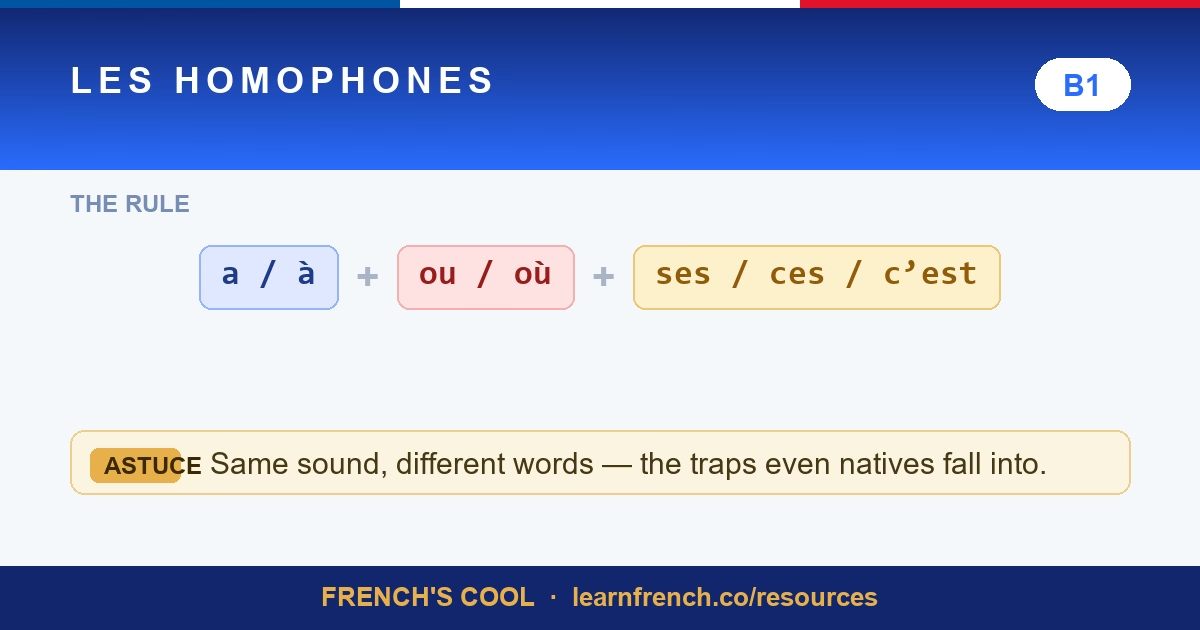
a is the verb avoir; à is a preposition. Test: if you can swap in avait, it’s a (no accent).
et vs est
et = « and »; est = the verb être. Test: swap in était → if it works, it’s est.
son vs sont
son = « his/her » (+ noun); sont = être (they are). Test: swap in étaient → sont.
ces / ses / c’est / s’est
All sound like « say ». ces = these/those (pointing); ses = his/her (belonging); c’est = « it is »; s’est = a reflexive verb (il s’est levé).
ou vs où
ou = « or »; où = « where » (or « when »). Test: swap in ou bien → if it works, it’s ou.
The bonus: on vs ont, leur vs leurs
on = « one/we »; ont = avoir (they have) → test avaient. leur (+verb = to them, invariable) vs leurs (+ plural noun = their).
Drill all of these on the grammatical homophones chalkboard.
✍️ Homophone check
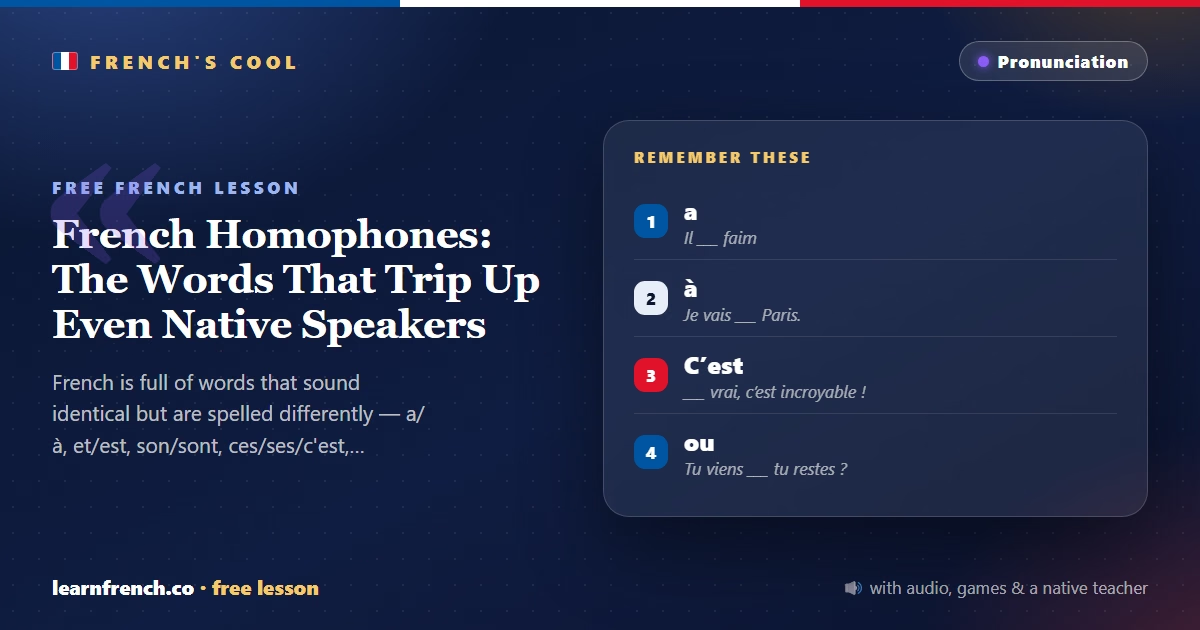
Il ___ faim (test: « avait »). (a or à)
Show answer
a
Je vais ___ Paris. (a or à)
Show answer
à
___ vrai, c’est incroyable ! (it is) (ces/ses/c’est)
Show answer
C’est
Tu viens ___ tu restes ? (or) (ou/où)
Show answer
ou
Play the Quiztap to start · quick practice from this material
Loading the quiz…
Twenty sets to keep straight (and the trick that sorts them)
Homophones are words that share a pronunciation and nothing else — and French, having deleted so many final consonants, is the world capital. Here are 20 french homophones sets worth knowing, from the daily to the legendary: a/à (has / to), ou/où (or / where), son/sont (his / are), ses/ces/c’est/s’est/sait (the five-way champion), mer/mère/maire (sea / mother / mayor), ver/vert/verre/vers (worm / green / glass / toward — the four-way icon), le sang/cent/sans/s’en (blood / hundred / without), le poids/pois/poix (weight / pea / pitch), foi/foie/fois (faith / liver / time), eau/au/haut, si/six/scie, père/paire/pair, cou/coup/coût, saut/sceau/seau/sot (jump / seal / bucket / fool), vin/vingt/vain, champ/chant, col/colle, date/datte, maître/mètre/mettre, and the verb conjugation trio every learner writes wrong once: parler/parlé/parlez, identical in sound, sorted only by grammar.
How do french speakers tell the difference? They don’t — the sentence does. Context clues resolve every set instantly: nobody pours a worm of wine or swims in their mother. The spelling differences only matter in writing, which is why homophones can cause zero trouble in conversation and endless trouble in dictées. The learner strategy that works: don’t memorize the sets as lists — anchor each word in one vivid phrase (un verre de vin, vers la mer, une paire de chaussures) and let the phrases carry the spelling. Note the neighbours too: homophones and homonyms overlap but differ — homonyms are similar words sharing spelling OR sound; these sets share sound only. For comprehension, train your ear to expect ambiguity and lean on grammar: after je, a /parlé/ sound must be parle or parlais, never parler. That single reflex — hear the sound, check the slot — is worth more than any list of french sound-twins, and it turns the language’s most confusing feature into a favourite party trick of french learning: five spellings, one sound, zero confusion.
FAQ
What are some French homophones?
The everyday core: a/à, ou/où, son/sont, ses/ces/c’est/s’est, mer/mère/maire, foi/foie/fois. The full twenty sets are above — verre/vert/ver/vers is the one every teacher shows off.
What are the 20 examples of homophones?
See the list above — twenty sets covering roughly fifty words. French inherits them from silent final letters: -s, -t, -d and -x all vanish in speech and reappear in spelling.
What is “I love you” in French Canadian?
« Je t’aime » — identical to France. Québec pronunciation shifts some vowels, but no homophone trouble here.
Do the French say “je ne sais quoi”?
Yes, literally — « un je-ne-sais-quoi » is a real noun for an indefinable quality. English just promoted it from phrase to cliché.
Des, dès ou dés ? 🎯
Three words that sound identical — one accent changes everything. Tap each one to hear it:
Sens : pluriel de « un/une » — de + les (plural article)
J’ai des amis français.
Sens : point de départ : temps, espace ou prix (as soon as / from)
Il a commencé à neiger dès le matin.
Sens : pluriel de « dé » — cube de jeu ou de nourriture (dice / small cubes)
Elle a ajouté des dés de viande dans la salade.
What is a homophone (and why French has so many)
A homophone is a set of words that sound identical but have different meanings and usually different spellings — like English there / their / they’re. French is packed with them because it stopped pronouncing most final consonants centuries ago while keeping them in the spelling: ver, vers, verre, vert, vairs all sound like « vair ». Your ears can’t tell them apart — only context and correct spelling can.
More common French homophones (vocabulary edition)
Beyond the grammar traps above, these noun homophones catch everyone:
- ver (worm) · vers (towards / a verse) · verre (glass) · vert (green)
- cent (hundred) · sang (blood) · sans (without) · s’en (of it)
- mer (sea) · mère (mother) · maire (mayor)
- foi (faith) · foie (liver) · fois (time, as in « une fois »)
- mur (wall) · mûr (ripe) · mûre (blackberry)
- pain (bread) · pin (pine) · peint (painted)
Homophone or homonym?
Quick distinction: homophones sound the same but are spelled differently (mer / mère). Homonyms are spelled and sound the same but mean different things (la tour = tower / le tour = turn — same spelling, gender tells them apart). Both rely on context; only homophones threaten your spelling.
French homophones FAQ
How do you tell French homophones apart in conversation?
Pure context. « Il fait un temps magnifique » can only be temps (weather), never tant (so much) — the sentence decides. Native speakers never consciously choose; the meaning is obvious from what surrounds the word. Your job as a learner is the reverse skill: getting the spelling right when you write.
What’s the best way to learn French homophones?
Learn them in pairs with a tiny example sentence each, not as isolated words — « la mer est bleue » vs « ma mère est gentille ». One phrase per meaning locks the spelling to the context, which is exactly how you’ll need to recall it.
Why does French pronunciation create so many homophones?
Silent final letters. Because -s, -t, -d, -x and nasal endings often aren’t pronounced, dozens of differently-spelled words collapse into one sound. It’s the flip side of French’s regular pronunciation — great for reading aloud, tricky for spelling. Train your ear and your spelling together on the grammar and vocabulary charts.
🧰 Sharpen your written French
The pages that clean up spelling and grammar:
🎯 More practice — translation — put it into French
Translate into French: « He’s hungry, he’s going home. » (translation)
Show answer
Il a faim, il va à la maison.
Translate into French: « My brother is tall and strong. » (translation)
Show answer
Mon frère est grand et fort.
Translate into French: « His friends are in his garden. » (translation)
Show answer
Ses amis sont dans son jardin.
Translate into French: « It’s true: those are his keys, not these keys. » (translation)
Show answer
C’est vrai : ce sont ses clés, pas ces clés-là.
Translate into French: « Do you prefer here or where we were? » (translation)
Show answer
Tu préfères ici ou là où on était ?
Want your writing corrected by a native teacher? Book a free lesson with Xavier →
🎮 Practise this lesson
Games built from this exact page — turn what you just read into play:
🧩 Sentence Builder rebuild these sentences
🎧 Listening Game which sentence do you hear?