How to Learn French Verbs (Without Memorising 1,000 Conjugations)
There are thousands of French verbs, and beginners often try to memorise them one conjugation at a time. That way lies despair. The truth every fluent speaker knows: French verbs run on a small set of patterns . Learn the patterns, learn ~20 irregular workhorses, and you can conjugate almost anything. Here’s the system —…
What you'll learn
There are thousands of French verbs, and beginners often try to memorise them one conjugation at a time. That way lies despair. The truth every fluent speaker knows: French verbs run on a small set of patterns. Learn the patterns, learn ~20 irregular workhorses, and you can conjugate almost anything. Here’s the system — and every verb chart you need to drill it.
🧠 The mindset shift
Don’t memorise verbs. Memorise patterns + endings, then slot new verbs into a pattern you already know. A new -er verb costs you nothing; you already have it.
Step 1 — The three regular families
Most French verbs are regular and fall into three groups by their ending. Learn one model from each and you own hundreds:
- -ER (~90% of all verbs): parler — je parle, tu parles, il parle, nous parlons, vous parlez, ils parlent.
- -IR (like finir): finir — with the -iss- in the plural (nous finissons).
- -RE: attendre — je attends, tu attends, il attend, nous attendons…
Nail these three and you can already handle the present tense of most verbs you meet.
Step 2 — The spelling-change -ER verbs
Still -er, just with a small spelling tweak to keep the sound right. Each has a whole family:
- e→è: acheter (j’achète), lever, promener.
- l→ll / t→tt: appeler (j’appelle), jeter.
- y→i: essayer (j’essaie), payer, envoyer.
- -ger / -cer: manger (nous mangeons) to keep the soft sound.
Step 3 — The ~20 irregulars that do all the work
A handful of irregular verbs appear in a huge share of everyday sentences. If you drill only twenty, drill these:
Charts for every one: être, avoir, aller, faire, pouvoir, vouloir, prendre, venir — and the whole verbs hub.
Step 4 — Learn verbs in families, not alone
Irregulars travel in packs. Learn the leader, get the family free:
- venir → tenir, devenir, revenir, obtenir, maintenir (all take -iendrai in the future).
- prendre → comprendre, apprendre, surprendre.
- craindre → peindre, éteindre, atteindre, rejoindre.
- recevoir → apercevoir, décevoir, concevoir.
Step 5 — Then, and only then, tenses
Once the present is automatic, add tenses one at a time — each reuses stems you already know: the passé composé & imparfait first, then le futur, le conditionnel, and finally the subjunctive.
✍️ Check the system
Which family is ~90% of French verbs? (the big one)
Show answer
the -ER verbs
Conjugate: nous (manger) → ? (keep the soft g)
Show answer
nous mangeons
venir, tenir, devenir share which future ending? (the family trait)
Show answer
-iendrai (je viendrai, je tiendrai)
Play the Quiztap to start · quick practice from this material
Loading the quiz…
The system: three groups, pattern verbs, and the twenty that matter
French verb conjugations stop being infinite the moment you see the group system. The first group — verbs ending in -er, 90% of all verbs in french — shares one conjugation pattern: master parler and you’ve mastered thousands. The second group (-ir with -iss-: finir) is small and perfectly regular. The 3rd group is the zoo — but even there, patterns rule: learn one model and its family follows (verbs like prendre give apprendre and comprendre free; sortir unlocks partir and dormir). So the way to learn french verbs is never one verb at a time — it’s one PATTERN at a time, with the infinitive form as the filing label and french conjugation tables as reference, not reading material: look up, say aloud, move on. The same logic runs through tenses — the future tense and conditional share one stem, the imparfait builds on nous — so grammar effort compounds instead of multiplying.
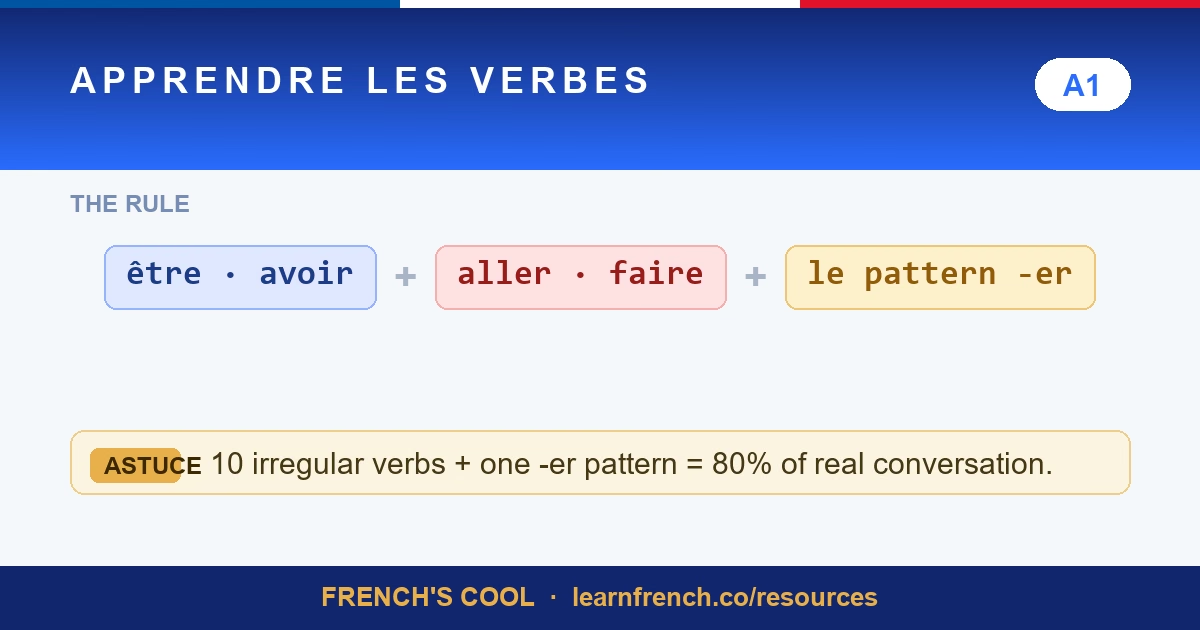
Then invest brute-force memory only where it pays: the irregular core. The big 4 — être, avoir, aller, faire — carry half of french grammar (auxiliaries, futur proche, weather, idioms) and each has a full chart on this site. The super 7 adds vouloir, pouvoir, devoir — the modal spine of politeness. Round out to the 20 most common french verbs with dire, voir, savoir, venir, prendre, mettre, donner, parler, trouver, passer, croire, falloir, and you hold the verb forms behind ~80% of native speech — the 100 most common verbs are a later luxury, not a starting requirement. Pronunciation note that flattens a classic hurdle: most present-tense endings are silent, so the six written forms of parler are only three sounds — native french speakers conjugate by ear, and reading tables ALOUD (pronoun + verb, je parle, tu parles…) is the single best way to improve your french conjugation because it trains the ear and the pattern together. One pattern a week, the big-20 on rotation, everything aloud, used in your own sentences the same day: that’s the whole approach to learning — french immersion for the verb system, no flashcard graveyard required. It beats any best-ways listicle by being the one method a french person unknowingly used too: hearing and saying useful verbs until the commonly used verbs conjugate themselves.
FAQ
What are the big 4 verbs in French?
Être, avoir, aller, faire — the auxiliaries and workhorses that appear in almost every sentence. Each has a dedicated conjugation chart on this site with audio.
What are the super 7 verbs in French?
The big 4 plus vouloir, pouvoir, devoir — want, can, must. With those seven you can improvise around any verb you haven’t learned yet (« je veux acheter… » needs no conjugation of acheter).
What are the 20 verbs in French?
The super 7 + dire, voir, savoir, venir, prendre, mettre, donner, parler, trouver, passer, croire, falloir, devoir’s twin savoir… — the frequency-list top 20 above covers the standard set.
What is the 80/20 rule in French?
Applied to verbs: twenty verbs and four tenses generate the overwhelming majority of real sentences. Depth on the core beats breadth across the dictionary.
The order to learn French tenses
Don’t learn all French verb conjugation at once. Build tenses in the order you’ll actually use them:
- Présent — everything starts here; the irregular present stems feed later tenses.
- Passé composé — the everyday past (avoir/être + past participle).
- Imparfait — description and habit; pairs with the passé composé.
- Futur proche (« je vais + infinitif ») — instant future with zero new conjugation.
- Futur simple & conditionnel — same stem, different endings.
- Subjonctif — last, after triggers become familiar.
The full map with per-tense lessons is in our French verb tenses guide.
How to memorize French verb conjugation that sticks
- Say them out loud, in rhythm. Conjugation is muscle memory — « je parle, tu parles, il parle » chanted beats silent reading every time.
- Learn the endings, not 50 whole verbs. Every regular -er verb shares one ending set; master it once and you own hundreds of verbs.
- Spaced repetition on the ~20 irregulars. être, avoir, aller, faire, pouvoir, vouloir, devoir, prendre, venir, voir… flashcard these until automatic.
- Conjugate in context. Put each new verb in a true sentence about your day — « je prends le bus » — so recall comes with meaning.
How to learn French verbs FAQ
Which French verbs should I learn first?
The high-frequency irregulars: être, avoir, aller and faire. They are the most-used verbs in the language and the auxiliaries every compound tense depends on. Then add regular -er verbs, which follow one predictable pattern.
What is the fastest way to memorize French conjugation?
Learn patterns, not lists. French conjugation rewards pattern-learning: nail the three regular families and the ~20 irregulars, and you can conjugate the vast majority of French verbs by rule. Drill out loud with the audio conjugation charts — hearing and repeating cements it far faster than reading tables.
How long does it take to master French verbs?
The everyday present + passé composé of common verbs: a few weeks of daily practice. Comfortable control across all the main tenses: several months. You never « finish » — but you reach useful very quickly if you build in the order above and speak from day one.
🗂️ Your verb toolkit
35+ verb charts, all with audio, usage notes and exercises:
🎯 More practice — translation — put it into French
Translate into French: « to be, to have, to go, to do » (translation)
Show answer
être, avoir, aller, faire
Translate into French: « can, to want, must, to know » (translation)
Show answer
pouvoir, vouloir, devoir, savoir
Translate into French: « to take, to come, to see, to say » (translation)
Show answer
prendre, venir, voir, dire
Want a teacher to fix your verbs fast? Book a free lesson with Xavier →
🎮 Practise this lesson
Games built from this exact page — turn what you just read into play:
🧩 Sentence Builder rebuild these sentences
🎬 This article in 20 seconds
The quick version — the full detail is below. More shorts → Open this short as a page — transcript included →